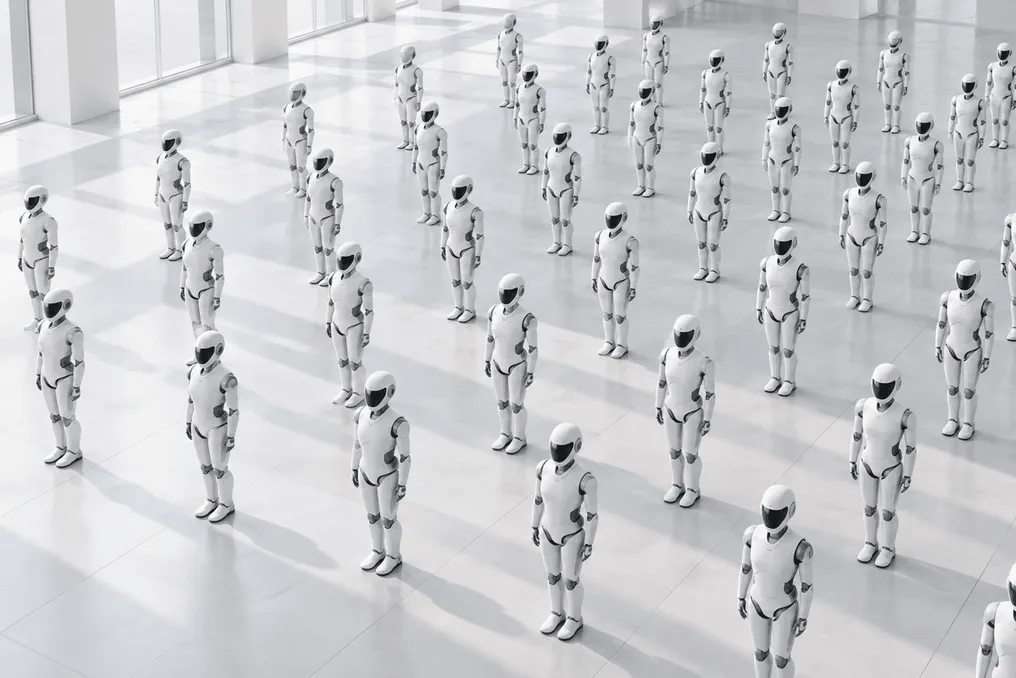
Six humanoid AgiBot G2 robots operated in a Shanghai store for 24 hours, completing 1730 tasks
Read more
Pandaily
pandaily.com

Six humanoid AgiBot G2 robots operated in a Shanghai store for 24 hours, completing 1730 tasks

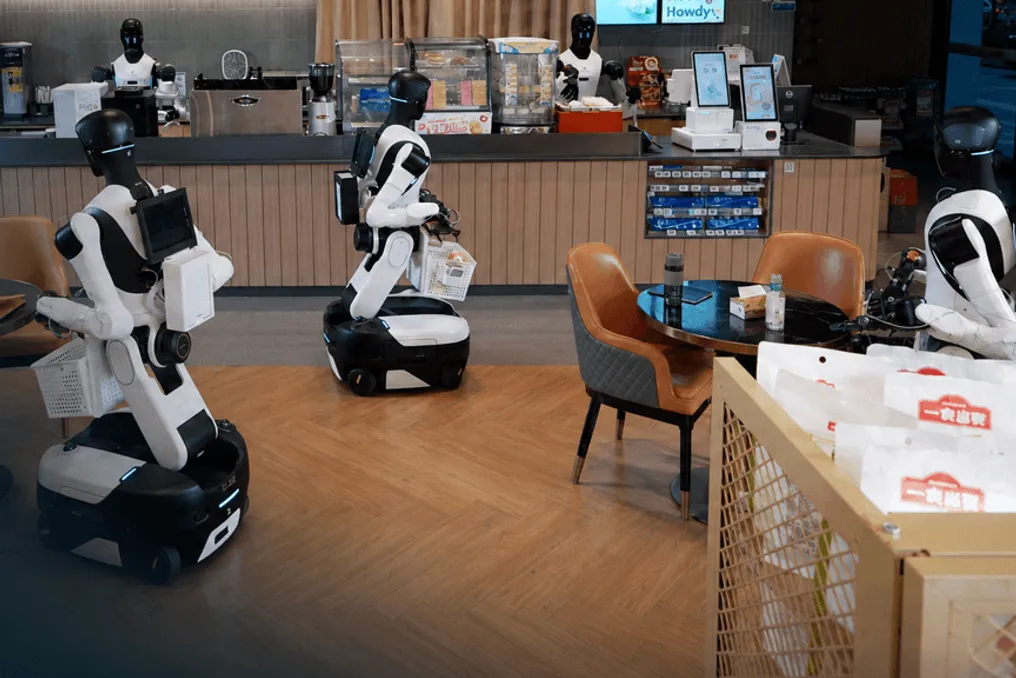
Six humanoid robots of the AgiBot G2 model completed a 24-hour shift in a convenience store located in the Xuhui district of Shanghai. This live-streamed event ran from 10:00 on November 2nd to 10:00 on November 3rd, and according to AgiBot, online viewership exceeded two million people.

Each robot performed a strictly defined function: one greeted customers at the entrance, two handled stocking, inventory replenishment, and shelf patrolling, one prepared coffee, one managed the checkout and hot food service, and the sixth was responsible for table cleaning. According to AgiBot's final count, the six robots completed 1730 tasks, which included 683 customer receptions, 369 deliveries and goods pickups, 147 coffees prepared, 126 breakfast orders, 277 inventory replenishment and shelf checking operations, and 128 instances of table cleaning.

Four out of the six robots passed the event certification, which assessed task completion speed, reaction time, ability to handle exceptions, and customer feedback. Invited testers attempted to create difficulties for the robots by mixing regular and diet cola and requesting only the latter, creating disorder on a full pack of chewing gum shelf, as well as standing in aisles or dropping boxes in the robots' paths.

Reports indicated that the robots confirmed beverages by combining voice requests with visual verification; they restocked shelves by visually counting items instead of relying on price tag placement; and they stopped to navigate around obstacles. Minor manipulations, such as hanging candy bags on hooks or picking up a soft cake without damaging it, remained among the most challenging tasks, and the robots occasionally made errors.

All six robots were coordinated using Genie Master, an embodied agent framework from AgiBot, which links task decisions, movement execution, and feedback through its Embodied Execution Protocol. The system analyzes successful and unsuccessful runs daily, stores useful experience in long-term memory, and filters corrected attempts for use in training data, while the robots practiced during periods of lowest activity. AgiBot emphasized that the test was conducted without human involvement in the loop, meaning no human demonstrations or on-site manual adjustments.

Ren Guanghui, Vice President of AgiBot's Embodied Research Center, told the media that the company would track metrics such as task success rate, first-attempt success, response time, total cycle time, qualified deliveries per unit of time, frequency of human intervention, recovery time, and system availability. However, the figures published upon completion only concerned the number of tasks completed, and AgiBot has not yet released data on success rates or the number of interventions.

This test launch marked the conclusion of AgiBot's AI WAVE series of releases, which began on October 22nd and integrated the company's datasets, simulation platform, models, and robotic hardware onto one live platform.
Similar stories

AgiBot's Genie Master system allows G2 robots to self-diagnose errors during in-store operation.
Read more
pandaily.com

AgiBot's Genie Master system allows G2 robots to self-diagnose errors during in-store operation.

AgiBot has introduced Genie Master—an embodied agent framework that enables robots to continue improving after deployment, rather than waiting for engineers to conduct retraining. The company states that G2 robots using this framework operated in a real neighborhood store, performing tasks such as packaging ready meals, picking items, and restocking shelves, while also detecting and resolving their own failure modes without human intervention in the training process.

AgiBot describes the result as the first proof of concept for what they call Physical RSI, or Embodied Recursive Self-Improvement, outside of simulation and laboratory settings. One example presented at the presentation involved a robot repeatedly missing a small hook on a shelf because a price tag was obstructing the view from its head camera. By analyzing its own execution logs, the agent identified the problem, changed its approach by bringing its left arm closer so the wrist camera could confirm the hook's position, then picked up the item with its right hand and saved this correction for future use.

This framework is based on the Embodied Execution Protocol (EEP)—a unified interface between the agent and the robot. It consists of four components: a capabilities interface, which informs the agent what the robot can do; a guidance interface for transmitting spatial cues, object references, and detailed action policies; a feedback interface, which reports the physical outcome; and a continuity interface, which tracks progress and task dependencies across the entire robot fleet, allowing work to resume or be rescheduled after breaks.

When tasks consistently fail or are performed slowly, the agent schedules targeted practice during the store's least busy hours. Improvement occurs in two directions. RSI, which does not affect model weights, refines cues, memory, and execution rules by using daily analysis of successes and failures to create what the team compares to an error log. The RSI policy collects data from autonomous runs, human interventions, and recoveries, filters and reweights it, and then retrains the base action policy using supervised learning, imitation, or reinforcement. AgiBot notes that the second track still utilizes human intervention data and model training, meaning humans are not entirely excluded.

Genie Master is the fourth release in AgiBot's AI WAVE series, which began on October 22nd. According to the company's published schedule, the next item on October 28th will be an update to the Genie Sim simulation platform with an internal physics engine designed to simulate deformable objects, which, according to AgiBot, achieves over 95% consistency between real and simulated results in complex tasks. More detailed information was not published at the time of writing.

Public testing is scheduled for November 2nd and 3rd, when six G2 robots will operate for 24 hours in a real neighborhood store environment, covering peak lunch and dinner hours, the night shift, and breakfast preparation.

AgiBot G2 Max Robot Operates at JD Logistics Warehouse, Processing 80 Boxes Per Hour
Read more
pandaily.com

AgiBot G2 Max Robot Operates at JD Logistics Warehouse, Processing 80 Boxes Per Hour

The AgiBot G2 Max robot has begun its operation at the JD Logistics warehouse. This robot, which was officially unveiled on October 26 as an embodied robot with a safety rating and the ability to handle heavy loads, is responsible for processing incoming boxes at the JD Logistics automated warehouse, known as the Smart Wolf warehouse, according to data from IT Home and Sina Finance.

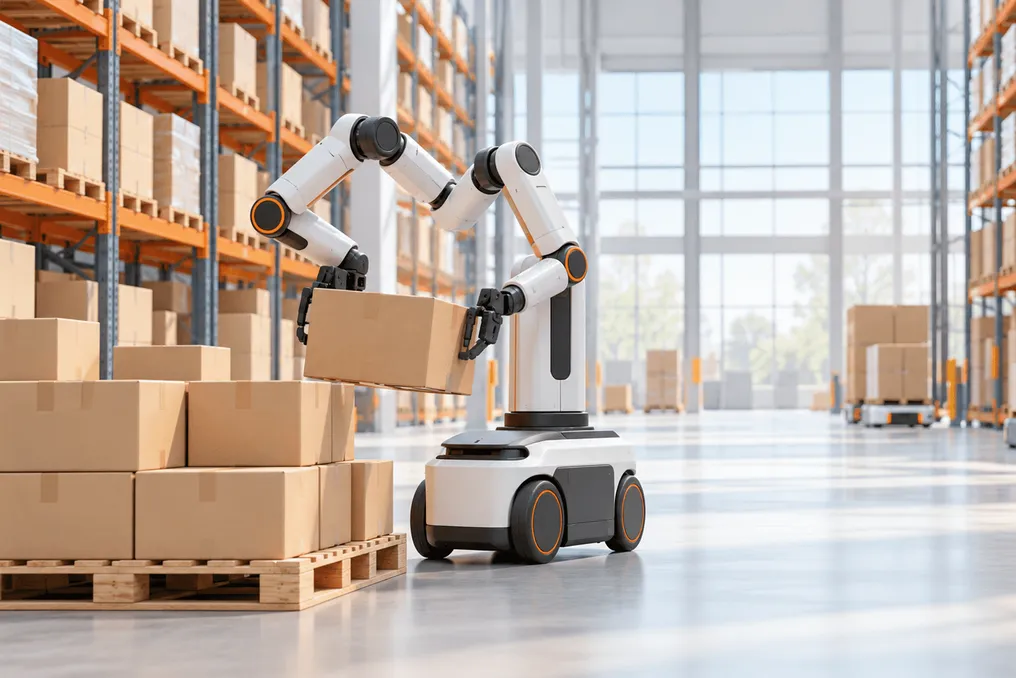
During the goods receiving stage, the G2 Max removes boxes from arriving pallets and stacks them for the automated system. According to AgiBot, it is capable of removing 80 boxes per hour from pallets and stacking 75 boxes per hour onto pallets, with an overall success rate exceeding 99%. The robot operates around the clock on several production lines.

The Smart Wolf warehouse is a proprietary development by JD Logistics for the goods-to-person system. It utilizes vertical space up to 12 meters high, increasing storage efficiency sixfold compared to traditional warehouses, while simultaneously managing hundreds of robots. Processing the incoming flow is the initial stage of this chain, so its pace and stability affect all subsequent processes, from storage to sorting, especially during the current peak shopping season.

JD Logistics and AgiBot first demonstrated the G2 Max together at the World Artificial Intelligence Conference in July, when they announced its implementation at the Smart Wolf warehouse. The official launch of the AgiBot product took place on October 26.

The G2 Max is designed for handling heavy loads. Each manipulator can carry 20 kilograms, and both manipulators together are rated for 40 kilograms, with a peak load of 50 kilograms. Repositioning accuracy is within 0.5 millimeters. Thanks to a waist joint that allows the robot to bend in the middle, it can integrate into existing industrial lines without requiring 1.5 meters of free space for turning. This is critically important where lines are already set up for personnel.

AgiBot offers this robot for pallet unloading, material handling, and line feeding tasks in factories, stating that it can operate continuously without shifts or night staff. A JD Logistics executive noted that real industrial sites are the best proving ground for embodied AI, and the company is ready to open its facilities, test environments, safety protocols, and service standards to more robot manufacturers.

AgiBot sets Guinness World Record for Synchronized Dance of 110 Humanoid Robots
Read more
pandaily.com

AgiBot sets Guinness World Record for Synchronized Dance of 110 Humanoid Robots

AgiBot has set a Guinness World Record for the highest number of simultaneously dancing humanoid robots, demonstrating a synchronized routine featuring 110 full-sized Expedition A3 model robots. This event took place on October 24th at the Yellow River International Exhibition and Conference Center in Jinan city.

The Guinness judge confirmed the count of 110 units at the venue, according to reports from IT Home and Science and Technology Daily. Furthermore, according to Science and Technology Daily, the key criterion for setting the record was not the quality of the dance, but the fleet's ability to complete the performance without any errors.

The robots executed several sets of complex movements over a period of 5 minutes and 43 seconds, alternating between synchronized movement and formation changes. AgiBot specified that all 110 participating robots are standard production units.

Technical Aspects of Coordination

Wan Chuan, AgiBot partner and Senior Vice President, noted that controlling a hundred robots goes beyond simply copying movements; it requires a full planning stack that includes real-time positioning determination, distributed decision-making, and dynamic obstacle avoidance. The robots independently exited their transport crates, calibrated their positions, and performed the program without manual control by engineers via remote operation.

Coordination was managed using LinkBots—AgiBot's internal multi-robot planning system. Wan described three key capabilities of this system. Firstly, formation changes are calculated based on the current state of each robot, rather than being reproduced from pre-saved movements. Secondly, the ultra-wideband positioning system provides accuracy of less than 10 centimeters, allowing the robots to coordinate walking and running while tracking mutual positions. Thirdly, individual groups can receive different instructions, and the orchestration is designed to prevent robots from interfering with each other. IT Home reported that the system is capable of locally compensating for the failure of one unit.

According to Wan, the successful implementation of these three points represents a technical boundary separating humanoid robots used as display exhibits from those that can function as productive tools.

AgiBot reports that the robots are already beginning to be used in real-world applications. Currently, they are undergoing trials at Jinan subway stations, including the Olympic Sports Center and Zhuangshan West Road, where they provide directions, assist in managing crowd flow, conduct security patrols, and offer cultural accompaniment. The company plans to utilize the robots that participated in the record attempt in tourist performances, public services, exhibition halls, and education.

Popular