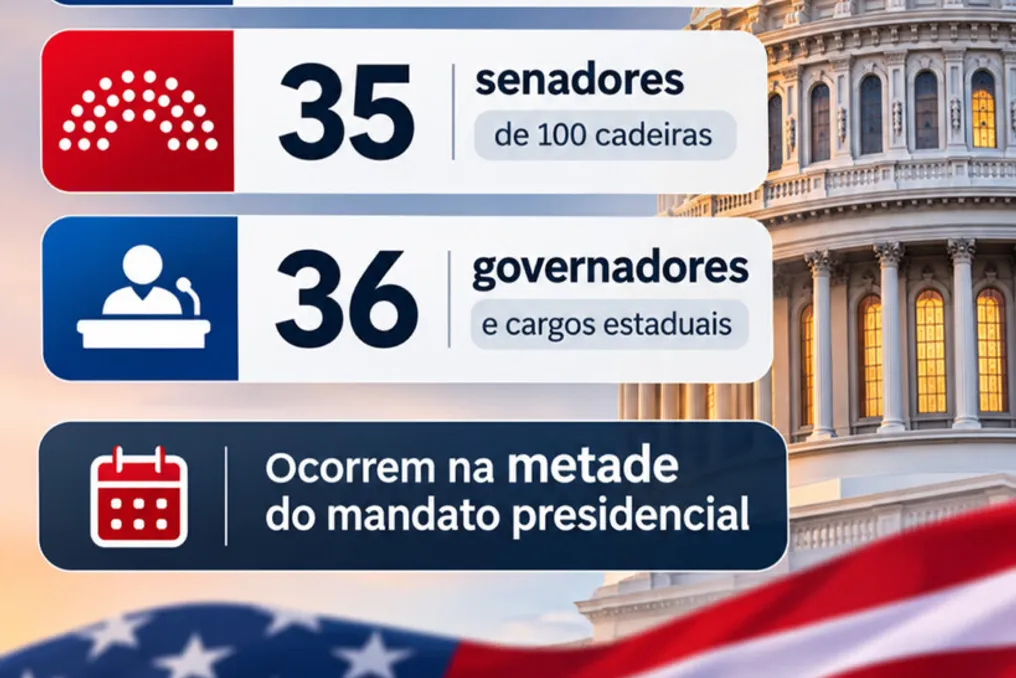
The outcome of the mid-term elections in the United States, scheduled for this Tuesday (the 3rd), could potentially affect the advancement of a bill that proposes to change federal environmental licensing rules for energy infrastructure projects. This occurs against the backdrop of growing electricity demand needed to power data centers supporting artificial intelligence expansion.
The Bipartisan American Accessibility to Economy and Employment Act (BAAJA), developed by Republican and Democratic lawmakers, aims to alter environmental assessment and authorization procedures for large enterprises. This initiative combines changes across various legislative acts and seeks to reduce the time required for infrastructure projects to move from planning to implementation.
The text of the bill is the result of negotiations between four senators holding leadership positions in the committees on environment and public works, as well as energy and natural resources: Shelley Moore Capito and Mike Lee, who are Republicans, and Sheldon Whitehouse and Martin Heinrich, representing Democrats.
One of the key goals of BAAJA is to establish deadlines for federal environmental reviews. According to the text, the analysis of major projects should generally be completed within one to two years. The proposal also provides for closer coordination between government agencies, limits certain avenues for judicial challenge, and sets conditions for increasing the reliability of issued licenses.
The bill amends provisions in three federal environmental laws: the National Environmental Policy Act (NEPA), which regulates the assessment of impacts from work and projects; the Clean Water Act, which protects water resources; and the Endangered Species Act, aimed at conserving endangered animals and plants.
According to analysis, this reform could change the approach to analyzing projects affecting natural areas, waterways, and animal habitats. The stated goal of proponents is to prevent the endless delay in obtaining construction permits due to successive administrative stages and legal disputes. However, environmental organizations question whether reducing these stages will lead to diminished opportunities for public participation and oversight.
The proposal also concerns electricity transmission. BAAJA provides for changes to the operations of the Federal Energy Regulatory Commission (FERC), expanding its authority to authorize certain interstate lines if governmental processes stall. The initiative also adjusts criteria for such enterprises and aims to facilitate the connection between producing and consuming regions.
This aspect is particularly important because expanding electricity generation itself does not solve supply problems. Energy produced at a power plant must reach consumers through a grid capable of transporting large volumes over long distances. Without transmission lines, new generation projects may face difficulties connecting to the system, even if they have production capacity.
According to Thiago Maia, a physicist with master's and doctoral degrees in nuclear physics, an oil engineer, and an MBA holder in project management, simplifying licensing could help overcome some of these obstacles. In an interview with Olhar Digital, he explained that the construction of power plants, substations, and transmission lines could accelerate due to reduced approval times.