NHAI to begin cleaning Bihar's rivers and use silt for road construction
Read more
The times of India
timesofindia.indiatimes.com

NHAI to begin cleaning Bihar's rivers and use silt for road construction

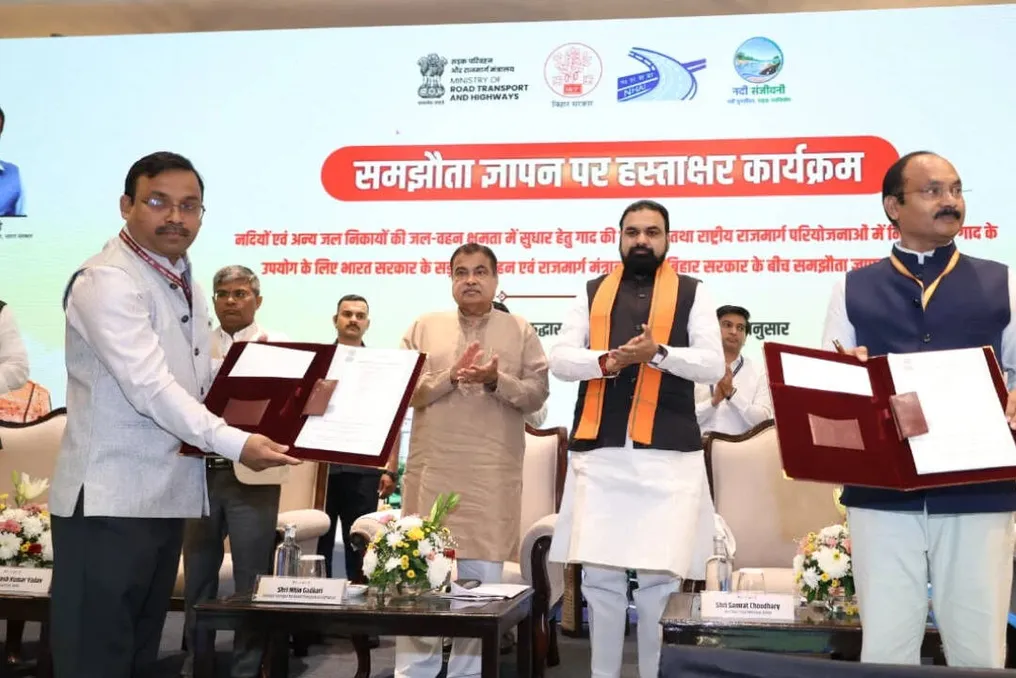
The Ministry of Transport and NHAI plan to clean rivers and water bodies across the state of Bihar at their own expense to address the issue of annual floods, as well as utilize the extracted silt and sand for road construction needs.

This initiative, implemented under the 'Nadi Sanjivani' (river rejuvenation) program, was signed between the Ministry of Transport and the Government of Bihar on Tuesday. This measure has a dual purpose: road departments will carry out dredging operations and receive construction material free of charge, which simultaneously improves water flow in the rivers and reduces the risk of flooding.

According to the agreement, 243 million cubic meters of silt will be used in 16 current national highway projects, and another 835 million cubic meters are planned for 27 future projects.

Annual floods in Bihar are caused by the deposition of silt in riverbeds, where turbid water from the Himalayas in Nepal flows during rains. Union Minister of Transport Nitin Gadkari stated after signing the agreement that if the plan is successfully implemented, this problem will be largely resolved. He noted: 'The silt, which until yesterday was the cause of floods, will now become the basis for development.'

Gadkari also emphasized that this approach can serve as a model for other states, allowing construction materials to be obtained through the dredging of rivers and water bodies. Currently, highway builders are forced to purchase soil and other materials from afar, leading to delays and increased construction costs.

Bihar Governor Samrat Choudhary highlighted the state's vulnerability to recurring floods, which damage farmers, agricultural land, livelihoods, and infrastructure. He explained that the destruction in Bihar is caused not by its own water, but by water from neighboring countries and other states. Choudhary added that seven major rivers from Nepal flow through Bihar, and rains in Nepal lead to destruction in Bihar. Despite receiving more than 32% less rainfall this year, the water level in three main rivers reached its maximum (HFL).

Choudhary reported that the maximum water level in the Ganges in the last 200 years has been reached, which is a clear sign of silt deposition in the rivers, prompting the state government to promptly accept Gadkari's proposal for river cleaning.


Similar stories

Transport Minister Gadkari announced that NHAI will use dredged river material for road projects in Bihar
Read more
timesofindia.indiatimes.com

Transport Minister Gadkari announced that NHAI will use dredged river material for road projects in Bihar

The National Highways Authority of India (NHAI) plans to utilize sand and other materials extracted from the rivers and water bodies of Bihar for highway construction. This was stated by Union Road Transport Minister Nitin Gadkari following the signing of a memorandum of understanding between the Bihar government and the Ministry of Road Transport.

Nitin Gadkari also noted that this initiative will help reduce the risk of flooding in the state.

The Chief Minister of Bihar emphasized that the state faces floods not only due to its own waters but also from the inflow of water from other regions, including Nepal. He pointed out that the High Flood Level (HFL) has risen in three rivers despite Bihar receiving less rainfall this year.

The state chief added that cleaning rivers and water bodies can lessen the impact of floods. He also mentioned that draining the Ganges and restoring lands along its banks would allow for housing creation for one hundred thousand homes facing the Ganges.

Bridge worth 8.86 crore rupees built in Madhya Pradesh, but access road remains unfinished
Read more
www.aajtak.in

Bridge worth 8.86 crore rupees built in Madhya Pradesh, but access road remains unfinished

A significant gap exists between statements about state development and the actual situation on the ground in the state of Madhya Pradesh. In the Narmadapuram district of Madhya Pradesh, a 308-meter bridge across the Dudhi River was completed, costing approximately 8.86 crore rupees. However, the access road, about a kilometer long, connecting the bridge to the main road, remains unfinished after three years.

The question arises as to why people have not been provided with a way to use the bridge despite the multi-million rupee expenditure on its construction. It is also being questioned who is responsible for this incomplete work.

The situation is related to the village of Umordh in the Bankheri area of Narmadapuram district. The bridge, built over the Dudhi River, was intended to improve transport connectivity between the districts of Narmadapuram and Narsinghpur. There was hope that the bridge would facilitate the movement of residents from surrounding villages, simplify life for farmers, and ensure easy access to medical services when necessary.

Nevertheless, despite the bridge being ready, work on the access road has not been completed. The lack of road surfacing on both sides forces rural residents to face difficulties when approaching the bridge. During rains, the dirt road turns into mud and swamp, and after drying, it becomes riddled with potholes.

It is expected that this bridge will benefit approximately 40–50 villages in the Narmadapuram and Narsinghpur districts. Despite this, residents continue to experience inconvenience due to the unfinished access road for three years. The question arises regarding the reasons for the construction delay: is it due to insufficient coordination between departments or awaiting administrative approval?

There is also a question about what steps have been taken to eliminate any technical or administrative obstacles. The main question is why people cannot reap the full benefits of the bridge despite the millions of rupees spent.

Keshav Raidas himself, a senior official of the Bridge Construction Department, stated that information about this problem has been forwarded to the government. A decision will be made at the government level regarding which department should carry out the construction of the access road to the bridge.

This raises another question: why has it still not been determined who will build the road if the bridge itself has been ready for three years? Will they have to wait years to determine responsibilities for building roads and bridges in government projects? For now, the bridge stands over the Dudhi River, but the path to it remains incomplete. Residents are still forced to contend with mud and potholes. Now, all that remains is to wait for the government and relevant departments to determine responsibility and begin constructing the access road, as the true benefit of development will only be realized when there is a path to the bridge.

Popular