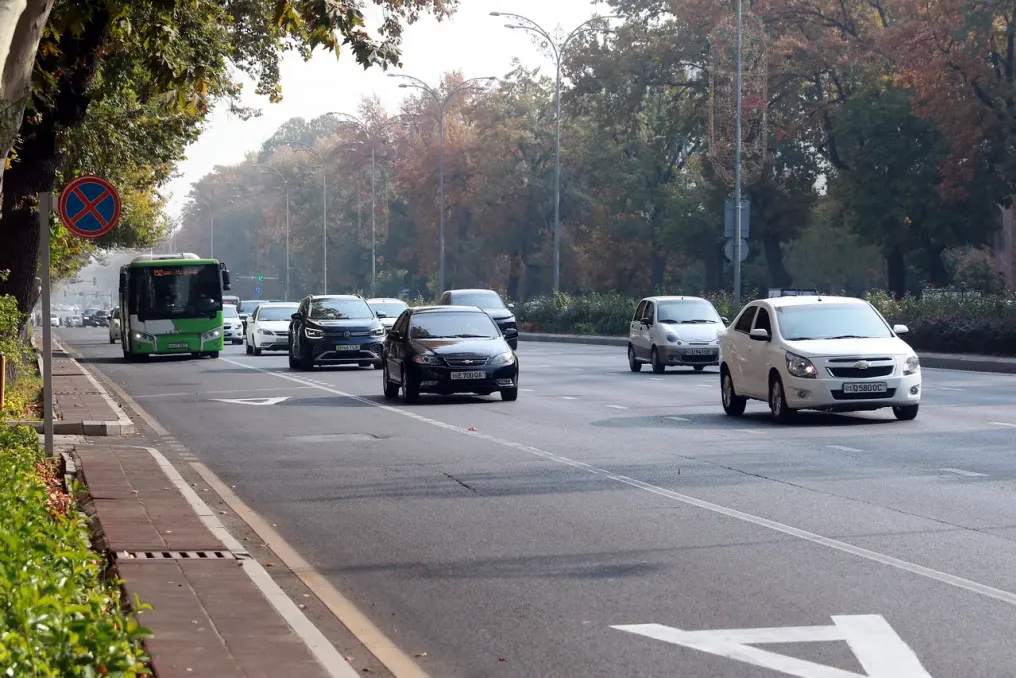
In Tashkent, Uzbekistan, the 'green wave' traffic light regulation system has been launched on a seven-kilometer section of Kukcha Darvoza Street. This system integrates sixteen traffic lights into a single coordinated network.
Preliminary calculations indicate that the average travel time has been reduced by 40% thanks to the new system, allowing for savings of about eight minutes per trip. The traffic lights are configured so that drivers traveling at the permitted speed can pass through several consecutive intersections with minimal stops. Green signals are activated sequentially in the direction of the main traffic flow.
The system operates in two modes, changing traffic priorities depending on the time of day. From 7 AM to 5 PM, the 'green wave' is set to prioritize traffic heading towards the city center. From 5 PM to midnight, the synchronization is adjusted in favor of vehicles leaving the central part of Tashkent.
The main goal of implementing the system is to reduce the number of stops, sudden braking, and acceleration. According to an official statement, this should contribute to fuel savings, reduced emissions, and improved overall road safety and smoothness of traffic.
It is important to note that the presence of the 'green wave' does not mean that the traffic lights remain green along the entire road. The system continues to account for pedestrians and traffic moving on intersecting streets. Therefore, drivers may still need to stop at a red light before entering the synchronized flow.
Drivers are advised to adhere to the established speed limits to gain maximum benefit from the system. Exceeding the allowed speed does not guarantee a faster journey, as vehicles traveling faster than the norm may reach an intersection before the green light turns on and be forced to stop.
The efficiency metrics were recorded during off-peak hours to assess the system's impact without significant influence from heavy traffic. During peak load hours, actual travel time may vary depending on road conditions.