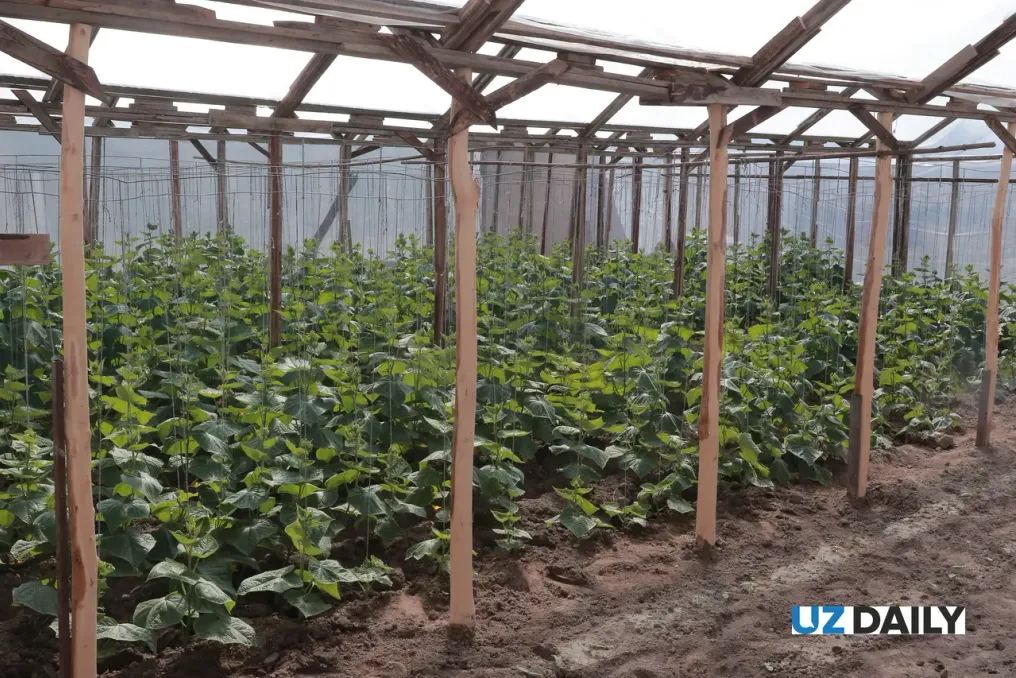
Uzbekistan has approved a special environmental regime for greenhouse farms in Tashkent and five districts of the Tashkent region. These rules establish requirements for heating systems, emission monitoring, and waste management, while also providing financial assistance for ecological modernization.
The new rules are enshrined in Government Decree No. 586 and apply to the capital, as well as the districts of Yukorichirk, Kibray, Yangiyul, Zangiata, and Tashkent. According to the press service of the National Committee on Ecology and Climate Change, the preparation of relevant proposals for the president was completed on October 13.
Requirements for energy sources and fuel
According to this decree, greenhouse farms in the designated zone equipped with heating systems must use natural gas (including liquefied gas), electricity, geothermal or solar energy, or thermal waste generated by thermal power plants. A positive conclusion from the state environmental expertise is required to begin operations.
Greenhouses currently using solid fuels such as coal, biofuel briquettes, and pellets must switch to the specified energy sources by December 1. The use of solid fuels will only be permitted if established environmental standards are met.
These standards include automated control of fuel supply and combustion, installation of dust and gas purification equipment meeting set efficiency standards, and equipping boilers with continuous emission monitoring systems.
Continuous Emission Monitoring Systems (CEMS) must comply with national standards, integrate with the information systems of the Ecology Committee, and transmit data in real time. Boilers, pollution control equipment, and monitoring systems must have certificates of conformity.
Greenhouse operators are also obliged to install online cameras for constant observation of boiler operation and flue gas emissions. Cameras, monitoring systems, and pollution control equipment must be supported by uninterruptible power supplies and backup generators.
Greenhouse owners must organize the collection, transportation, and disposal of ash, heavy metals, scale, sludge, and other toxic substances in accordance with established procedures. It is forbidden to make changes to the equipment that affect its operation and are not provided for in the technical documentation.
The decree separately prohibits the use of car tires, bitumen, fuel oil, plastic, and polymer films, synthetic cardboard, rubber, wool fibers, used oils, household and industrial waste, and materials of similar composition as fuel.
Financial support for ecological modernization
Until January 1, 2028, greenhouse farms in this zone will receive compensation equal to 50% of the cost of purchasing equipment for dust and gas purification, boilers, energy-saving screens, and energy-efficient technologies. Subsidies will also cover costs for heating equipment powered by electricity, geothermal, and solar energy, as well as cogeneration units. The maximum payment will be 50 million sums per hectare of greenhouse area.
During 2026–2027, commercial banks will provide loans to support the transition to heating systems using electricity, geothermal, and solar energy, as well as cogeneration. These loans will have a seven-year term with a three-year grace period and an annual interest rate of 14%, of which four percentage points will be the bank's margin.
Loans can cover up to 50% of the project cost, but no more than 3 billion sums per hectare. Financing of up to 350 million sums per station is available for the purchase of CEMS equipment. These funds will be provided under a tripartite agreement with repayment over five years without interest.
Beneficiaries must comply with technical requirements, install the equipment, integrate it into the Ecology Committee's information system, and ensure uninterrupted data transmission. In case of breach of contractual obligations—including failure to install equipment, integrate it into the system, or make timely payments after written warning—the stations may be dismantled and seized according to the contract. Overdue debts will be collected without the debtor's consent.
The decree also establishes environmental standards for boilers in other industries that use fuel negatively affecting air quality. Enterprises impacting the environment will be classified into red, yellow, and green categories depending on the level of environmental safety. Corresponding requirements will be included in legislation.
Furthermore, until January 1, 2030, the import of equipment intended for the creation and modernization of greenhouses and manufactured outside Uzbekistan will be exempt from customs duties. This benefit applies to dust and gas purification equipment, energy-efficient boilers, cogeneration units, equipment for using geothermal and solar energy, automated emission monitoring systems and their components.
Filtrate treatment and water reuse
The decree provides for the treatment of hazardous liquid waste generated in the heating system filters of greenhouses, as well as hydroponic drainage solution, known as filtrate, for subsequent use as technical water. Construction of a temporary reservoir for storing filtrate in the eco-industrial zone in the Akhangaran district is planned by January 1, 2027. The operator responsible for filtrate processing will be selected through a competitive selection process by June 1, 2027.
The Tashkent region administration must allocate a land plot in the eco-industrial zone by November 1 of this year. The construction of the reservoir can be carried out in stages within the framework of relevant design documentation and in accordance with urban planning standards and regulations.
Greenhouse owners, regardless of ownership form, are obliged to transfer the filtrate they generate to the appointed operator at established tariffs. The Committee noted that the modernization of greenhouse farms should contribute to improving air quality in Tashkent and surrounding areas through the introduction of modern filtration systems, automated monitoring, and energy-efficient technologies. The Committee emphasized that these measures aim to balance business development and efficient resource use with the citizens' right to a favorable environment.