Study points to 2023 as year with most heatwaves in Cape Verde, affecting respiratory health
Read more
Noticias ao Minuto
noticiasaominuto.com

Study points to 2023 as year with most heatwaves in Cape Verde, affecting respiratory health

An investigation focused on temperature and public health in Cape Verde concluded that the year 2023 recorded the highest number of heatwave episodes in the country. This phenomenon was shown to have a significant influence on the increase in respiratory diseases, also showing a higher occurrence during the nighttime period.

Gisela Garcia, an epidemiologist and researcher at the National Institute of Public Health (INSP), confirmed that the study highlighted 2023 as the year with the most heatwave events. The statement was made in the city of Praia, within the context of a national debate on climate and health, which is taking place in preparation for COP31, the 31st United Nations Climate Change Conference, scheduled to begin in Turkey on Monday.

According to Gisela Garcia, the findings indicate a more pronounced impact on respiratory problems, but consequences were also observed in chronic, dermatological, and neurological conditions. The researcher emphasized that the frequency of heatwaves was higher at night compared to the day, a piece of data that can aid in formulating mitigation strategies.

To reduce the impacts of climate change on public health, the study suggests implementing an early warning system. This system should be based on the continuous collection of meteorological and health data, the official definition of heatwaves, and the strengthening of collaboration between various institutions.

As part of the study's monitoring, thermal sensors are being installed on the island of Brava to ensure the continuous collection of long-term health and meteorological data. The work, developed in 2024 and scheduled for implementation starting in January 2025, covered six of the country's 22 municipalities, including São Vicente, Sal, Praia, Ribeira Brava, Fogo, and Brava.

The INSP conducted this research in collaboration with the Institute of Meteorology and Geophysics, with technical and financial support from Luxembourgish cooperation. Additionally, the World Meteorological Organization (WMO), a United Nations agency, predicts that 2025 will be the second or third hottest year since existing records, due to ocean warming, which intensifies storms and worsens sea-level rise.

Similar stories

Extremely high fire danger declared in the Northern Cape amid heatwave in the Eastern Cape, South Africa
Read more
iol.co.za

Extremely high fire danger declared in the Northern Cape amid heatwave in the Eastern Cape, South Africa

The South African Weather Service has warned that most of the Northern Cape will face conditions of extremely high fire danger. It is forecast that residents in many regions of the country will experience hot weather, with an extremely high risk of wildfires expected in some parts of the Northern Cape, and a heatwave warning remains in effect in some areas of the Eastern Cape.

The heatwave, characterized by persistently high temperatures, is also expected in the Chris Hani and Alfred Nzo districts of the Eastern Cape until Sunday, November 1. While much of the country will enjoy good and hot weather, isolated afternoon and thunderstorm rains are forecast in parts of Mpumalanga, Free State, and KwaZulu-Natal.

Gauteng is expected to have good, warm, or hot weather with partial cloud cover in the afternoon. Residents are advised to take precautions against sun exposure as the expected UVB sunburn index is high.

Mpumalanga is forecast to have morning fog, followed by afternoon rains and thunderstorms along the escarpment and eastern Highlands. In other areas, the weather will be good and cool or warm, with partial cloud cover during the day, except in Lowveld. Drivers traveling through foggy areas should remain vigilant due to possible reduced visibility.

Limpopo expects good, warm, or hot weather, with partial cloud cover in the central parts of the province in the afternoon. The North West is forecast to have good and hot weather, which will become partly cloudy during the day.

Free State is expected to have good and hot conditions with partial cloud cover, as well as isolated afternoon rains and thunderstorms in the eastern parts of the province.

The Northern Cape faces a significant fire weather issue, as conditions of extremely high wildfire risk are expected in most areas of the province. Western parts of the province are expected to have cloudy and foggy conditions, while the rest of the province will have good and warm or very hot weather. Eastern areas will be partly cloudy during the day, and northwestern areas will be warm. Moderate southerly winds are expected along the coast, occasionally strengthening during the day.

Residents, farmers, and outdoor workers should exercise caution in areas prone to wildfires and avoid actions that could cause accidental fires.

The Western Cape is expected to have good and hot conditions, with partial cloud cover on the southern sections. Very hot weather is forecast for the Central Karoo. Moderate or fresh southerly winds are expected along the southwest coast, and easterly or southeasterly winds in the southern coastal areas. A very high UVB sunburn index is expected, making sun protection important for people spending time outdoors.

The Eastern Cape will experience warm or hot weather, with morning and evening fog in some coastal areas. In the western half of the province, the weather will be good or partly cloudy and warm or hot, although some coastal areas will be warm or cool. Moderate or fresh easterly or northeasterly winds are expected along the coast. The eastern half will also experience good or partly cloudy and warm or hot weather, with morning and evening fog near the coast. Moderate or fresh easterly or northeasterly winds are forecast along the coast, initially light or moderate.

The heatwave warning remains in effect for the Chris Hani and Alfred Nzo municipal areas until Sunday, November 1. Residents in affected areas should take precautions against prolonged heat exposure, especially during the hottest hours of the day.

KwaZulu-Natal is expected to have morning fog in some inland areas, followed by good or partly cloudy and warm conditions. Isolated afternoon rains and thunderstorms are expected in the far western parts of the province. Light to moderate northeasterly winds are forecast along the coast, increasing from late morning. A very high UVB sunburn index is expected, and residents and visitors are advised to use sunscreen outdoors.

The main weather concerns are the extremely high wildfire danger in most of the Northern Cape and the heatwave affecting parts of the Eastern Cape. Residents are advised to avoid activities that could trigger wildfires, especially in dry and fire-prone areas. It is also recommended to drink water regularly and limit strenuous outdoor activities during the hottest hours of the day. Sunscreen, protective clothing, and staying in the shade should be used, especially in areas with a high or very high UVB sunburn index. Caution should be exercised when driving through areas affected by morning or evening fog. It is important to monitor official weather updates for changes in warnings and recommendations.

SAWS reported that hot weather will dominate most of the country, while isolated afternoon thunderstorms are expected in some areas of Mpumalanga, Free State, and KwaZulu-Natal. The Northern Cape faces the highest wildfire risk, and parts of the Eastern Cape remain under a heatwave warning until Sunday.

Mozambique warned of intense heat with temperature forecast up to 39°C
Read more
noticiasaominuto.com

Mozambique warned of intense heat with temperature forecast up to 39°C

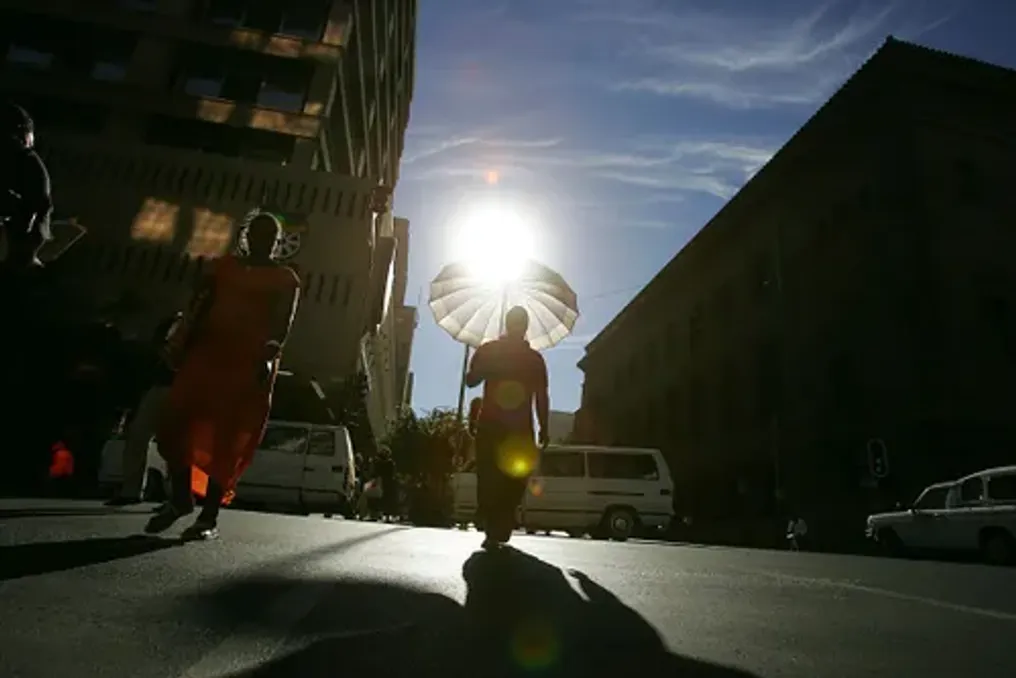
The National Institute of Meteorology (Inam) issued a yellow warning today for the provinces of Maputo, Gaza, and Inhambane due to the forecast of intense heat, where the maximum temperature may reach 39 degrees Celsius on Tuesday.

According to the Inam warning, which is the second of its kind in about a week, this phenomenon is caused by the persistence of warm and humid air transport and will affect various districts of the three southern provinces of the country.

In Maputo province, the warning covers the districts of Boane, Moamba, Magude, Manhisa, Marracuene, and Matutune, as well as the cities of Maputo and Matola.

In Gaza province, the notification includes the districts of Chibuto, Guija, Mapai, Chicualacuala, Mandlakazi, Chokwe, Massingir, Mabalane, Massangana, and Limpopo, as well as the city of Hay-Hay.

In Inhambane province, the intense heat is expected to mainly affect the districts of Zavala, Mabote, Funhaluro, Panda, and Inharrime.

In the same warning, the institute predicts a change in weather conditions at the end of Tuesday, with thunderstorms, heavy rains, or rain, as well as gusty winds. Inam added that these phenomena should contribute to a sharp decrease in maximum temperatures on Wednesday.

Authorities urge the population to take precautions and ensure safety in connection with the heatwave.

South China faces abnormal weather in 2025: more hot days and earlier typhoons
Read more
noticiasaominuto.com

South China faces abnormal weather in 2025: more hot days and earlier typhoons

The Greater Bay Area, which includes Macau, demonstrated an 'abnormal climate picture' in 2025, marked by an increase in high-temperature days and the earlier arrival of typhoons, according to the annual report for this Chinese region.

According to the report published on Tuesday by meteorological services of Guangdong, Hong Kong, and Macau provinces, the average annual number of high-temperature days was 26.5 days, exceeding the usual norm by 7.1 days.

The document also indicates that the first typhoon of the season reached the coast 'earlier than usual,' and the region suffered from a large number of tropical storms.

A total of 14 typhoons made landfall or affected the Greater Bay Area, causing damage to 2,095,000 people, destroying 26,800 hectares of crops, and resulting in direct economic losses of 9.89 billion yuan (1.316 billion euros).

Typhoons are a frequent occurrence in Southeast Asia because warm Pacific Ocean waters promote cyclone formation, and South China is annually subjected to dozens of such tropical storms.

At the end of March this year, the Meteorological and Geophysical Bureau of Macau did not rule out the possibility that the territory could be affected by super typhoons similar to Ragatz, which became the most powerful storm on the planet in 2025.

A study published in 2024 shows that in 2026, typhoons in the region will form closer to the coast than before, intensify faster, and remain over land longer due to climate change.

Scientists assert that climate change is causing an increase and intensification of extreme weather events worldwide.

The Greater Bay Area is a Beijing project aimed at creating a global metropolis based on the Special Administrative Regions of Macau and Hong Kong, as well as nine other cities in the neighboring Guangdong province (Guangzhou, Shenzhen, Dongguan, Foshan, Zhongshan, Huizhou, Jianmen, Zhuhai, and Zhaoqing), where more than 89 million people live.

According to the 2025 report, the average precipitation in the Greater Bay Area was 2,056.9 millimeters, which is 7% higher than the average. During the rainy season, this figure reached 1,917.8 millimeters, exceeding the average for the same period by 22%.

Climate disasters in the region affected 2,833,000 people and led to two deaths last year, with total direct economic losses amounting to no less than 16.39 billion yuan (2.181 billion euros).

Regarding Macau, the territory recorded the lowest maximum temperature among the main meteorological stations analyzed in the region, setting the annual temperature peak at 35.3°C. Nevertheless, in 2025, the number of days with temperatures above 32.6°C reached 37, which is 5.7 days more than the annual average of 31.3 days.

Popular