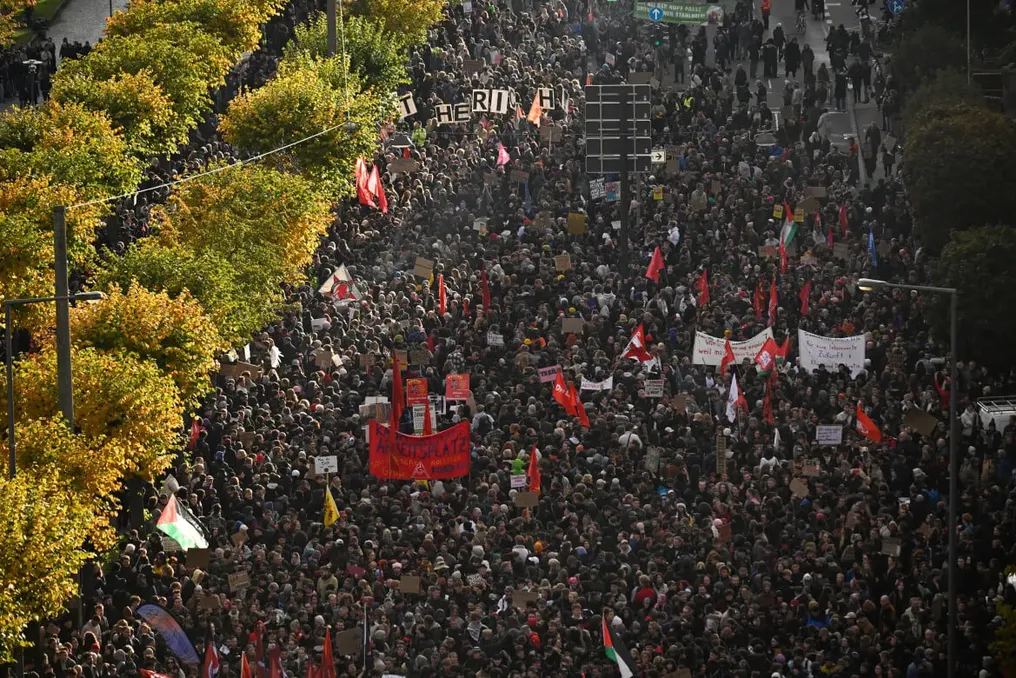
A wave of protests has swept across European countries, fueled by youth dissatisfaction with the rising cost of living, housing issues, and labor market instability, according to France 24. While local problems served as the trigger, the movements that gathered hundreds of thousands of people in the streets of France, Belgium, Spain, Italy, and Germany last weekend are united by common pan-European concerns such as excessively high housing prices, low wages, and the climate crisis.
Students and university pupils were at the forefront of these demonstrations. The initial spark ignited in mid-September when French high school students took to the streets demanding improved conditions and an end to the opaque university admission system.
Sylvain Bouluk, a historian of social movements, noted that 'this is a European movement, but France served as the catalyst.' Following several weeks of rallies in France, at least 550,000 people gathered on October 17; although the demonstrations were largely peaceful, they were quickly marred by acts of looting, arson, and clashes with the police.
Four days later, over 10,000 people participated in rallies in various Greek cities, some holding placards with slogans in Greek and French. Philippos Armen, a physics student at Aristotle University of Thessaloniki, emphasized that 'the problems are shared across different European countries.'
Belgian sociologist Geoffrey Pleers stated that many people across the continent have encountered a 'model that has exhausted its potential.' The social movement expert from the Catholic University of Leuven added that they are offered, at best, jobs, often unstable ones.
Simultaneously, education no longer guarantees the standard of living their parents enjoyed, due to high housing costs and risks associated with climate change. The researcher also noted that in several protests, including those in Spain, Portugal, and Greece, housing is a 'central element' because it is directly linked to purchasing power and 'an increasingly uneven distribution of wealth.'
On the other hand, political scientist Mariam Martinez-Bascunan argued that 'dissatisfaction is fueled more by uncertainty than by poverty.' The professor from the Autonomous University of Madrid, speaking to Spanish broadcaster RTVE, pointed to the 'contagion effect' of the protests in France and the housing rights camps in Portugal.
For Bouluk, young people keenly feel the burden of debts and environmental problems left by previous generations, feeling 'sacrificed' as a result. Bouluk, who also teaches at a school, pointed to an unexpected side effect of banning mobile phones in classrooms in France: 'Students started communicating again and looked up to see how much their working conditions had deteriorated.'
In Germany, the possibility of reintroducing military service amid tensions with Russia also prompted many young people to join the protests. These youth demonstrations resonated with the general public at a time when Europe is preparing for a wave of key elections in Spain, France, Italy, and Greece over the next year.
French students supported the 'Yellow Vest' movement, which previously organized protests against the cost of living in 2018–2019. In Italy, young demonstrators at Friday rallies joined drivers and farmers protesting high fuel prices. Another common complaint is the widespread feeling that they are not being heard, leading to a growing 'distance' and 'alienation' between ordinary people and the state, according to Pleers. Furthermore, there is a sense that society has become unjust and unequal. Pleers added: 'Young people whose parents live comfortably lead a more comfortable life, while those from more precarious situations today live much harder.'