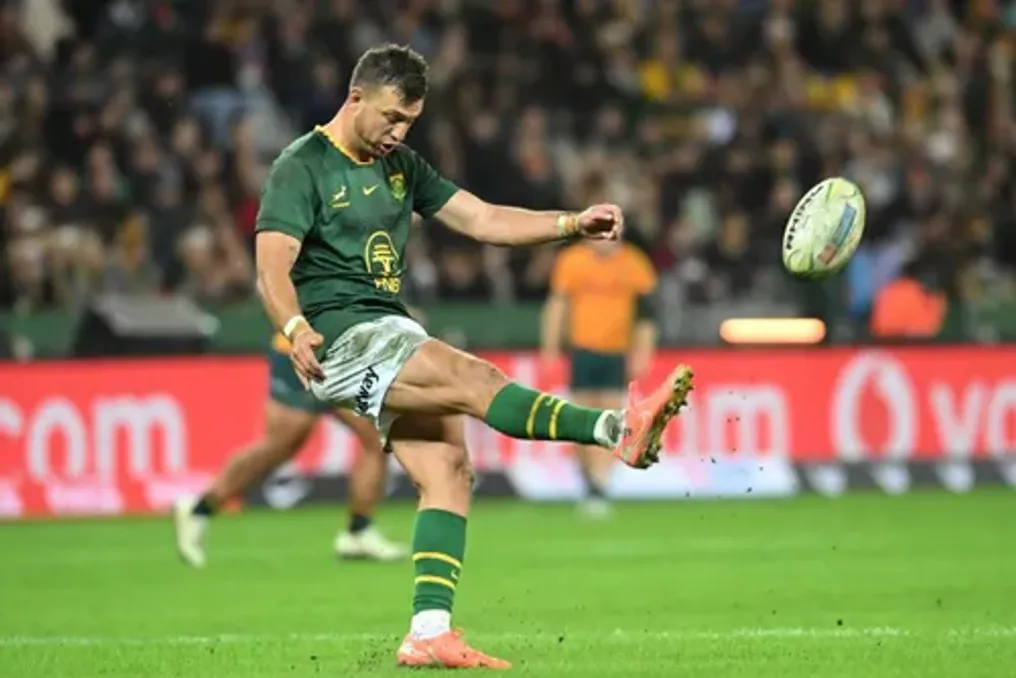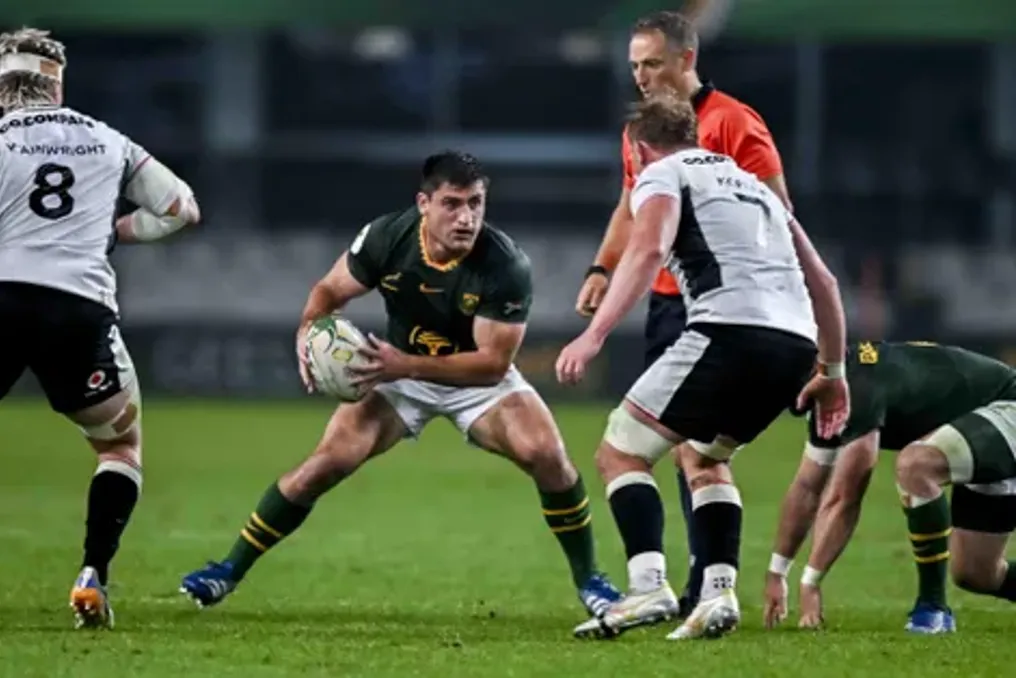
Cameron Hanekom and Paul de Villiers provide balance to the Springboks' 'Bomb Squad'
Read more
IOL
iol.co.za

Cameron Hanekom and Paul de Villiers provide balance to the Springboks' 'Bomb Squad'

Due to Quagg Smith's long-term knee injury, the Springboks' renowned 'Bomb' has lost some of its sharpness this season. For many years, Smith brought tireless energy, speed, and power to the Bok lineup in the second half of matches.

His ability to fiercely battle at the attacking line to steal or slow down the opponent's ball is legendary. Thanks to his experience in Sevens, he covers every area of the field as a supporting runner with exceptional awareness and foresight.

Replacing a player with such a unique tactical profile as Smith is not an easy task for Rassey Erasmus, but the Springboks coaching staff offered an immediate solution by including Paul de Villiers and Cameron Hanekom in the bench for the upcoming Test against Italy in Turin.

The closest player to Smith in the current Springboks squad may be De Villiers, whose popularity grew after every match in the domestic National Championship tournaments earlier this year.

De Villiers possesses the precise set of skills needed to replicate Smith's dominance in the second half of the game at the attacking line. Operating with a low center of gravity over the ball, his grip strength during a jackal makes him an immediate threat for turnovers or securing crucial penalties when opponents' stamina wanes.

From a defensive perspective, his lateral movement pace and tackling efficiency match the covering tackle energy that Smith provided for years.

The reserve strategy for the match against Italy gains particular strength from how effectively De Villiers complements Hanekom. Bringing both forwards off late in the match allows the Boks to maintain a perfectly balanced dynamic in the backline.

While Hanekom provides raw hitting power, explosive line-breaking ability, and strong collisions in tight channels, De Villiers is responsible for linking play, gathering the ball at the attacking line, and relentless coverage in defense.

Together, the Hanekom and De Villiers axis in the second half of the match represents an ideal combination of power and mobility against the Azzurri, with major matches against France and Ireland still ahead.

Stepping onto the pitch in Turin, De Villiers and Hanekom have all the tools to prove that the Springboks' offensive firepower in the second half has not lost its destructive force.

Similar stories

How quality pitches helped unlock the potential of the Proteas team under Shukri Conrad
Read more
iol.co.za

How quality pitches helped unlock the potential of the Proteas team under Shukri Conrad

Seven years ago, South African Test cricket faced serious problems. In 2019, the Proteas team was weakened by unpredictable home surfaces. These green and uneven pitches concealed fundamental flaws, making the batting unit weak and uncertain, and the attacking lineup unable to adapt when the fields did not assist.

However, this picture has completely changed today. Proteas is now deservedly considered the best Test team in the world across all conditions.

Proof of this transformation is their impressive recent global statistics. Last year, they won the Cricket World Cup Test Championship, defeating Bangladesh at home, and subsequently winning against Sri Lanka and Pakistan on their own turf, with the final match against Australia played at Lord's ground.

Earlier this year, South Africa not only survived but dominated the subcontinent. A historic 2-0 clean sweep series against India on home soil, which was long considered one of the toughest challenges in Test cricket, followed a tense draw in the series in Pakistan.

At home, the situation has undergone an equally significant change. The days of dangerous, two-day pitch lotteries are over. Instead, South African grounds now create full, sporting pitches that engage all elements of the game.

Players have to earn runs through effort, without having to fear any dangers on the field. Bowlers must achieve breakthroughs through skill and execution, and spinners have a real opportunity to showcase themselves as the match develops.

These competitive surfaces, far from weakening the hosts, have unleashed the full potential of Proteas, demonstrating how good they are when the playing field is level.

All three matches this season lasted a full five days, and Shukri Conrad's team won two out of three, possessing both tactical acumen and the complete squad necessary to win grueling competitions.

At the core of this success lies a perfectly balanced bowling attack capable of dismantling lineups on any surface. The world-class pace attack, led by Kagiso Rabada and Marco Jansen, provides relentless power and skill. Bian Mulder has become a vital weapon, offering control over the crease, as well as relentless line and length to become an excellent partnership destroyer.

Crucially, the era of instability for South African spinners has ended. With Simon Harmer and Keshav Maharaj, Proteas possesses a world-class spin pairing.

Although the batting is still developing, it is certainly much better than what the players showed seven years ago. There are no true superstars with averages above 50, but there are players who contribute vital runs in critical moments.

Players are once again scoring centuries, creating conditions for their lethal bowling attack to finish the job.

The Proteas team of the late 2000s and early 2010s set the standard for global adaptability. For years, critics doubted whether South African cricket could ever rebuild a side capable of matching those legendary achievements.

But by holding their ground in Pakistan, winning away in India, and surpassing Australia on fair five-day home pitches, this generation has answered the challenge. They no longer depend on substandard pitches for competition; they are simply the most complete Test team in world cricket at the moment.

Mani Libbok and Sacha Feinberg-Mngomezulu must take responsibility for scoring goals for the Springboks
Read more
iol.co.za

Mani Libbok and Sacha Feinberg-Mngomezulu must take responsibility for scoring goals for the Springboks

The Springboks squad is missing two of its most reliable penalty kick takers, Handré Pollard and Cheslin Kolbe, ahead of the upcoming Rugby World Cup matches in Europe. Consequently, the responsibility for goal-kicking will fall entirely on Mani Libbok and Sacha Feinberg-Mngomezulu.

Both players possess outstanding playmaking abilities that they have demonstrated vividly in the Springboks' attack in recent years. Sacha Feinberg-Mngomezulu, in particular, has made number 10 his signature role through impressive performances.

Former World Cup-winning midfielder Butch James recently commented on the hierarchy at the flyhalf position, naming Feinberg-Mngomezulu as his primary choice for the Springboks' playing style, while acknowledging the immense pressure associated with number 10.

However, like many other experts, he often views Pollard merely as a temporary solution, especially when it comes to penalty execution. James stated in a recent interview with IOL: 'My first choice would be Sacha Feinberg-Mngomezulu. Sacha would be my first choice at number 10.' He added: 'If Sacha were injured, I would start with Handré from the bench, relying on all his experience.'

Much of the pressure associated with the Springboks' number 10 is not about managing the team on the field or creating moments of genius to free up the backline, but rather about the precise execution of kicks at goal.

During the recent series of matches against the All Blacks, Feinberg-Mngomezulu was not the primary penalty kicker; Cheslin Kolbe performed excellently in the first two test matches before sustaining a jaw fracture in the third match in Soweto. Pollard did not participate in the game against the All Blacks due to injury, but he was planned to play in the second test match in Cape Town.

Acknowledging his merits, Feinberg-Mngomezulu kicked well in the third and fourth test matches, but Pollard represents the gold standard for Springboks penalty kicking, maintaining an accuracy of around 85% under the immense pressure of test matches. Pollard missed only one kick in the 2019 Rugby World Cup semi-final and final, and in the 2023 World Cup in France, he did not miss any kicks at goal in the quarter-finals, semi-finals, and final.

In these high-stakes matches, where the margin for error is minimal, as confirmed by the Boks' three knockout victories in France by one point, there is a need for a player who can be trusted in critical moments. The question ahead of the World Cup matches is whether Feinberg-Mngomezulu and Libbok can act as decisive goal-kickers without Pollard and Kolbe's 'safety net.'

Feinberg-Mngomezulu and Libbok have shown some inconsistency in place kicks, which explains why Kolbe took on the task of taking kicks in several matches over the past few years when Feinberg-Mngomezulu and Libbok played at number 10. Against the All Blacks, the Springboks more often sought to convert penalties because they enjoy putting pressure on the scoreboard by converting penalties earned through their excellent work in set pieces.

Will the Springboks follow the same tactics over the next month with Feinberg-Mngomezulu and Libbok at flyhalf, or will they kick more for attacking lineouts, risking the maul to create scoreboard pressure? Alternatively, South Africa could rely on its forward dominance, choosing rucks inside the 22-meter zone to secure free kicks for penalty advantage, aiming to score or earn a try close to the line.

Erasmus will hope that Feinberg-Mngomezulu and Libbok improve their accuracy in penalty kicking to prove that there is something more to their game than just exciting roles as playmakers and ball carriers. One thing is clear: this will be the ultimate test of their character, especially in major test matches against France and Ireland.

Boec James believes experienced Handre Pollard is vital for the Springboks ahead of Rugby World Cup
Read more
iol.co.za

Boec James believes experienced Handre Pollard is vital for the Springboks ahead of Rugby World Cup

Boec James, a World Cup champion, believes that Handre Pollard still plays a huge role in the Springboks squad ahead of next year's Rugby World Cup in Australia, despite preferring Sasha Feinberg-Mngomezulu as the primary player at number 10.

Pollard played a key role in South Africa winning two consecutive Webb Ellis Cups in 2019 and 2023, establishing himself as one of the most reliable players in crucial matches in modern rugby history.

However, in recent years, Pollard has served a supporting role in the Springboks setup following the emergence of Feinberg-Mngomezulu, who brought new attacking potential and individual skill to South Africa's backline.

Feinberg-Mngomezulu possesses incredible ball-carrying stats: speed, anticipation, and power make him difficult to defend. Nevertheless, at 24, he is still learning his trade, especially regarding game management and goal kicking. However, there is no doubt that he is a talent of his generation.

Despite the addition of new attacking elements to Rasmus Erasmus's team via assistant coach Tony Brown, James insists that Pollard's composure and rich experience make him an indispensable part of the squad for the World Cup.

Pollard featured in the last two World Cup semi-finals and finals, helping the Springboks secure victories. For James, having such a backup option in the squad is an obvious decision.

"Yes, I think Handre Pollard has a role in the World Cup in Australia next year," James told 10bet. "He is one of, if not the best, flyhalves South Africa has ever had. So he needs to be kept. I think we have seen that he can still step up and do the job." He added: "Why not keep him? He is very calm and brings so much experience and knowledge to the team."

It is critical that James noted Pollard's physical qualities remain sharp, despite the high mileage his body has covered over a decade at the elite level. James emphasized: "Physically, he still runs like a young Handre. He still has that ability."

Nevertheless, when asked about who should wear the Springboks number 10 jersey as the Boks' playing style evolves, the 2007 World Cup winner clearly stated his preference.

"My first choice will be Sasha Feinberg-Mngomezulu. Sasha will be my first choice at number 10," James announced. "If Sasha gets injured, I would start with Handre, putting him on the bench to support him with experience. And the third choice would be Mani Leibbok. They are all outstanding options for that jersey."

Feinberg-Mngomezulu's rise in the Springboks squad has attracted the attention of South African rugby fans, but it has also generated huge expectations. Critics and fans often scrutinize the young playmaker in every match, expecting genius capable of changing the course of the game.

James acknowledged the weight of these expectations for the Stormers prodigy, noting that young players in prominent positions often feel the need to force things instead of allowing the game to develop naturally. He explained: "Yes, I think sometimes he probably creates more pressure for himself than necessary," James clarified. "But unfortunately, when you are at the top, that's when the pressure arises. And I think every player wants to be there, so they don't object to the pressure—it's just part of the game at the elite level."

Reflecting on Feinberg-Mngomezulu's recent impact in green and gold, James urged fans to give the young athlete room to grow and accept that dips in form are a natural part of player development. He said: "I think he had such a great debut season for the Springboks, which causes this pressure, and obviously, we all want him to play in every match like his first season." He continued: "So it's hard for him because we know he can perform. He is a great player, and he is a person. He will have bad games from time to time, but he is a wonderful rugby player."

Regarding Mani Leibbok, whose bright performances off the bench against the All Blacks demonstrated his unique playmaking abilities, James views him as a necessary element of the Springboks squad depth, even if he currently holds the third spot in line. James added: "I think he will definitely get more starts at number 10, but I think he is slightly behind Sasha." He concluded: "I think it also depends on who you are playing and what the match is. You can even put him on the bench. But if it's a decisive match and you need points, I would put Handre forward."

With three first-class options with completely different skill sets, the depth of South Africa's flyhalf squad remains a subject of envy in world rugby as Australia approaches.

Popular