Argentina seeks to establish Patagonia as an artificial intelligence-focused data center hub. To attract large technology corporations, President Javier Milei has proposed reducing taxes and keeping AI free from regulatory restrictions.
This initiative has generated interest from companies such as Amazon, Google, and OpenAI, but it has also sparked debates about the environmental impacts and the benefits these investments will bring to the local population.
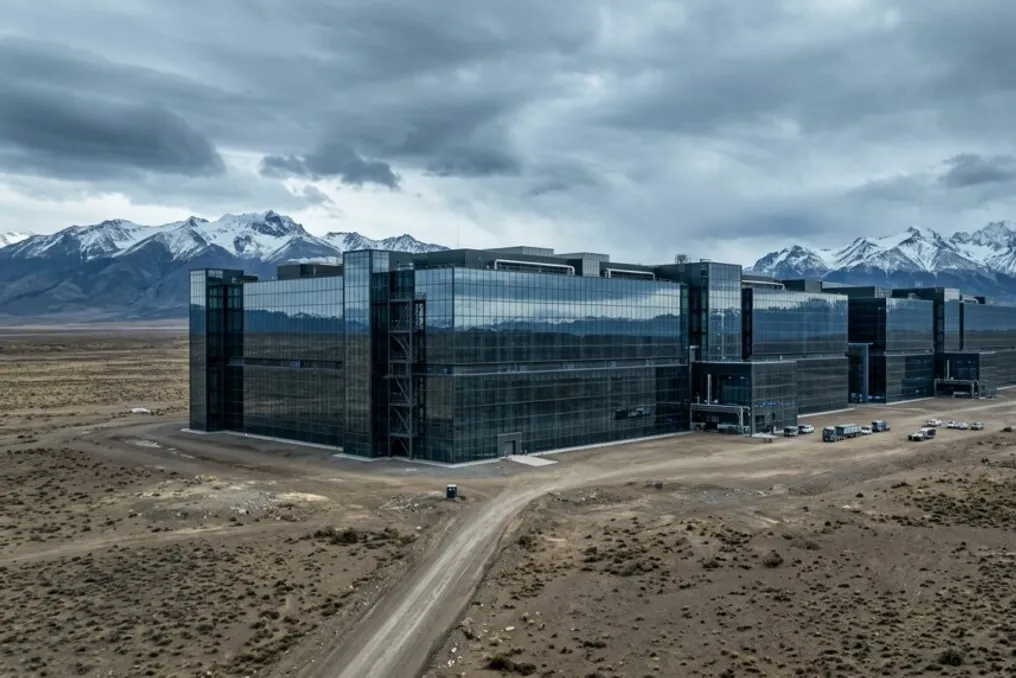
The region possesses ideal characteristics for the installation of these data centers, including vast available land areas, mild climate, strong winds, and access to gas derived from the Vaca Muerta shale formation, a resource that can be used for both energy production and facility cooling.
While communities in the United States and Europe contest new projects due to competition for electricity, the Argentine government is trying to capitalize on these advantages to entice investors. In a meeting held last month with the US Chamber of Commerce, Milei stated categorically: 'We will not regulate artificial intelligence. We will let it be free.'
Visit records provided by the Associated Press indicate that representatives of investors and industry companies met with the president and his team in recent months. Among those present were investor Peter Thiel and delegates from OpenAI, Amazon, Google, and Oracle.
The movement also involves the data center developer Crusoe, which approached Argentine authorities this year to discuss investments supported by the United States government. This company has already participated in the construction of OpenAI's main campus in Texas.
Another project under negotiation is that of Green Capital, a Polish company, which intends to invest US$3 billion (approximately R$16.05 billion) in a complex in Patagonia. This complex would be leased to large technology companies for AI processing, although it does not yet have a defined client.
To make projects of this magnitude viable, Milei advocates for a program that would reduce the corporate income tax rate from 25% to 15% for investments of at least US$1 billion (about R$5.45 billion) directed towards artificial intelligence and other emerging sectors. However, this proposal is still awaiting approval from the Senate.
It is important to note that this tax incentive imposes no reciprocal obligations regarding the use of infrastructure within the country itself. Companies are not required to reserve computational capacity for the Argentine market, nor do they need to report the volume of water and energy their ventures will consume.
The discussion about technological sovereignty concerns researchers and environmentalists. Alan Rocha Varsanyi, a member of the Argentine group Observatorio Petrolero Sur, assesses that the processing capacity will be mainly destined for the international demand of contracting companies, rather than for local technological advancement.
The lack of regulation also raises fears about risks such as cyberattacks and mass surveillance. Nicolás Wolovick, a computer science professor at the National University of Córdoba, expresses concern that the country could become a testing ground for technologies that would not be evaluated in more controlled markets.
In the province of Chubut, Green Capital plans to install its complex in an area of 130,000 hectares, leased from 14 rural landowners. Among them is the family of Francisco Sáenz, an agricultural engineer and sheep breeder, who sees in the venture a new source of income against the decline of livestock farming.
Construction is not expected to begin before 2028. When operational, the campus could demand, in a single year, about 2.7 times more electricity than was consumed by the entire city of Buenos Aires in 2025, according to an Associated Press estimate.
Green Capital assures that it will generate its own electricity through wind turbines, solar farms, and gas generators. Provincial authorities expect the project to attract billions in investment, generate specialized jobs, and create a market for excess wind energy.
However, the assurances presented have not yet convinced all residents of Trelew, a city near the proposed site. Environmental studies are underway, licenses remain pending, and the company has not specified water consumption or the participation of gas in energy generation.
The lack of information has motivated in-person and virtual protests under the slogan 'Trelew Free of Data Centers.' The resistance has also reached Congress, where the opposition managed to alter a proposal to relax rules on foreign land ownership and block Milei's plan that would allow artificial intelligence agents to control companies.