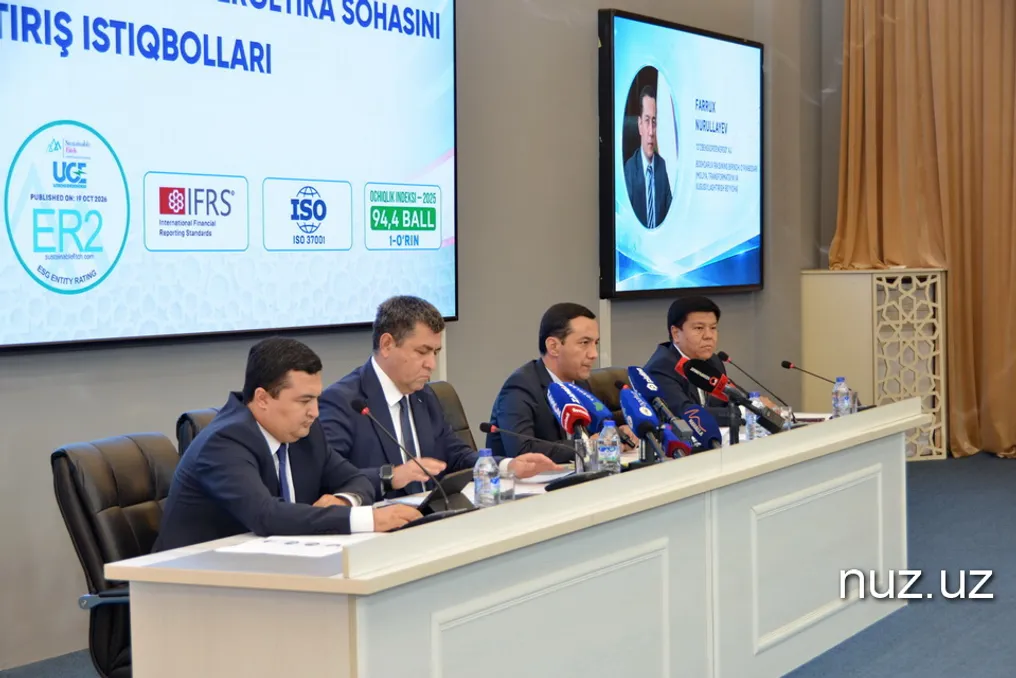
Modernization of the energy system, transition to a 'green' economy, and efficient use of water resources are the main tasks of Uzbekistan's state policy, where JSC Uzbekhydroenergo plays a key role in transformations. On November 3, 2026, a press conference was held at the Content Preparation Center under the Administration of the President of the Republic of Uzbekistan, where the management and specialists of the Society presented the results of work for January–September 2026 and announced future plans. The main conclusion of the event was that national hydropower has reached a new, qualitative level of development.
The First Deputy Chairman of the Board of the Joint Stock Company 'Uzbekhydroenergo', Farrukh Nurullaev, detailed the achievements of the hydropower sector. Thanks to ongoing reforms, the country's hydropower complex showed significant growth: the number of hydroelectric power plants (HPPs) increased from 36 to 106, and the total installed capacity of the industry reached 2.5 GW. This development is ensured by both large investment projects and the construction of small and micro-HPPs based on small rivers and canals.
The period from January to September 2026 marked historical production indicators for JSC Uzbekhydroenergo. For the first time in the history of the Society, such high results were recorded: electricity generation amounted to 6,642.7 million kWh, corresponding to the fulfillment of the plan by 120%. The growth rate compared to the same period last year reached 124%, and the market value of the produced electricity is estimated at 3 trillion soms. In addition, the company set a daily record for the first time, exceeding the mark of 50 million kWh, which was made possible by maximum optimization of production processes and effective use of existing hydro facilities.
Investment activity became a crucial factor in infrastructure modernization. In the first nine months of 2026, the company attracted 151.9 million US dollars, exceeding planned indicators by 110%. The financing structure included foreign direct investments (FDI) of 48.7,141% and the Society's own funds, amounting to 103,2100%. By the 35th anniversary of Uzbekistan's independence, nine major energy facilities with a total capacity of 74.3 MW were commissioned. These include the HPPs 'Kugay-1', 'Kugay-2', and 'Beshkurgan' (on the Bolshoy Andijansky Canal), HPP 'YUFK-3' (on the South Fergana Canal), HPPs 'Rabat', 'Chappasuy', and 'Tamshush' (on the Oksov River), as well as the micro-HPP 'Zarchob-3A' and the Charvak Wind Power Plant with a capacity of 20 MW, built with grant funds. The launch of these facilities contributed to the creation of about 120 new jobs in the regions.
JSC Uzbekhydroenergo is actively working to reduce dependence on imports. During the reporting period, industrial products worth 576.3 billion soms were produced, which exceeds the plan by 108%. Within the framework of eight localization programs, products worth 177.2 billion soms were manufactured, which is an overfulfillment of the plan by 25%. The enterprise 'UzHydroPower', which is part of the Society, plays a significant role in this process. It operates in a round-the-clock three-shift mode under the 'Made in Uzbekistan' label, producing hydrogenerators with a capacity of up to 40 MW and components for modernized and constructed HPPs. In parallel, the company achieved financial savings, saving 156.4 billion soms for the budget through the optimization of management expenses and the implementation of thrift principles.
Modern hydropower utilizes digital technologies. The company actively uses artificial intelligence to automate production processes, operational management based on big data analysis, and preliminary forecasting of water flows, which contributes to the more rational use of water resources. The reliability and transparency of JSC Uzbekhydroenergo are confirmed by international rating agencies. The rating agency Fitch Ratings confirmed the company's long-term credit rating at 'BB' with a 'Stable' outlook. Furthermore, the agency Sustainable Fitch raised the company's ESG score to 80 points (ESG Entity Rating '2'), and the 'Pure-player' status emphasizes the Society's leadership in environmental and social responsibility in Central Asia.
The strategic development of the industry is closely linked to science. Currently, the company is developing a dual education system, combining theoretical knowledge of students from specialized universities with practical work in production. To develop future hydraulic structures, JSC Uzbekhydroenergo cooperates with leading engineering firms from Turkey, Iran, and the Russian Federation. This combination of advanced foreign experience and domestic innovations allows Uzbekistan to confidently move towards achieving complete energy independence and building a sustainable 'green' future.