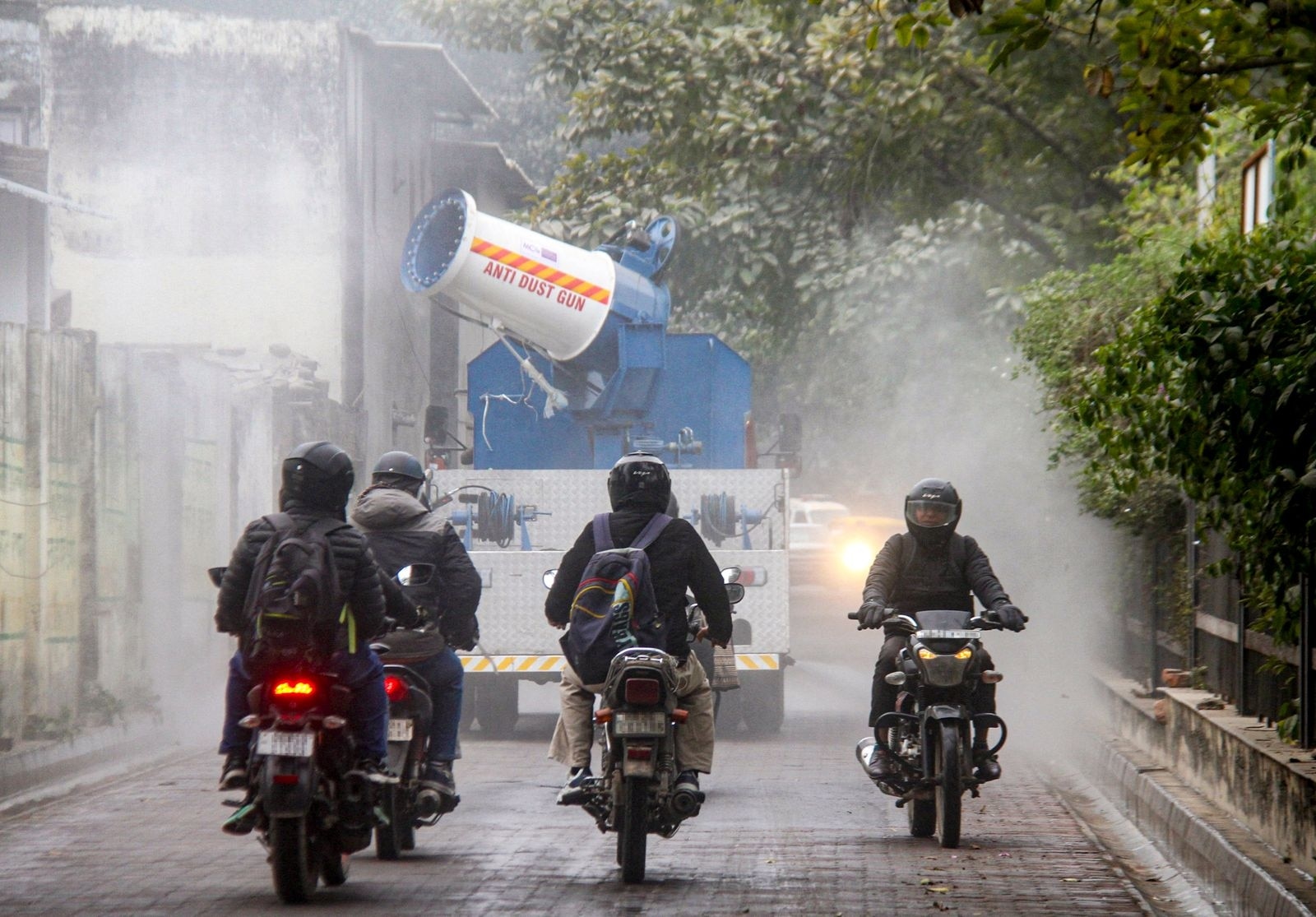
Air Pollution Record Set in Delhi: AQI Reaches 350, Breathing Becomes Difficult
Read more
Aaj Tak
www.aajtak.in

Air Pollution Record Set in Delhi: AQI Reaches 350, Breathing Becomes Difficult

The air in the capital has once again become toxic ahead of the Diwali festival. On Tuesday, the Air Quality Index (AQI) in Delhi was recorded at 350, which is the worst air quality in the city in the last 287 days. Previously, on January 20, the AQI was 378.

The situation deteriorated to the point where air was classified as being in the 'Severe' category at 10 out of 57 monitoring stations. Furthermore, 35 stations showed extremely poor air quality, and another 12 stations showed poor quality.

The highest pollution was recorded in Jahangirpuri, where the AQI reached 462, which falls under the Severe category. The Central Pollution Control Board (CPCB) defines the categories as follows: 0 to 50 — Good, 51 to 100 — Satisfactory, 101 to 200 — Moderate, 201 to 300 — Poor, 301 to 400 — Very Poor, and 401 to 500 — Severe.

Forecast for the coming days

According to the Delhi Air Quality Early Warning System, the air may remain in the Very Poor category from November 4 to 6. The forecast for the next six days also indicates that the pollution level will fluctuate between Very Poor and Severe.

After registering an AQI of 324 on Monday, Phase II of the Graded Response Action Plan (GRAP-2) was implemented in Delhi. This season, for the first time, the air in Delhi reached a Very Poor level.

Sources of Pollution

Burning stubble and vehicle emissions contribute significantly to the air pollution in Delhi. According to the Decision Support System (DSS), the contribution of stubble burning was 15.3%, and transport emissions were 15.8%.

In addition, factories in Delhi and surrounding areas contributed 3%, domestic sources contributed 3.9%, and construction activities contributed 2.2%. Waste burning accounted for 1.4% of the pollution, power generation for 1.2%, and road dust for 1.2%. Other sources contributed 1%.

In the surrounding NCR areas, the contributions were: Ghaziabad — 8.8%, Gurugram — 4.1%, Sonipat — 2.6%, Rohtak — 2.5%, and Mewat — 2%.

Stubble Burning in Six States

On November 2, satellite data recorded 219 instances of stubble burning across six states. The highest number of cases (98) was noted in Punjab. Rajasthan recorded 67 cases, Madhya Pradesh recorded 48, Uttar Pradesh recorded 4, and Haryana recorded 2 cases. No stubble burning cases were registered in Delhi or Uttarakhand.

Between September 15 and November 2, a total of 3535 field burn incidents were recorded in these states. The largest numbers included 1612 in Punjab, 738 in Rajasthan, 614 in Madhya Pradesh, 349 in Uttar Pradesh, 176 in Uttarakhand, 44 in Haryana, and 2 in Delhi.

The stubble burning season runs from September 15 to November 30. In Delhi, the first stubble burning cases this season were registered on September 19, and the second case on October 24. PM2.5 proved to be the most effective pollutant in Delhi's air. These very fine particles are 2.5 micrometers or smaller. They can penetrate deep into the lungs along with inhaled air and enter the bloodstream, posing a serious threat to health.


Similar stories

Air quality in Delhi-NCR deteriorates to AQI 334; improvement not forecasted
Read more
www.aajtak.in

Air quality in Delhi-NCR deteriorates to AQI 334; improvement not forecasted

The air pollution problem has flared up again in the Delhi-NCR region, as air quality in the capital and surrounding cities reached the 'Very Poor' category. On Tuesday morning, the Air Quality Index (AQI) in Delhi-NCR was recorded at 334. Consequently, the Commission for Air Quality Management (CAQM) immediately implemented Phase Two of the Graded Response Action Plan (GRAP-2) for the entire NCR.

Due to adverse weather conditions, relief from pollution is unlikely in the coming days. As a result, control measures will be intensified, including street cleaning, water spraying, and monitoring of vehicles and industries.

Pollution levels in Delhi have sharply increased over the last two days. On October 31, the AQI in the capital was 117, which falls into the moderate category. Then, on November 1, the index rose to 261, moving the air into the 'Poor' category. On Monday, November 2, at 4:00 PM, an AQI of 324 was registered, placing the air in the 'Very Poor' category. On Tuesday morning, air quality did not improve but worsened further.

The Commission for Air Quality Management attributed the rise in pollution to unfavorable meteorological conditions. According to the commission, the AQI may remain in the 'Very Poor' category in the following days. Forecasts from the India Meteorological Department (IMD) and the Indian Institute of Tropical Meteorology (IITM) also show no signs of air quality improvement currently.

With the implementation of GRAP-2, numerous measures to prevent pollution in Delhi-NCR will be accelerated. The Commission has directed all relevant agencies to strictly adhere to the rules of GRAP Phase One and Phase Two. Under these measures, municipal bodies are instructed to increase mechanized street sweeping, regularly spray water to prevent dust rise, and use anti-smog cannons as necessary. Proper collection and disposal of construction debris generated during demolition and construction, along with household waste, must also be ensured. Measures will be taken against those who burn garbage in the open ground.

Special attention is being paid to road traffic to reduce pollution levels. The presence of traffic police officers has been increased at major intersections and busy streets to avoid congestion. Since smoke from cars stuck in traffic also increases pollution, the focus is on maintaining smooth traffic flow. Furthermore, checks on vehicle Pollution Under Control (PUC) certificates have been tightened. Action is being taken against vehicles that emit excessive smoke. Restrictions applicable to older petrol and diesel vehicles are being strictly enforced.

Under GRAP-2, control over industrial units, brick kilns, and power plants has also been strengthened. Personnel have been instructed to ensure strict compliance with pollution control rules by these establishments and to use only approved fuel. Hotels, restaurants, and street food stalls are also under surveillance. They have been directed to stop using coal and wood in tandoors and switch to electrically or gas-powered equipment.

GRAP, or Graded Response Action Plan, is an emergency measure to combat pollution. Various levels of restrictions and control measures are introduced depending on the deterioration of air quality. GRAP-1 is applied when the AQI is between 201 and 300, considered a poor category. GRAP-2 is introduced when the AQI is between 301 and 400, corresponding to the 'Very Poor' category. GRAP-3 is applied when the AQI is between 401 and 450, called the critical category. GRAP-4 is activated when the AQI exceeds 450.

The Commission for Air Quality Management made amendments to the GRAP rules in September. These changes extended the scope of certain restrictions for vehicles operating during GRAP-3 to Sonipat in Haryana state. Previously, these restrictions for light motor vehicles of BS-3 petrol and BS-4 diesel or older were applicable in Gurugram, Faridabad, Ghaziabad, and Gautam Buddha Nagar. After the amendment, Sonipat was also included in this list. Currently, the administration has directed an intensification of monitoring and pollution control measures in Delhi-NCR considering the weather conditions.

Air Quality Worsens in Delhi-NCR After Dasara, AQI Exceeds 300
Read more
www.aajtak.in

Air Quality Worsens in Delhi-NCR After Dasara, AQI Exceeds 300

Following the Dasara festival, pollution levels in the Delhi-NCR region significantly increased, reaching hazardous levels. The Air Quality Index (AQI) surpassed the mark of 300 due to smoke from fireworks and stubble burning.

To stabilize the situation, GRAP 1 restrictions were implemented, which prohibit construction work and open waste burning. According to meteorological service forecasts, the situation may worsen in the coming days.

Popular