Disagreements Among Stakeholders Over Timelines for Implementing Nutritional Labeling Norms on Packaging Front
Read more
Business Standard
business-standard.com

Disagreements Among Stakeholders Over Timelines for Implementing Nutritional Labeling Norms on Packaging Front

Disputes between food manufacturers, the packaging industry, and public health experts have intensified regarding the timelines for implementing mandatory nutritional labeling on the front of packaging (FOPNL) for packaged products high in sugar, salt, and fat, as the Supreme Court reviews this contentious issue.

The Food Safety and Standards Authority of India (FSSAI) proposed a unified FOPNL regime, under which packaged products exceeding established thresholds for any specified nutrient must carry a red hexagonal warning on the front of the package. These thresholds are proposed to be based on the Dietary Recommendations for Indians 2024, issued by the Indian Council of Medical Research – National Institute of Nutrition.

On September 28, the Bench of the Supreme Court, comprising Justices J. B. Pardival and Vinod Chandran, questioned the FSSAI's proposal for a voluntary compliance period of 365 days and demanded an explanation as to why a new round of stakeholder consultations was necessary, given that the issue had been under discussion since 2022.

Public Health Expert Opinion

Health expert Monica Arora, Vice President of Research and Health Promotion at the Public Health Foundation of India (PHFI), stated that the delay in implementing FOPNL since 2022 has postponed a crucial public health opportunity.

She emphasized that it is vital for pre-packaged foods to have clear and easily understandable warnings if they contain high amounts of sugar, salt, or fat, so that consumers can easily identify products that may pose a health risk. Arora also noted that protecting children and youth through such warning labels is a public health imperative that cannot be delayed, especially considering their vulnerability to persuasive marketing of unhealthy foods and beverages.

"Timely implementation of evidence-based labeling policy is a critical step towards creating a healthier food environment and preventing non-communicable diseases (NCDs)", she stated. The Parliamentary Committee also expressed concern over the delays in approving the FOPNL rules. The Committee noted that the draft FOPNL rules were initially notified in 2022, and over 14,000 comments were received from stakeholders. The FSSAI's proposal in 2022 envisioned a star system based on the Indian Nutrition Rating, which has since transformed into the warning sign system presented to the Supreme Court in 2026.

Concurrently, the parliamentary committee pointed out that "more than two years have passed since the draft was notified, and the ongoing delay in final approval of the rules has resulted in the absence of simplified and interpretable information on the front of the package, especially regarding sugar content." It added that "the lack of simple interpretive tools, such as warning signs or color indicators, limits the effectiveness of such disclosure in influencing consumer behavior."

What is FOPNL?

Nutritional labeling on the front of the package aims to provide simple, quickly viewable information about nutrients on packaged products. The main idea is to help consumers determine the food profile of the product and potential health consequences, enabling them to make more informed dietary decisions. The current FSSAI proposal mandates red hexagonal warnings for products exceeding established thresholds for nutrients such as sugar, salt, and fat. The regulator also proposed a separate warning for products containing non-caloric sweeteners.

What is the Position of the Packaged Food Industry?

While health experts insist on faster implementation, the packaged food industry calls for a longer transition period. The Indian Food and Beverage Association (IFBA) believes that a realistic starting point for compliance would be a two-to-three-year transition period from the date of final notification, depending on the final scope and complexity of the requirements.

Dipak Jolly, Chairman of IFBA, told Business Standard that such a timeframe would allow micro, small, and medium enterprises (MSMEs) and other food producers to assess their product portfolios, confirm nutrient classifications, rework packaging and labels, manage existing packaging inventory, and align production and supply chain operations. IFBA stressed that the goal should be time-bound implementation supported by a clearly defined and practical transition period.

Jolly also stated that "the proposed timeline must balance the urgency of providing consumer information with the operational realities of implementation, ensuring that compliance is effective, consistent, and scientifically sound, rather than merely rushed." Although the FSSAI labeling policy provides a minimum transition period of 365 days from notification for amendments to labeling requirements, unless otherwise decided in emergencies, some packaging industry representatives have stated that the financial impact of regulatory changes could ultimately be passed on to customers.

Timmayya Napanda, Managing Director and CEO of rigid plastic packaging company Alternicq, noted that "when rules change, the impact on existing packaging stock is usually manageable, as we typically do not hold large stocks of empty packaging. Non-compliant printed labels or packaging materials may require disposal, the cost of which we may pass on to our client if we procured them on their behalf."

Previously, the All India Food Processors Association (AIFPA) had stated that the proposed threshold values should be finalized after considering available scientific material aligned with international standards, data on food consumption in India, differences between product categories, and input from consumer organizations, public health experts, food scientists, MSMEs, traditional food producers, and industry stakeholders. However, Arora countered that the growing prevalence of overweight and obesity in India, coupled with the expansion of the packaged food and beverage retail market, demands faster implementation. She cited statistics: "Between NFHS-3 (2005–06) and NFHS-5 (2019–21), overweight or obesity among adults increased from approximately 9 percent to 23 percent in men and from 13 percent to 24 percent in women. Among children under five, the prevalence of overweight rose from 2.1 percent in NFHS-4 (2015–16) to 3.4 percent in NFHS-5."

Similar stories

J.P. Nadda at Healthwealth Summit: Government is focusing on early detection of diseases alongside treatment
Read more
www.aajtak.in

J.P. Nadda at Healthwealth Summit: Government is focusing on early detection of diseases alongside treatment

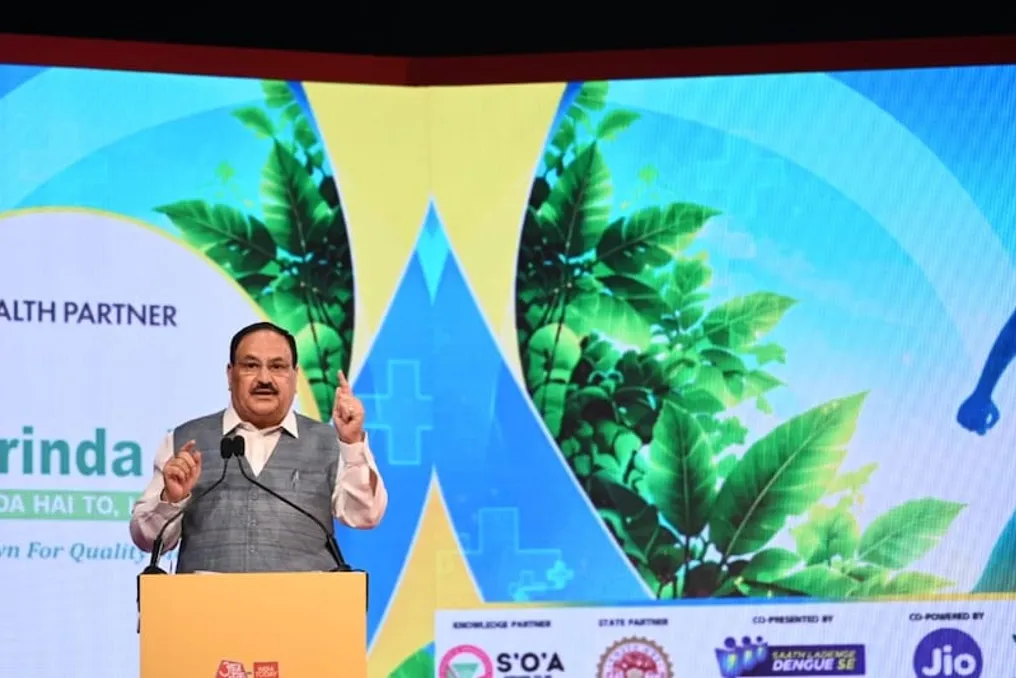
Union Health Minister J.P. Nadda discussed in detail the roadmap for the country's healthcare system, government expenditure, and making medical facilities accessible to the general public at the India Today Healthwealth Summit 2026 held in Noida. Nadda emphasized that the government is focusing not only on providing treatment but also on identifying diseases in their early stages. Screening and primary healthcare services are being strengthened through the Ayushman Bharat scheme, aiming to detect serious illnesses in their initial phases.

Specialist medical care will reach smaller cities

Addressing the issues of increasing burden on AIIMS Delhi and the shortage of specialist medical services in Tier-2 and Tier-3 cities, the Health Minister stated that medical colleges have been extensively expanded in recent years. He gave examples of new colleges established in districts where neither government nor private medical colleges previously existed, such as Siwan and Purnia in Bihar, Dumka, Deoghar, and Daltonganj in Jharkhand. He said that with each new medical college, the number of MBBS, nursing, and PG seats increases, ensuring the availability of local specialist doctors in the future.

It will take time to reach the level of AIIMS Delhi

When asked about the fact that many complex procedures, such as cochlear implant surgery for children, still require months of waiting at AIIMS Delhi, he acknowledged that all new AIIMS institutions will take time to attain the status of AIIMS Delhi. However, he assured that the government is gradually expanding specialized services and has opened several new AIIMS across the country, where patients are being provided with advanced healthcare facilities.

Redressal of complaints related to Ayushman Bharat scheme

Regarding complaints related to the Ayushman Bharat scheme, J.P. Nadda stated that special committees have been formed in states and districts to resolve these grievances. He clarified that efforts will be made to find solutions at the district level for complaints, such as hospitals refusing treatment citing low payment from private hospitals, with a maximum time limit set at one month.

New meal and food voucher rules take effect in November, promoting greater card interoperability.
Read more
g1.globo.com

New meal and food voucher rules take effect in November, promoting greater card interoperability.

A significant change is about to be implemented for those who use meal or food vouchers issued by companies such as Alelo, Ticket, VR Benefícios, Pluxee, Flash, or Swile. Starting in November, these cards must be accepted at any payment terminal enabled for this type of benefit, concluding a transition phase that began in May and expands the possibilities of using the benefit.

This determination is part of a set of new guidelines from the Worker Feeding Program (PAT), which was announced by the government in February of this year. In November, the adaptation period ends, and the rule that guarantees that any card belonging to the program can be used at any machine capable of receiving the benefit comes into full effect.

The main transformation introduced is called interoperability, which simplifies the operational scenario. In practice, this feature eliminates the requirement for restaurants, supermarkets, and other points of sale to maintain specific agreements or equipment for each meal or food voucher brand.

What changes starting in November?

Although the integration between systems began in May, the adjustment period was completed last Saturday. Previously, some companies were still in the migration process. At the beginning of September, g1 reported that more than one hundred companies had been notified by the Ministry of Labor and Employment (MTE) to provide documentation and clarifications regarding possible failures in complying with PAT rules.

With full interoperability, the worker gains the freedom to use their card at any commercial location that accepts this benefit, without depending on the company that issued the card.

Will the benefit amount change?

There will be no change in the amount of the meal or food voucher provided by companies to employees under the new rules. Furthermore, the use of these resources for purposes other than food remains prohibited. Thus, the amounts remain exclusively intended for the purchase of ready meals or food items, according to the benefit modality. The change aims to broaden the options for using the benefit and foster competition in the sector, without increasing the amount received by the worker.

What has changed since February?

Even though full interoperability only starts to apply in November, other regulations have been in force since February. Among the most relevant changes are: a maximum limit of 3.6% for the fee applied to sales processed with meal and food vouchers; a ceiling of 2% for the exchange fee; and a maximum period of 15 calendar days for the sales money to be transferred to the establishments.

Previously, merchants frequently complained about high fees and long waiting periods to receive payments, which could exceed 30 days. The government justifies these rules as an effort to reduce costs and make the acceptance of benefits more advantageous for businesses of all sizes.

What do the operators say?

After the disclosure of the new rules, some operators have challenged the decree legally. These companies argue that the government exceeded its authority by establishing tariff limits and promoting structural transformations through a decree.

What happens if the rules are not complied with?

Contracts and operations linked to the PAT must strictly adhere to the guidelines established in the decree. Non-compliance with these rules can result in various consequences, such as fines, sanctions, de-registration from the program, and the requirement to return tax benefits previously enjoyed. Penalties may fall on the operators, the companies participating in the PAT, and the businesses, depending on the nature of the infraction found.

Popular