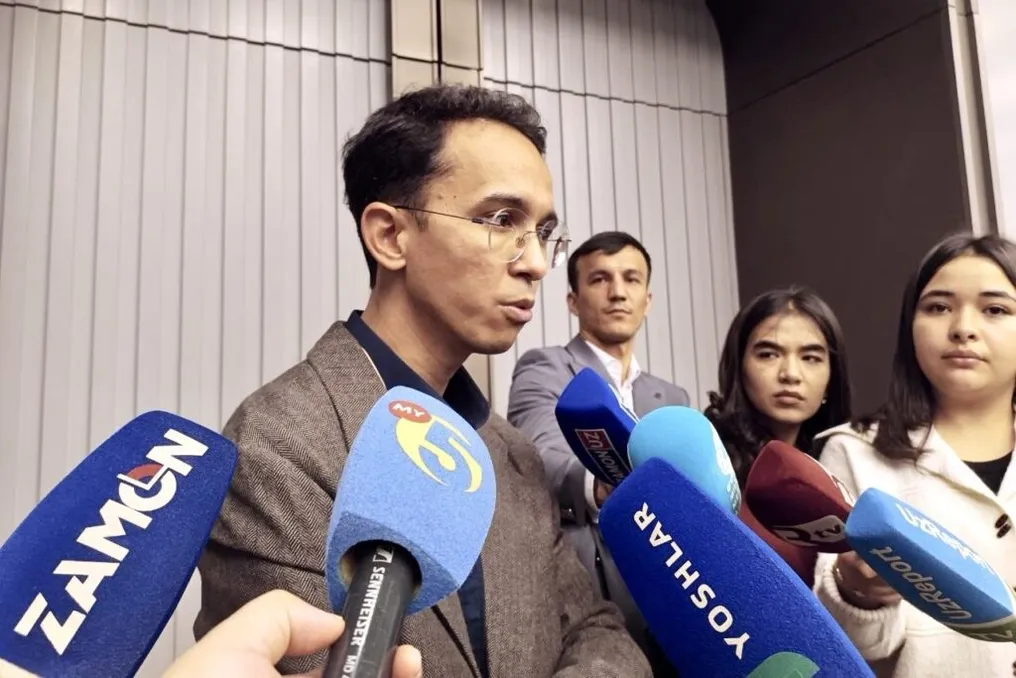
The Public Foundation for Support and Development of National Mass Media, funded by the European Union, presented the report 'National Study of Media Consumption in Uzbekistan.' This field study, conducted by the 'Ijtimoiy Fikr' center from September 8 to 19, included face-to-face surveys of 1,411 citizens across 14 different regions of the country.
This two-hundred-and-forty-page report, positioned as the first of its kind, covers information consumption through television, radio, print publications, social networks, and the messenger Telegram. According to key findings, despite digital platforms holding leading positions in news dissemination, audience trust remains with traditional mass media.
News is more often received from digital sources
Half of the surveyed respondents (50.4%) regularly follow national news, and another 30.4% do so occasionally. The main channel for receiving news for most is digital sources. Telegram channels were the leader among these sources, noted by 51.6% of respondents. They are followed by television (44.6%), social networks (41.6%), YouTube and video blogs (31.3%), and online publications (30%).
Radio, government websites, and print newspapers show lower representation: radio at 7.2%, government websites at 5.9%, and print newspapers at 5.2%. The share of those who use search engines and artificial intelligence to get news was 1.8%. Respondents could indicate multiple sources simultaneously.
Telegram users account for 86.1% of respondents, while 67.5% watch television. Social networks are used by 64.8% of respondents, press is read by 28.3%, and radio is listened to by 21.9%. The most important factor when choosing a source was timeliness, named by 48.6% of participants. Criteria for source trust (31.3%) and accessibility from any location (31%) were mentioned less frequently.
Despite Telegram's popularity, trust in it is low
When asked about the most reliable source, 44.3% replied that it was television. Official government websites ranked second in terms of trust (17.3%), although only 5.9% of respondents receive news from them. Online publications are rated at 7.4%, social networks at 6.7%, and YouTube and video blogs at 5.4%. In total, between 30% and 42% of respondents receive news from each of these sources.
Significant differences in trust appear between age groups. Television is trusted by 23.1% of people aged 18–24 and significantly more—70.6% of people over 55. The situation with Telegram is the opposite: it is trusted by 17.1% of young people and only 5.4% of older individuals. Furthermore, among young people, the proportion who trust government websites (22.8%) exceeds the proportion who trust Telegram channels. For people over 45, trust in official websites drops to 7.5–10.4%.
Overall, 44.5% of participants fully trust the media, 21.4% trust it more, and 30.9% trust it partially. Rural residents (50.1%) expressed a higher level of trust compared to city dwellers (39.7%).
Cyrillic or Latin?
Most respondents (71.7%) prefer to receive information from the media in Uzbek written in Cyrillic, while 49.8% prefer Latin script. Russian was chosen by 43.3%, and English by 11.3%; respondents could indicate multiple languages.
The figures show a sharp contrast between the preferences of young and older generations. Among people aged 18–24, 76.5% prefer Latin, and 47% prefer Cyrillic. In the 25–34 age group, Latin maintains an advantage—71.1% versus 56%. However, in the 35–44 age group, the situation changes: 75.5% choose Cyrillic, and 53.1% choose Latin. Among people aged 45–54, 86.1% prefer Cyrillic, and among those over 55, 94.3%, while the share of Latin lovers in this group is 27.4% and 20.4% respectively.
English language preference is shown by 23.1% of young people, whereas among people over 55, this figure is only 3.6%.
Confrontation with fakes
Respondents encounter unreliable or misleading information with varying frequency: very often—13.9%; quite often—13.7%; sometimes—33.7%; rarely—27.6%; and never—8.7%. False information is most often associated with YouTube and video blogs (50.1%), Telegram channels (44%), and social networks (38.4%), while television is considered a source of fakes only in 5.4% of cases.
25.1% of respondents always check information, while 13.3% never check it. Among people over 55, the proportion who do not check information reaches 23.3%. 17.7% of respondents admit to being unable to distinguish lies from truth independently. Among young people aged 18–24, this percentage is 9.6%, and among older people, it is 26.2%.
48.7% of social media users have encountered fake news, and 34% have encountered fraud and attempts at extortion. In Telegram, the prevalence of fraudulent messages (24.4%) and fake online stores (23.2%) is noted.
Freedom of speech and control
Nearly half of the respondents (49.7%) highly rated the level of freedom of speech and media independence, while 45.2% reported limitations in certain areas. Only 4.7% gave a low rating. The most pressing issues in media operation were cited as the spread of fake news (46.6%), lack of objectivity and impartiality (33.1%), insufficient transparency of government body activities (30.6%), and limited opportunities for journalists to obtain information (27.4%).
Moreover, 77.4% of respondents supported the idea of strengthening media responsibility for spreading false information. When the question was phrased as the necessity of strengthening responsibility, 75.9% of participants believe that the state should control the accuracy of information. The share of those who fear that stricter penalties may limit freedom of speech was 4.5%, and supporters of complete media independence were 5.3%.
To increase media independence, 56.5% of participants ranked strengthening legal guarantees of freedom of speech as the top priority. Young people support the development of private agencies and independent media (32.4%) twice as much as older generations (17.2%). It should also be noted that pressure on journalists (17.1%) was mentioned more often in the 18–24 age group than in other cohorts.
Audience expectations
Most often, respondents pointed to the lack of information in the media about prices, income, employment, and social support (41.3%). Second in line were population problems and needs (40.6%), followed by healthcare (23%) and laws and citizens' rights (22%).
Main complaints against print and online publications concern the insufficient depth of coverage of important social issues: respondents note a lack of open discussion of social problems (31.8%), in-depth analytical materials (29.1%), journalistic investigations (20.6%), and fact-checking (20.1%).
Television receives criticism regarding program monotony (36.8%), frequent repetitions (36.2%), a large amount of advertising (29.1%), and low quality of national series (27.5%). Regarding formats, most prefer traditional news broadcasts (48.8%) and short digests (41.7%), while Reels were chosen by 22%, and detailed analysis by 21.5% of participants.
Media leaders
Among online publications, Kun.uz is the most popular, read by 74.7% of respondents. Next are Daryo (43.5%), Qalampir (36.8%), and 'Gazeta' (20.4%). In the segment of print publications, the leaders are Xalq So‘zi (38.9%), Yangi O‘zbekiston (37.7%), and Mahalla (28.7%).
Among TV channels, Milliy TV is watched most often (44.5%), followed by O‘zbekiston 24 (41.7%), Zo‘r TV (34.9%), and Sevimli TV (33.8%). O‘zbekiston 24 leads in terms of trust, trusted by 52.8% of viewers. Among radio stations, Vodiy Sadosi leads (38.2%), followed by Yoshlar, Mahalla, and O‘zbekiston 24.
In social networks, Instagram is the undisputed leader, used by 92.7% of users. Facebook is used by 28.2%, and TikTok by 14.2%. Instagram leads regardless of gender, age, or region. TikTok is more popular among young people (21.2% in the 18–24 age group), and men use Facebook twice as often as women (38.1% versus 17.9%). The most active time for using social networks and Telegram is between 18:00 and 00:00.