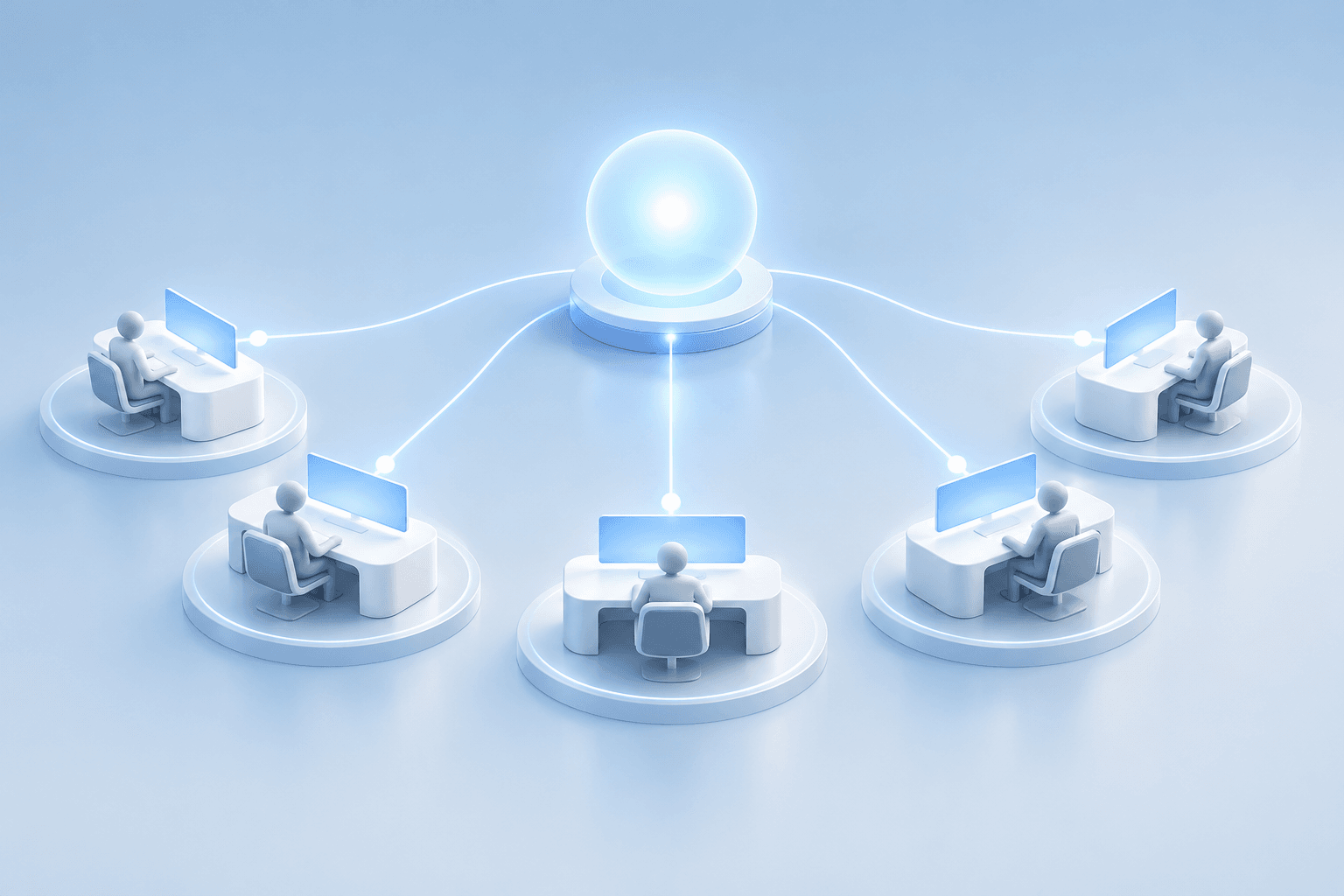
DeepSeek introduces Creator Mode for creating custom plugins via dialogue
Read more
TechNode
technode.com

DeepSeek introduces Creator Mode for creating custom plugins via dialogue

The DeepSeek's Harness team demonstrated Creator Mode on November 2nd, which allows users to create custom plugins using natural language prompts. The demonstration featured a design workspace, a video editor, and interactive 3D visualizations.

The company released seven demonstration prompts in Chinese and English. These examples cover various tools such as a document reader, a poster designer, and a dialogue statistics monitoring panel. Users can copy these prompts into Harness and activate Creator Mode to develop their own versions.

Harness is an open agent platform from DeepSeek, and the plugins extend the functionality, skills, and interface of this platform. DeepSeek reported that some of the presented plugins were refined through several rounds of interaction.

Similar stories

DeepSeek Team Unveils Prototype Research Agent for Proactive Coding
Read more
technode.com

DeepSeek Team Unveils Prototype Research Agent for Proactive Coding

The DeepSeek Harness team has made dsh-superagent publicly available—a research prototype that accepts development requests via GitHub and, optionally, via Feishu. The agent performs work in separate sessions and returns results, such as pull requests, back to the original conversation.

This prototype is configured around a single GitHub repository and functions as a package for DeepSeek Harness. It transforms authorized requests into working tasks, allocates a dedicated working directory and agent session for each task, and provides a web dashboard to display issues requiring human attention.

The project explores the capabilities of coding agents to complete long-running tasks with reduced need for human coordination. The implementation, which originated from the team's daily workflow, has been published and is available under the MIT license.

DeepSeek Harness Team Unveils Prototype of Super Agent Capable of Self-Finding and Fixing Errors
Read more
pandaily.com

DeepSeek Harness Team Unveils Prototype of Super Agent Capable of Self-Finding and Fixing Errors

The DeepSeek Harness team has published a description of their project, which they named the Super Agent. This agent is designed as a continuously operating system that simultaneously advances multiple tasks, independently seeks work, and recovers from failures. The corresponding research prototype was released on GitHub under the MIT license, according to Chinese tech media.

The dsh-superagent-prototype repository is a package of a proactive coding agent intended to work with a single GitHub repository within the DeepSeek Harness ecosystem. The agent monitors activity on GitHub, and optionally on Feishu. When an authorized user requests a task execution, the agent creates a work item, processes it in its session and catalog, and then responds in the original dialogue, for example, by creating a pull request.

The accompanying documentation emphasizes that this code is for research purposes and is not an official DeepSeek product, and some concepts described in the document have not yet been implemented.

System Architecture

The core concept is built upon a two-layer architecture. The Router session receives all human activity from different channels but does not perform the work and may not even have a Bash tool. Tasks are delegated to isolated Worker agent sessions, which execute work in parallel using a full set of tools, and send reports back to the Router, bypassing communication with users.

Each Worker agent subscribes to branches of interest, such as chat discussions or pull requests, allowing subsequent events to go directly to it without passing through the Router. The system functions based on events: triggers include messages in chats, emails, review comments, and Continuous Integration (CI) results, which are first filtered by deterministic code and then by the model.

The team also separated the agent's state and the execution environment so that the agent can remain active in the cloud while interacting with the user's local machines. An external Watchdog session is also used to monitor whether the Worker agents are making real progress. Within the internal user group, the team established a rule: the instance must silently reproduce reported errors and only report them after finding a simple solution, sometimes opening a pull request before anyone flags the issue.

During preliminary tests on synthetic loads, including about 300 messages and approximately 20 work requests, the Super Agent completed half of the tasks in 12.4 minutes and 95% in 15.7 minutes. These figures surpassed the results achieved by a single session with a sub-agent tool, although they required more cached tokens. Without direct routing of subsequent events to the Worker agents, the Router's solutions increased by approximately 30%, and batch processing under high load reduced the time to output one Router solution from 6.4 seconds to 1.6 seconds. The team called these results a preliminary benchmark.

Among the unresolved issues listed by the team are scaling the Router, long-term memory, inter-agent communication, and the risk of prompt injection if the cloud agent gains access to credentials on local devices.

DeepSeek Harness v0.2.2-alpha.2 allows the main agent to delegate tasks to local Codex and Claude Code tools
Read more
pandaily.com

DeepSeek Harness v0.2.2-alpha.2 allows the main agent to delegate tasks to local Codex and Claude Code tools

DeepSeek has released a pre-release version of DeepSeek Harness, its open-source agent software, version v0.2.2-alpha.2, which was posted on GitHub on October 28. The main innovation is an experimental plugin called subagent_oar, which enables the main agent to assign an autonomous task to install Codex CLI or Claude Code on the same machine.

Previously, Harness supported Claude Code and Codex; the v0.1.0-rc.8 update in August allowed users to install them as profile packages within their subagent system. However, the new tool functions differently. It provides the main agent with a single entry point for distributing work: when calling subagent_oar, the agent selects either codex or claude, then sends the task description, the full prompt, and an optional working directory. The tool immediately returns a task ID, and upon completion, a notification of execution brings back the final answer or an error message to the main session.

External tools operate independently. Codex CLI and Claude Code maintain their own configurations, models, tools, and login process, so users must install and authorize each one, and ensure that the Harness host can find them. Provider parameters can pass the model, reasoning level, launch arguments, environment variables, and timeout, depending on each runtime's support.

The documentation sets clear limitations: the main conversation is not redirected, so the request must explicitly state which files are important and what should be returned. Tasks are one-off, without the possibility of subsequent questions, session resumption, or real-time progress streaming. Only the final answer or failure is returned, not the internal reasoning of the external agent or its tool history. Official examples allow for a writable workspace and disable permission requests, and canceling a task does not undo file changes already made by the external agent.

Other add-ons help users track delegated work. An experimental change request feature can display the status and differences of a related merge request for a session running in its own Git working tree. The developer statistics plugin details the usage of context, cache, as well as the time spent on models and tools for each step and turn. Output from small background tasks now comes through the completion notification, and the subagent waiting guide reduces the need for repeated polling.

The release also allows users to update third-party plugin packages, with the option to roll back in case of a hot update failure, and adds interface text in Japanese, Spanish, French, German, Russian, and Brazilian Portuguese. Earlier community materials, including multi-agent setup tests from Bilibili creators, were created by users themselves and are not DeepSeek products.
Popular