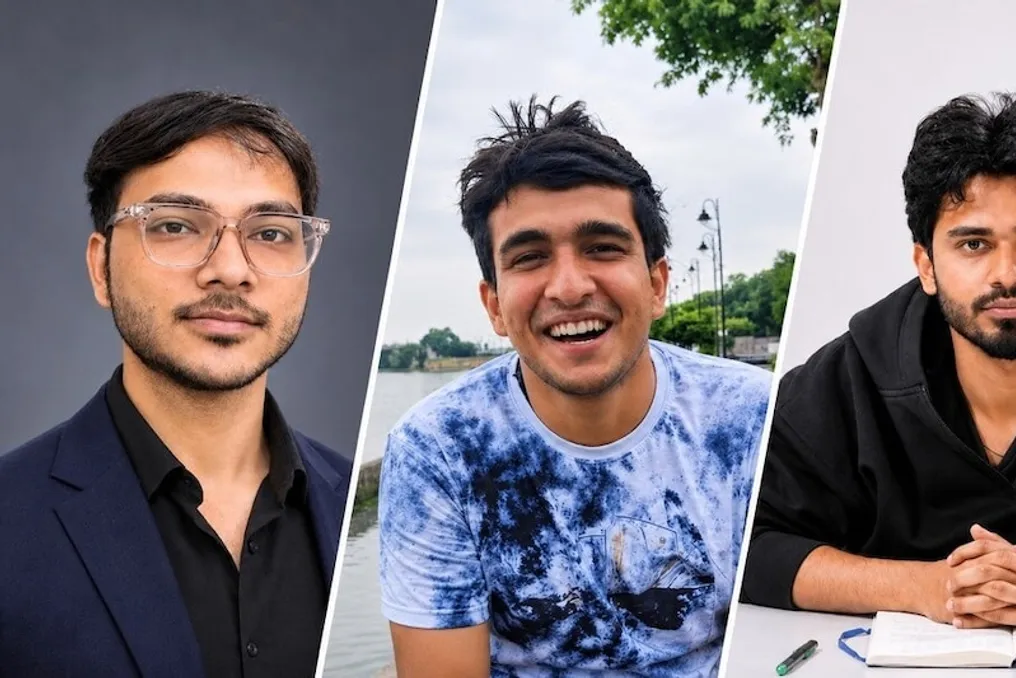
From a village in Bihar to IIT and raising 80 crore rupees in funding: Friends gave up IT jobs for math learning games
Read more
Aaj Tak
www.aajtak.in

From a village in Bihar to IIT and raising 80 crore rupees in funding: Friends gave up IT jobs for math learning games

Mohan Kumar, who grew up in the remote village of Bihar, initially showed an interest in drawing and music, receiving awards at district and state levels. However, after finishing the tenth grade, he focused his attention on mathematics, which led him to IIT Guwahati.

Today, Mohan, along with two friends, runs a startup whose goal is to make mathematics engaging by taking it out of textbooks and exams and putting it into the format of a mobile game. Their company, Matiks, recently attracted new funding of $10 million USD. This company, founded by three friends, plans to offer users worldwide intellectual challenges through math games, puzzles, and memory exercises.

Matiks was founded in 2024 by Sudhanshu Bhatia, Mohan Kumar, and Sushant Thimmapa. All three graduated from IIT Guwahati in 2022. Despite studying different disciplines, their views converged on the desire to make mathematics and mental exercises enjoyable for people. Sudhanshu studied mathematics and computer science, and also underwent additional training in product design; he is a record holder in mental mathematics and won the world championship in junior mental calculation in 2016. Sushant studied electrical engineering, electronics, and communication, and achieved national recognition in mental mathematics.

Mohan Kumar's story among the founders is particularly noteworthy. He was born in a remote village in Bihar where educational opportunities were limited, so his childhood was spent in hostels and with relatives. Initially, he was interested in drawing and music, for which he received many awards. But after the tenth grade, he began focusing on mathematics and started preparing for IIT-JEE. In 2018, he enrolled in the Computer Science and Engineering program at IIT Guwahati. During his studies, in 2021, he interned at Sprinklr. After that, he was offered a position before employment, and in 2022, he became a product engineer at the company. By 2024, he reached the position of lead product engineer.

However, instead of advancing up the corporate ladder, he decided to start his own startup, after which he began working on Matiks with his university friends. He is currently a co-founder and CTO of the company.

The core idea of Matiks was that mathematics should not be exclusively associated with exams, homework, and books; it can be made as engaging as a mobile game. Sudhanshu Bhatia began working on this concept while working on anti-money laundering strategies at American Express. He wanted people to play mind-challenging games on mobile devices instead of just scrolling through videos. Matiks users can play games related to mathematics, puzzles, memory, and logic. Initially, they could compete against the computer, and then against each other. The game also includes features such as daily challenges, rewards, and streaks.

The main goal of the company is to turn mathematics into a kind of game. According to Mohan Kumar, his vision is to make mathematics popular, like a sport.

Matiks claims that by September 2026, its platform had 2.2 million monthly active users, and in this month, users played a total of 48 million games. The company's daily active users grew from approximately 22 thousand at the beginning of the year to over 300 thousand by September. The company raised $10 million in a Pre-Series A round. This round was led by General Catalyst. Entrepreneur Ronnie Screwvala and existing investors Info Edge Ventures, Tanglin Venture Partners, and Untitled Ventures also participated. Thanks to these investments, the company's total funding exceeded $13.5 million.

Now, Matiks plans to use these funds to expand to other countries, develop new games and social features, and work on an AI-based game creation platform. The journey of these three friends demonstrates how a common idea conceived in university can transform into a business. It is worth noting that they created a product that combines a discipline like mathematics with gaming, which is appealing not only in India but also in other countries.

Similar stories

Contrast between the rejection of AI in games and its acceptance in hardware development
Read more
olhardigital.com.br

Contrast between the rejection of AI in games and its acceptance in hardware development

In December 2025, the game Clair Obscur: Expedition 33 received two negative awards at the Indie Game Awards due to the use of Artificial Intelligence (AI)-generated textures in the final version. In contrast, corporations like Nvidia employ AI to design their own GPUs, which are used in various games, without facing calls for boycotts.

This scenario raises the question of the gaming community's prejudice against AI. The distinction lies between what is considered acceptable and what is not, requiring analysis not only of data but also of examples where the technology was well-received and of internal practices within the hardware industry.

A survey conducted by GDC 2026, based on responses from over 2,300 industry professionals, assessed opinions on the use of generative AI. The results indicated a worse scenario compared to the previous year, especially regarding the use of generative AI.

Among the interviewed professionals, 52% believe that generative AI harms the industry, a significant increase from the 30% recorded the previous year and 18% two years prior.

The numbers are even more critical when looking at the gaming public. A survey conducted by Quantic Foundry, which collected data from 1,799 players, revealed that about 85% of them expressed an unfavorable opinion towards the use of generative AI, with approximately 63% holding a very negative view.

The Quantic Foundry study points out that the gaming public's motivation is a relevant factor. They demonstrated greater negativity when AI is applied to the creation of art, music, sound effects, narrative, and dialogues.

For comparison, the use of AI to adjust difficulty was viewed negatively by 27% of the public, while its use in visual arts reached 83% aversion. This public resistance was also high in other creative areas, with 77% against music and sound effects, and 70% against narrative and dialogues. This suggests that public objection tends to decrease as the use of AI moves away from strictly creative processes.

An example of AI application that found some public acceptance is DLSS and related technologies. These systems use AI to increase frame rate (FPS), reduce latency, and enhance visual quality. Users welcomed these features due to the remarkable quality and performance achieved.

However, problems began to arise during the evolution of DLSS. Features initially focused on performance turned into dependencies for game development, causing new titles to require these tools, often presenting performance flaws even on powerful computers.

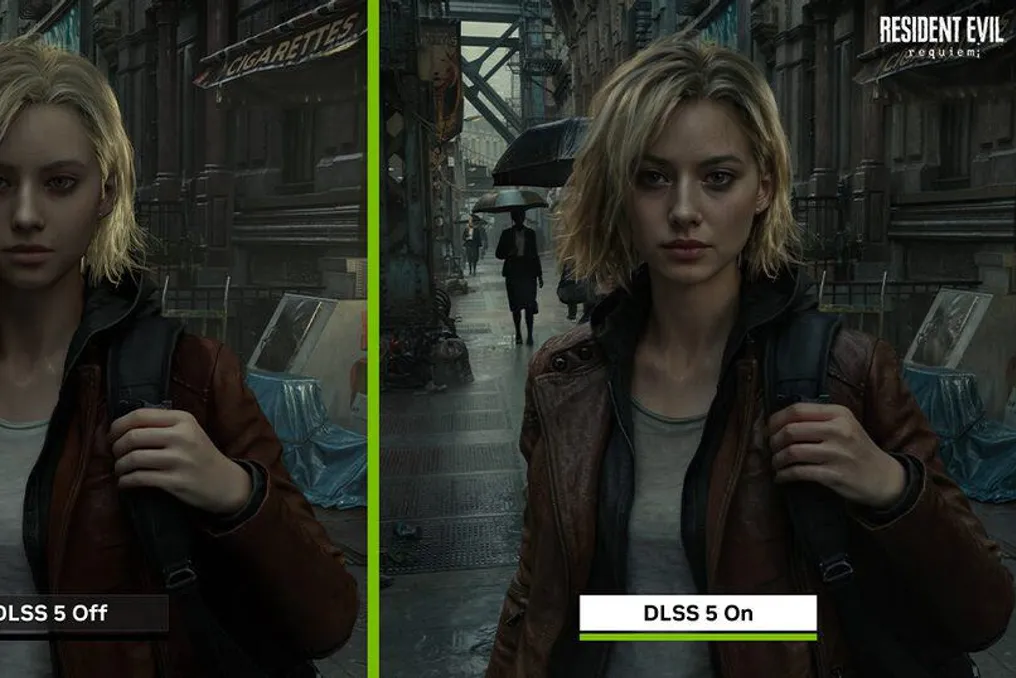
The situation worsened with the presentation of DLSS 5. This tool, which incorporates real-time neural rendering to reconstruct pixels with photorealistic lighting and materials, showed difficulties in maintaining visual coherence between scenes, resulting in the distortion of the original work and artificial and generic characteristics. Such problems were received extremely negatively by the gaming community.

Companies like Nvidia apply AI in their chip designs, covering everything from component layout to final project validation. A notable result was the development of a 64-bit adder—a circuit responsible for summing binary values—that occupies about 25% less chip area when created using PrefixRL, as reported by Jeff Dean of Google and Bill Dally of Nvidia.

At the 2026 DAC (Automation and Design Conference), companies such as Synopsys, Cadence, and Siemens displayed AI-assisted automation projects. Synopsys' long-duration design verification agent demonstrated a process 50 times faster, according to the company itself. Simultaneously, Siemens' project, in collaboration with Nvidia, presented agents capable of characterizing libraries more than ten times faster.

Although these are only two examples, they share one common point: the partial replacement of human work by AI did not generate revolt, protests, or boycotts from the public.

Explanation of SIM card binding principle: how changes will affect messenger operation
Read more
www.aajtak.in

Explanation of SIM card binding principle: how changes will affect messenger operation

Due to the development of messengers such as WhatsApp and Telegram, significant changes are expected as the government seeks to ensure that applications are tied to the active SIM card used during account registration. This means that after initial verification via a one-time password (OTP), the application will not be able to continue operating if the SIM card is removed from the phone.

According to directives from the Ministry of Telecommunications, messengers must remain constantly linked to the SIM card that was used to create the account. This mechanism is called SIM binding. The government claims that the goal of this rule is to limit cybercrime, fraud, and identity misuse, especially in cases where Indian numbers are used to attack people from other countries.

Preliminary data suggests that the implementation of this rule is scheduled for January 1, 2027, with an deadline set for application developers by December 31, 2026, to comply with the relevant requirements.

To better understand the principle, consider an example: if a user created a WhatsApp account with the number 98XXXXXXXX, and the application verified the number via OTP, and then the user removed this SIM card and placed it in another phone, the application could continue functioning on the first device. However, under SIM binding, the application must maintain a connection with the active SIM card used to identify the account. If the corresponding SIM card is absent or inactive in the phone, the use of the application may be disrupted.

It is important to note that this does not mean every user will have to create their account again on January 1st. The main change lies in how the application will implement the condition of SIM card presence and activity.

The impact of this regulation extends beyond mobile applications. Special conditions have been set for web versions and desktop counterparts of messengers. According to initial directives from the Ministry of Telecommunications, web sessions should not remain active for more than six consecutive hours, after which re-binding via QR code will be required. This will hinder the prolonged use of someone else's account without repeated verification by the attacker.

Nevertheless, in April 2026, parliament stated that logging out of a web session would depend on the risk level, and the government has not set a fixed time period.

In the government's view, fraudsters sometimes create messenger accounts using Indian numbers, then remove the SIM card, while the account continues to operate. Such accounts can be used for deception, for instance, impersonating government officials, intimidating under the pretext of 'digital arrest,' offering false investment schemes, and stealing funds from citizens.

The purpose of constantly linking the SIM card to the account and device is to aid in identifying such numbers. The state believes that if the application requires confirmation of an active SIM card, it will be harder for an attacker to use the account from another location. Nevertheless, it is emphasized that SIM binding will not eliminate all forms of online fraud; fraudsters can still send phishing links, persuade victims to give them OTPs, or use other methods to gain account access.

For users who use two SIM cards, it is critically important that the SIM card linked to their messenger account remains active and is in the phone. If the account was created on one number but is used daily with another, it is necessary to verify which SIM card is registered in the system.

In case of SIM card replacement, purchasing a new one, or changing phones, re-verification by the application may be required. The exact process will depend on how the application developers implement it. The government also clarified that if the SIM card is in the phone, but the user is abroad in roaming mode, this will not be grounds for refusing to apply these instructions.

Popular