While manufacturers and buyers gather at the China International Import Expo (CIIE) in China, Chinese industrial technologies are transforming production in Africa thousands of miles away.
In the city of Kisumu, located by the lake in Kenya, equipment manufactured in China is helping local producers increase efficiency, boost production volumes, and meet the growing demand for packaging materials.
Packaging plays a critical role in protecting products, preserving their quality, and establishing a link between producers and consumers, covering sectors from food and agriculture to pharmaceuticals and retail.
IBS Pack Prints, established in 2023, is utilizing Chinese technology to strengthen local manufacturing and support businesses across western Kenya.
Chinese Equipment Stimulates Local Production
IBS Pack Prints was created to address the shortage of packaging suppliers in western Kenya, a region home to numerous tea factories, bakeries, and agricultural processing plants.
Beatrice Omari, the company's administrative director, noted that investments were aimed at bringing packaging production closer to manufacturers in the Nyanza and Western regions. She stated: 'The director had a vision for polyethylene packaging because we only have one in Eldoret in this region, so we wanted to cover at least this side.'
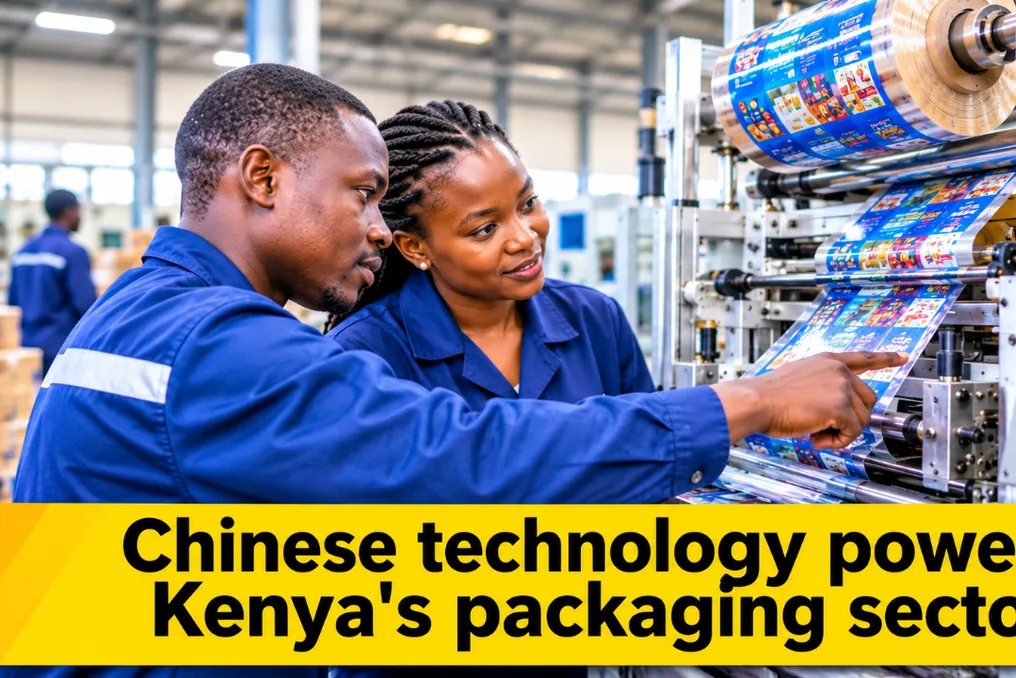
Today, Chinese equipment forms the backbone of the factory's operations, handling the tasks of printing, processing, and cutting packaging materials. Omari emphasized: 'In fact, 99% of the machines are from China. Furthermore, the raw materials are also from China, such as CPP and PET,' adding that other materials are sourced from Saudi Arabia.
The collaboration goes beyond mere equipment supply. Engineers from China visited Kenya to install and commission the machinery, ensuring the operational readiness of the production systems before handing them over to local staff. She explained: 'They sent the machines along with their mechanical engineers who installed each machine and ensured the machines were working before leaving the country.'
These investments have strengthened local manufacturing capabilities and reduced the region's reliance on sourcing packaging from distant suppliers.
Automation Boosts Efficiency and Skills
Inside the factory, machines handle the printing, processing, and cutting of packaging materials, while workers monitor the process and inspect the finished goods. This technology has automated tasks previously done manually, contributing to improved efficiency and production stability.
Eric Onyango, the company's production manager, noted that modern equipment has transformed daily operations. He said: 'Now you just turn on the machine, and the knife cuts. So it makes the job easier compared to how we used to do it manually.'
However, operating complex equipment requires technical knowledge, especially when dealing with various packaging materials and maintaining production systems. Onyango traveled to China in 2025 to acquire additional equipment as part of the company's expansion.
His experience reflects the growing importance of technical cooperation in assisting African producers in adopting modern industrial technologies. Beyond increasing productivity, such investments open up opportunities for workers to develop skills in machine operation, maintenance, and quality control.
Packaging Strengthens Value Chain Production
Although packaging is often the final stage of production, it plays a crucial role in determining how goods reach the consumer. For food processors, it helps maintain quality and protect goods during transport. For manufacturers and retailers, packaging enhances branding and product identification.
Henry Koski, assistant branch manager at Kipchimatt, a retailer in western Kenya, asserts that packaging allows consumers to distinguish products from competing brands. He stated: 'Packaging identifies goods from one producer to another and one company to another.'
He cited tea and sugar products from Kipchimchim Group of Companies as an example of how packaging supports brand recognition. IBS Pack Prints supplies packaging for bread, tea, sugar, water, ice cream, confectionery, and beans, as well as materials used by hospitals and pharmaceutical companies. The company's diverse clientele demonstrates the industry's contribution to agriculture, food processing, healthcare, and retail.
As Kenya expands local production and adds value to agricultural products, reliable packaging will remain indispensable for enterprises aiming to enter broader markets.
Challenges and Growth Opportunities
Despite technological progress, packaging manufacturers face difficulties, including high equipment costs, imported raw materials, and unreliable power supply. At IBS Pack Prints, power outages can disrupt production and necessitate restarting machines. Onyango explained: 'The problems we face mainly occur during voltage spikes. This machine is designed so that when the electricity goes out, everything stops.'
Such failures can slow down production and increase operating costs, highlighting the importance of reliable infrastructure. Nevertheless, the demand for packaging continues to create opportunities for industrial investment. Access to Chinese equipment provides Kenyan enterprises with the ability to modernize production, develop technical skills, and strengthen manufacturing capacity.
In Kisumu, IBS Pack Prints demonstrates how trade relations between China and Africa are translating into practical industrial development. As Kenya strives to expand local production and add value to domestic products, packaging becomes a vital link between technology, production, and market access.