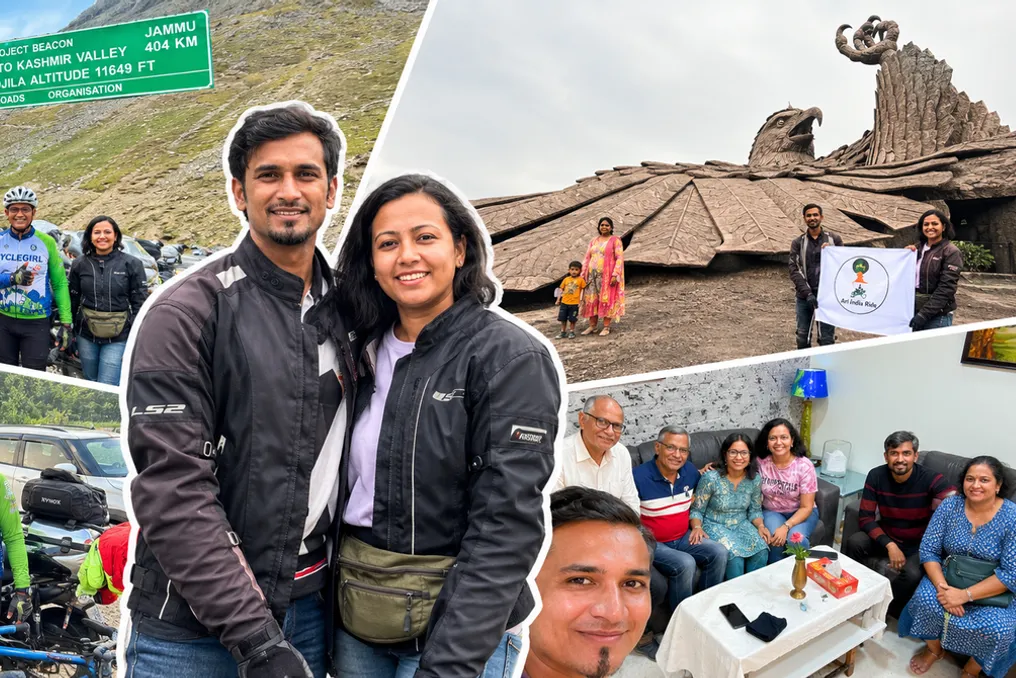
After losing their jobs in the corporate sector in 2024, Samrat Ulhas Dambe and his wife Varshali Samrat Dambe faced an uncertain future. Both had previously worked in the corporate environment, following a routine schedule. They were both laid off around June of that year, leaving them with several months without a clear plan.
During this period, they began contemplating a long-held dream: to travel across the borders of India by motorcycle. This idea had been with Samrat since he was 12 years old, when he drew the outline of India and imagined riding along its borders. Over time, it became a shared dream for the couple. They had been traveling together since 2018 and acquired a Benelli TRK motorcycle in 2022, hoping for longer adventures.
Deciding to undertake the trip, which they named 'Art India Ride,' they set off on September 19, 2024, from their home in Mhaprale, a village in the Ratnagiri district of Maharashtra state, approximately 150 kilometers from Mumbai. They planned to spend the next 80 days covering a distance of 16,428 kilometers, traversing 22 states and four union territories, passing through deserts, mountain passes, remote border settlements, and unfamiliar roads.
They returned home on December 8, 2024, completing a journey that initially seemed unattainable. In January 2025, their achievement was recognized by the Indian Record Book as an IBR Achiever 2025. However, the record was only part of the story; along the way, the couple faced freezing temperatures, a limited budget, and moments of doubt about whether to continue.
When the time finally felt right
Before the trip, Samrat worked as a digital marketing expert in a multinational company, while Varshali held the position of Digital Marketing Manager at a digital agency. Their lives revolved around work and standard plans for the future. The layoffs in June 2024 brought them uncertainty, but also something they hadn't had before—time.
The man told The Better India: 'Suddenly we had three to four months, and we didn't know what to do next.' He noted that it was an uncertain phase that they began to view as an opportunity to realize a long-held desire.
Samrat's dream of traveling across India's borders never faded. The couple had been traveling together for many years, and the idea of exploring the far corners of the country seemed like a natural next step. By August, they decided to set off, even though their savings were insufficient to guarantee completion of the entire route. Initially, they thought they could only cover half of India, but they did not want to postpone the dream until their financial situation improved.
Varshali added: 'If we waited for the perfect financial moment, we knew life would intervene, and the dream might fade. We decided to start and see how far our resources would take us.' Changes occurred before departure: they initially planned to head south, but heavy rains in South India forced them to change their route. Eight days before the start, they decided to begin in Gujarat and travel clockwise around the country.
Five bags and a stretching budget
The couple understood that completing the journey would require careful spending. The average fuel consumption of their Benelli TRK motorcycle was about 20 km per liter, making fuel a significant expense. They set a daily limit of 3,500 rupees for fuel, food, and accommodation, and tried to keep accommodation costs between 1,000 and 1,500 rupees per night.
They ate at small local eateries and maintained a simple lifestyle during stops. The couple did not have a detailed day-by-day itinerary; instead, they usually decided on the next destination and route only one or two days in advance. Varshali explained that they aimed to maintain flexibility, as weather, road conditions, and accommodation circumstances could change their plans at any moment.
Packing also became an exercise in deciding what could be left behind. Over 80 days, all their belongings fit into five bags. Each had a side pouch for clothing and personal items. The top compartment carried a laptop, cameras, electronic equipment, and a basic tool kit. The trunk held phones, documents, and essentials, while an extra bag contained winter clothes and raincoats. Samrat noted that traveling with such minimal belongings taught them that they didn't need as much as they thought.
Finances were always part of the calculations. Fuel, food, lodging, and motorcycle maintenance had to fit within their means. They also agreed that if their savings dropped to 40,000 rupees, they would return home and start looking for work. This contingency meant that every stretch of road was accompanied by the question: could they continue? Would the weather help? Where would they sleep tonight?
The road tested them before rewarding them
Their route passed through Maharashtra, Gujarat, and Rajasthan, then Haryana and Punjab, Jammu and Kashmir, Ladakh, and Himachal Pradesh. They continued through Chandigarh, Uttarakhand, Uttar Pradesh, and Bihar, before reaching West Bengal and Sikkim. From there, they traveled through Assam, Arunachal Pradesh, and Meghalaya, and then along the eastern coast through Odisha, Andhra Pradesh, Tamil Nadu, and Puducherry. After reaching Kanyakumari, they turned back north through Kerala, Karnataka, and Goa, concluding their journey in Maharashtra.
The first few days were harder than they expected. Near Santalpur, on the border of Gujarat and Rajasthan, they crossed a long isolated stretch without seeing a soul. A storm approached, the power went out, and the area started to feel unfamiliar. The only hotel they could find was surrounded by parked trucks, and only truck drivers stayed there.
Samrat began to feel anxious and wondered if they should turn back. Varshali urged him to continue. It was a difficult moment not because the couple suddenly stopped believing in their dream, but because they realized what it meant to pursue it without knowing what lay ahead.
Ladakh presented another set of challenges. They arrived in the high-altitude region in October, as the tourist season was winding down, and many hotels were closed. Near Pangong Lake, the temperature dropped to minus 12 degrees Celsius. They had never traveled to Ladakh before and did not fully anticipate how harsh the conditions could be. Poor network coverage, difficult roads, and the remoteness of some sections increased their anxiety. They also worried about potential motorcycle tire punctures in areas where help might be hard to reach.
In Upshi, the cold became particularly severe for Varshali, who was shivering. Eventually, a local Maharashtrian helped them find a room with a heater. This experience taught them to adapt quickly, care for each other, and accept help when needed. There were no guarantees that the next day would be easier, but they learned to handle one problem at a time.
Strangers who made them feel at home
For the couple, the most memorable moments of the journey were related to the people they met, rather than the places they saw. In Punjab, a family welcomed them into their home and insisted they stay as guests. In Tawang, Arunachal Pradesh, a woman from Maharashtra living there offered them prayers and blessings for the journey ahead, greeting them with a traditional Tibetan white shawl.
In Bhulukpong, they met an elderly couple running a cafe. The two travelers formed a warm bond with the uncle, who treated Samrat with affection he might show to his own son. When the couple returned to see him on their way back, he was upset when they prepared to leave.
Thousands of kilometers from home, they found people willing to give up their place, share what they had, and offer support without expecting anything in return. Their journey also gave them a deeper insight into life in remote border areas and the work of the Indian Army and Border Security Force. They left with a deeper understanding of people living in difficult conditions and those who serve in them.
The man explained: 'Before the trip, India was a map of different states, languages, foods, and cultures. After covering 16,428 kilometers, it felt like one big, caring family. The warmth we received from people remained largely the same, no matter where we went.'
One encounter in North Bengal showed how far the journey can extend beyond the participants themselves. Traveling from Sikkim to Jaigaon in West Bengal, the couple stopped at a small shop for breakfast. A group of people arrived by car and noticed the Maharashtra registration plate on their motorcycle. Curious about how far they had traveled, they invited the couple to sit with them and talk. The conversation lasted almost two hours.
One of the men, Arun Sarkar, a corporate worker from Kolkata, explained the reason for his numerous questions. 'It used to be my dream. I moved to the USA, worked hard, and bought a luxury BMW because I wanted to travel. My wife and I wanted to live a life on the road like you. But somehow life intervened, and we got stuck,' he said. He had traveled across the United States but had never experienced his own country like the couple had. 'You are living my dream, brother. Thanks to your journey, I feel like I am traveling too,' he told them.
These words touched Samrat and Varshali. Their trip started as a personal aspiration, but here was someone who connected with it because it represented a life he once envisioned. Sarkar and his wife invited the couple to their home. His wife cooked a vegetarian feast, although she hadn't cooked vegetarian food before, and they invited friends to hear about the journey. The couple was also provided with a room for the night.
For the traveling friends, this connection served as a reminder that a journey can mean something to people who never rode the same road.
What the road taught them
Kaushal Sethia, a 26-year-old software engineer from Surat, met the couple in Naggar, Himachal Pradesh, where they were neighbors in a guesthouse. They spent almost a month together and became close friends. When the duo began their border expedition, Sethia and his family followed their progress and regularly asked for updates.
He was impressed not only by the distance covered. 'The way they support each other makes the journey special. It tests you physically, mentally, and emotionally. The hardest part of the journey is the beginning, and they didn't just start it. They completed it despite all the problems,' he said.
The 80 days also tested the couple's relationship. Sharing a motorcycle, limited belongings, and constant uncertainty required joint decision-making, managing fatigue, and adapting to changing conditions. They learned to recognize when one of them needed support, rest, or a little personal space. For Samrat, riding also...
{