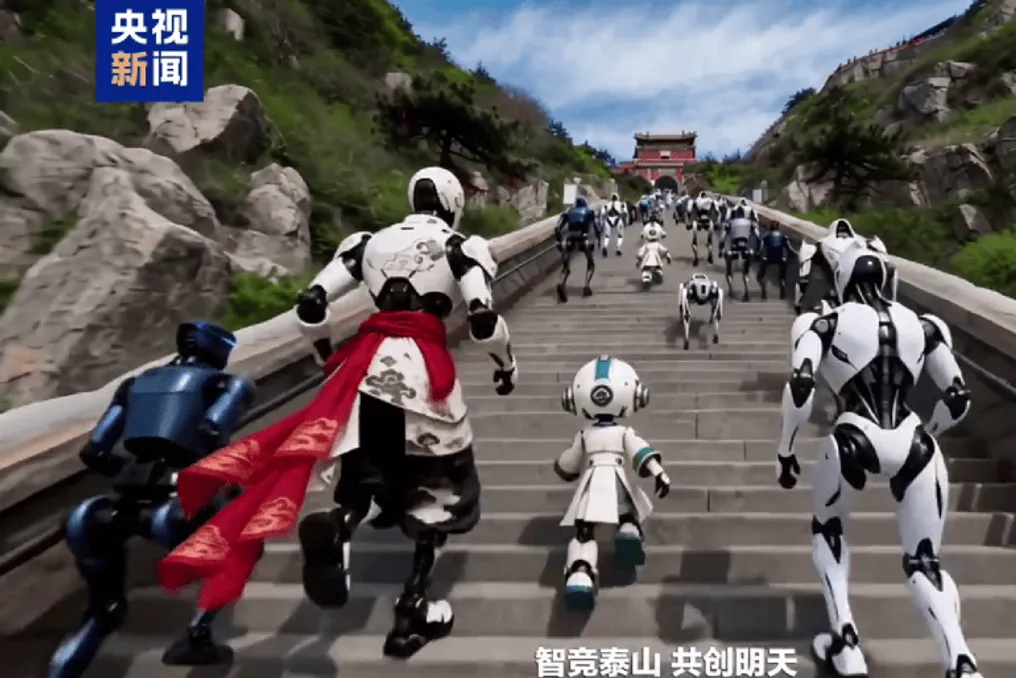
Although the idea of robots climbing Tai Mountain might have seemed like science fiction, it has become reality. On Monday, the first-ever competition by Chinese Media Group for robot ascent of Tai Mountain in Tai'an City, Shandong Province, concluded.
The event featured robots from over fifty companies specializing in embodied artificial intelligence, as well as universities and research groups from across China. They navigated a 3.9-kilometer mountain route stretching from Hunmen to Zhongtianmen.
This event was presented as the world's first professional robotics competition held in mountainous terrain that is a UNESCO World Natural and Cultural Heritage site (United Nations Educational, Scientific and Cultural Organization).
This test was not limited to simple walking on flat surfaces. The route included over 3,100 stone steps and a total elevation gain of nearly 600 meters, passing by several famous landmarks along the mountain trail, such as the Wangxian Tower, Dumou Palace, and the Valley of Stone Sutras.
The steps varied in height and width, and the uneven surfaces and changing slopes significantly increased the complexity of the task. Robots had to navigate not on smooth laboratory floors or carefully controlled testing environments, but on a real mountain trail. Organizers characterized this route as a natural proving ground for testing the limits of embodied AI systems.
The competition included four separate disciplines: humanoid robot races, quadruped robot races, quadruped robot load testing, and powered exoskeleton assistance. Additionally, there was a separate competition for off-road mobility and pathfinding. All events were broadcast via the multimedia platforms of the Chinese Media Group.
Analyzing the results, quadruped robots demonstrated particularly strong performances. In the quadruped robot race, the robot from Beijing Lingyi Technology, a subsidiary of Unitree Robotics, won, finishing in 43 minutes and 41 seconds. Second place was taken by the Shanghai Gaoyi Technology team, which also used Unitree robots, and third place by the Lingju team from Linxai Intelligent.
In the load testing phase, the focus was on endurance and sustained performance. The first place was secured by the Lingshi team from Linxai Intelligence, completing the task in 1 hour, 51 minutes, and 29 seconds. They were followed by teams from Shanghai Gaoyi Technology and Shenzhen Technology University.
The humanoid robot race presented a different set of challenges. Due to the complex terrain, the race section was adjusted to cover the stretch from Hunmen Square to Dumou Palace. The Zhishen Lingyue team took first place in this race, taking 27 minutes and 26 seconds.
However, beyond the race results, the significance of this competition lies in demonstrating the technical limitations of robots operating in real-world conditions. In laboratories, robots usually operate on standardized surfaces in a controlled environment, whereas Tai Mountain presented a completely different picture.
The uneven steps required more precise terrain perception and gait planning, while the continuous ascent tested dynamic balance and joint control. Prolonged operation at high intensity also placed significant strain on motor cooling, battery life, and overall system stability.
Robots also had to cope with unexpected obstacles, autonomously avoid them, and recover independently after losing balance or falling. All these capabilities become critically important when machines move beyond controlled environments.
During the event, some robots experienced motor overheating, automatic power reduction, and lateral posture deviations. Some robots participating in load testing also showed unstable gait after changing payloads at supply points.
While these issues might seem minor from a racing perspective, they highlight the engineering difficulties that quadruped robots still face during long-distance travel, heavy load transport, and navigation in complex terrain.
Ultimately, the ability to walk confidently on a flat surface does not mean a robot is ready for outdoor work. Maintaining stability on uneven terrain, balancing payload capacity with battery life and movement efficiency, and autonomous adaptation to unforeseen situations are key tasks that embodied AI must solve before moving from impressive demonstrations to practical application.
The event also included the Tai Mountain Embodied Intelligence Industry Summit, a robotics industry chain exhibition, and an investment partner search event. These activities provided a platform for exchanging ideas, showcasing products, and seeking potential partnerships between companies, research groups, and investors.
The essence of the event was more than just organizing a robot climbing competition. The harsh trails of Tai Mountain offered a rare environment for real-world testing, where robots could collect operational data during prolonged ascents, in complex terrain conditions, and over extended periods of operation.
The results obtained may serve as a guide for future product development and provide valuable insights into the potential use of humanoid and quadruped robots in specialized inspection, mountain rescue, and outdoor transport.
As robots master Tai Mountain, the competition in embodied AI is increasingly shifting from laboratory demonstrations to real-world performance. The next challenge for these machines is not simply proving their ability to walk, run, or climb, but demonstrating the ability to perform tasks reliably and consistently in complex environments.