UAE AI Minister Al Olama predicts industry consolidation around major players
Read more
Khaleej Times
www.khaleejtimes.com

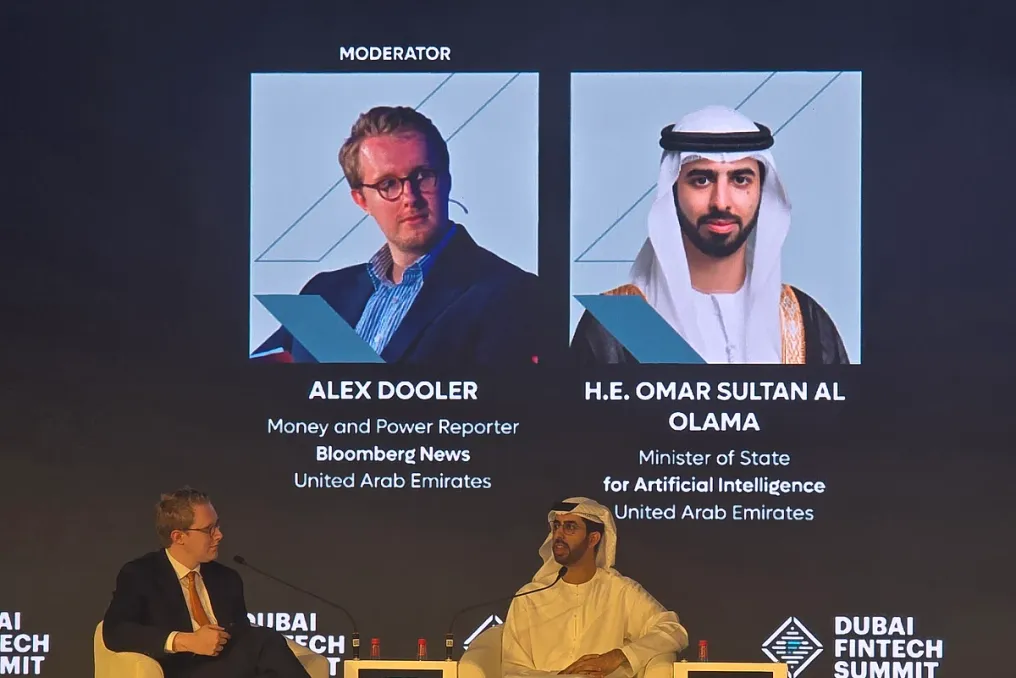
UAE AI Minister Al Olama predicts industry consolidation around major players

The UAE Minister of Artificial Intelligence, Omar Al Olama, stated that in the medium term, companies will 'consolidate into several larger players,' with each company leading in its specific field of artificial intelligence.

He noted that multi-billion dollar companies specializing exclusively in AI and life sciences are expected to emerge. In the financial sector, for instance, certain participants will appear focused on specific levels of finance, whether it be insurance, investments, or other areas.

Al Olama added that in the short term, AI will change the social and economic structure, but in the long term, it will become a powerful catalyst for countries like the UAE. He explained that due to the scale of the UAE economy and the country's demographic composition, AI will act as a 'catalyst.'

According to him, the long-term development trajectory is only upward, and this technology could become the internet of the coming era or something else that completely transforms people's lives, and he is not concerned about the long-term consequences.

Recently, the rating agency Fitch reported that the rapid growth of investment in the AI sector continues to create risks for central credit. The Minister emphasized that AI volatility will persist because it is a new technology, comparing it to past technologies that experienced 'booms' and 'busts,' such as the dot-com bubble in the late 1990s and early 2000s, when the Nasdaq index fell by 77 percent from its peak.

Al Olama also announced that after the UAE and the region exit the conflict, which still threatens amid renewed military actions, the UAE will establish standards classifying data centers as 'critical infrastructure' that cannot be attacked during military confrontation.

Addressing the audience at the summit, he said that the conflict has affected some plans, but not in a negative way, merely forcing them to plan differently. He added that no short-term shocks will affect long-term thinking, asserting that when problems arise, they do not allow it to influence the view of the future, but rather strengthen the direction of movement, allowing them to make leaps forward.

The Minister mentioned that most countries in the world are undergoing scrutiny over decisions to invest in data centers, leading to a loss of options for some politicians. Al Olama called this topic a 'taboo' in other countries, but in the UAE, they are actively increasing infrastructure construction.

Similar stories

Raghavan from IBM asserts that AI will create more software and change developer roles
Read more
business-standard.com

Raghavan from IBM asserts that AI will create more software and change developer roles

Sriram Raghavan, General Manager of IBM Software India and Software Innovation Lab, stated that artificial intelligence (AI) agents will accelerate the software creation process and transform developer functions. He also emphasized the necessity for enterprises to strengthen cybersecurity, governance, and personnel skills.

According to Raghavan's estimates, up to two billion AI agents could eventually be deployed globally, with AI writing half of all code. He clarified that the proliferation of these agents will not lead to the disappearance of software development but, on the contrary, will trigger the creation of significantly more software, fundamentally changing developers' work and technology building methods in companies.

At the IBM Think event in Mumbai, Raghavan told Business Standard that there is likely to be an increase in the volume of software produced. He noted that AI has already caused significant changes in software development concerning team organization, workflow management, and the software creation process itself.

The role of the developer is undergoing a fundamental shift: instead of writing code, specialists are now engaged in monitoring, verifying, and critically evaluating the results generated by AI. Raghavan stressed that this is a skills change requiring different training for developers.

He compared this trend to the automation of electronic design in the semiconductor industry. According to him, automation has allowed engineers to develop increasingly complex chips without eliminating the need for hardware engineers. Raghavan expects a similar transformation in the software sphere, where automation will enable the creation of more applications but will require new competencies.

Expertise in this area is now focused on verification, validation, strategy definition, setting constraints, and directing AI to perform the correct tasks. Raghavan believes that this is the direction software engineering is moving. He predicts that more software will be produced in the next two to three years than ever before, as innovation opportunities have become unprecedented, and value now lies in ideas and their implementation, rather than in the creation of code itself.

Nevertheless, Raghavan warned that the growing use of AI will not diminish the importance of fundamental engineering skills; on the contrary, judgment and core skills are becoming even more important.

Responding to questions about recent security issues related to new AI models, Raghavan stated that the adoption of AI is radically changing the cybersecurity landscape. He noted that one must think about cybersecurity in a completely different way because of AI. Raghavan emphasized that proactive, continuous integration of best practices and technologies into vulnerability management and risk prioritization based on AI is vitally necessary. He added that the company's proposals reflect this approach, insisting on the need to integrate AI into defense alongside concerns about AI misuse.

Regarding risks associated with unintended actions by AI agents, Raghavan advised enterprises to implement stricter controls over agent identifiers, permissions, and access to internal systems. Agents should only be granted the minimum necessary permissions to perform a specific task, rather than broad access to all corporate systems. He explained that an agent only needs a certificate and a token to perform an action on behalf of a user for 30 seconds. Furthermore, he highlighted the importance of constant monitoring, as AI systems do not always behave predictably, unlike traditional software.

AI Adoption in India

Referencing an IBM study conducted jointly with MeitY earlier this year, Raghavan reported that only about 15 percent of Indian enterprises have reached the stage of scaling AI adoption, while the remaining 85 percent continue to face difficulties. Companies that successfully scale AI have moved beyond isolated use cases and are integrating the technology across their entire structure.

According to Raghavan, approximately 15% of enterprises are truly scaling AI, meaning they have passed the stage of implementing one case that was integrated into the organization and may be moving to a second or third case. For the remaining companies, the main obstacles remain data governance, corporate governance, and a shortage of skilled personnel.

New Indian manufacturers could benefit from the $3 trillion global AI investment cycle
Read more
yourstory.com

New Indian manufacturers could benefit from the $3 trillion global AI investment cycle

According to a report by Avendus Capital, India's modern manufacturing sector is poised to gain significant benefits from the global artificial intelligence infrastructure investment cycle, which is estimated at $3 trillion.

The investment bank identified sectors such as aerospace and defense, space technology, robotics and automation, semiconductors, energy transition and advanced materials as those that will drive the next phase of India's industrial growth, opening opportunities for local companies.

The report emphasizes that the period of 2027–2028 is critical for commercialization, as companies transition from receiving policy support and project approvals to actual production.

This potential is driven by increased global investments in AI infrastructure, growing demand for energy infrastructure, and intensifying geopolitical security concerns. India's domestic demand, engineering talent, and regulatory framework can help manufacturers reduce import dependence and form globally competitive opportunities.

Koushik Bhattacharya, Managing Director and Head of Industrial Investment Banking at Avendus Capital, noted that 'the opportunity for modern manufacturing in India is substantial, but its right to win lies in specific segments.'

He added that since more than 80% of the $3 trillion in AI infrastructure investments have not yet been distributed globally, India has a chance to leverage its domestic demand base, engineering capabilities, and policy support.

Among the segments showing significant growth potential are semiconductors and space technology. Semiconductor consumption in India is projected to more than double: from $49.5 billion in 2025 to $106.5 billion by 2030, creating opportunities in chip design, packaging, testing, and specialized materials.

India's space economy is expected to grow more than threefold—from approximately $13 billion in 2025 to $44 billion by 2033. Domestic defense production should reach about $31.6 billion by 2030, while the robotics market could increase almost fourfold, reaching $4.6 billion by 2030, due to wider adoption and import substitution.

Furthermore, the report forecasts a further advancement of the clean energy manufacturing ecosystem in India up the supply chain over the next five years. By the end of the decade, the country could establish an integrated solar energy production chain, covering everything from ingots to modules, as well as gigawatt-hour scale battery cell factories and commercial production of domestic electrolyzer stacks and rare-earth-free motors.

Advanced materials represent another emerging opportunity; growing domestic demand and strong import dependency create room to build local capacity. Recycling is expected to expand first, followed by battery materials, and the production of rare-earth magnets may advance with policy support.

In conclusion, the report notes that the coming years will test India's ability to transform these opportunities into commercially viable manufacturing capacities.

How the UAE is building AI potential through infrastructure and talent despite its small size
Read more
www.khaleejtimes.com

How the UAE is building AI potential through infrastructure and talent despite its small size

Artificial intelligence is increasingly perceived as a competition intended for very large states. According to Stanford University's AI Index for 2026, private US investments in AI reached nearly $286 billion last year, more than 23 times the figure in China.

Training and launching advanced models requires enormous computational infrastructure, expensive chips, electricity, and a relatively small pool of highly skilled specialists. Nevertheless, two countries with populations and domestic markets significantly smaller than these two global powers have managed to position themselves unusually close to the center of this race.

The United Arab Emirates (UAE) is channeling significant capital into developing computational infrastructure, models, and international technology partnerships. Singapore, meanwhile, has spent years building a digital government, AI governance mechanisms, a research base, and one of the most concentrated pools of AI talent.

According to Spring Fu, Managing Director of the Mohammed bin Zayed University of Artificial Intelligence Academy, attempting to fully replicate the technology ecosystem of America or China is not a realistic goal. She argues that a medium-sized country cannot expect leadership in all areas but can leverage its size as an advantage in specific fields.

You Cannot Win Everywhere

For small states, this means accelerating government operations, concentrating resources on chosen capabilities, and becoming valuable partners within the AI ecosystem, which is not controlled by any single country.

The UAE's most notable bet is on computing power. Plans include creating the Stargate UAE computing cluster, with a capacity of one gigawatt, as part of a broader UAE-US AI campus totaling five gigawatts in Abu Dhabi. The project is being implemented by G42, with OpenAI and Oracle managing it, and Nvidia supplying the advanced chips. The first phase, with a capacity of 200 megawatts, is expected to go live this year.

Singapore faces a different physical reality. It already possesses over 1.4 gigawatts of data center capacity, but the island nation is constrained by land resources and a tropical climate that makes cooling energy-intensive. Data centers consume about 7 percent of national electricity, according to its Infocomm Media Development Authority. Instead of unlimited expansion, Singapore selects new capacity based on energy efficiency and strategic value.

This comparison demonstrates why there is no single formula for becoming an AI powerhouse. Abu Dhabi can use land, energy, capital, and geopolitical partnerships to create colossal computing infrastructure, whereas Singapore must derive maximum benefit from stricter physical limitations.

Both countries are heavily dependent on access to the outside world. Fu emphasizes that for a small state, international partnership is not an addition to national capability but an integral part of its construction, concerning access to chips, joint research, and attracting major international companies.

This dependency is not necessarily a weakness, as even the world's largest AI ecosystems rely on international supply chains for chips, manufacturing equipment, energy, models, and expertise. The question for small states is what capabilities they need to control independently and what they can reliably obtain through partners.

Fu believes that people are a more serious constraint. She notes that computing power can be bought or created, and capital can be quickly directed, but without people capable of utilizing this infrastructure, launching AI systems within organizations, and making informed decisions as regulators and buyers, investments remain unused.

Her definition of AI talent goes beyond a few elite researchers. The country needs not only these researchers but also many more engineers and practitioners capable of implementing technologies, as well as another group that receives less attention: leaders who understand AI well enough to decide where and where not to apply it.

Singapore offers one such strategy. Last year, it had the second-largest concentration of AI talent in the world, with 1.82 percent of LinkedIn users classified as AI talent in the Stanford index. Currently, the country aims to train 100,000 workers to become 'AI bilingual,' combining knowledge of their current profession with the ability to use AI, while helping 10,000 enterprises deepen adoption over the next three years.

The UAE is also moving quickly in this direction. Stanford found that the concentration of AI talent in the country grew by 121 percent between 2019 and 2025, the fastest growth among measured countries. The federal government is also collaborating with MBZUAI to develop expertise in agentic AI among 80,000 civil servants, including senior management and non-technical positions.

Fu's own program is a smaller example of this third level. Twelve UAE leaders spent five days in Singapore in September, studying the country's approach to AI policy, industry, governance, and talent, meeting with government bodies, multinational corporations, and local companies. The goal was not to train them in engineering but to enhance their decision-making capacity regarding the technology.

This exchange became part of a broader relationship. A few days later, the Abu Dhabi-Singapore Joint Forum identified AI and capacity building as areas where cooperation between the two parties would expand.

Perhaps the more complex question is how to determine if all this investment volume has yielded anything long-term. Fu notes that 'activity is easy to generate: announcements, pilots, startups, and signed conference partnerships. But seeing and imitating it is harder.'

Her criteria are more demanding: Is AI working within core government and industry operations, or is it remaining in innovation labs? Can the country develop and retain the necessary personnel? Are procurement rules, data systems, regulators, and testing standards mature enough for large-scale deployment? And will these capabilities withstand changes in technology, leadership, and funding?

Singapore is increasingly focusing on this less visible institutional level. Its National AI Strategy was updated this year, and the National AI Council was established in February, chaired by Prime Minister Lawrence Wong. Its AI governance work has also shifted towards agentic systems, updating frameworks this year based on feedback from over 60 organizations and examples of agents already operating within companies and governments.

Meanwhile, Abu Dhabi is actively integrating AI directly into the government. Last month, its Executive Council used an agentic AI platform for the first time to support analysis and discussion during a session chaired by Crown Prince Sheikh Khaled bin Mohammed bin Zayed Al Nahyan.

It is here that the argument about small states becomes more interesting than just counting data centers or investment announcements. Neither Singapore nor the UAE can compare with the United States in private capital or with China in industrial scale. Their bet is that they do not need to.

For small countries, AI potential may depend on carefully selecting what to build, developing sufficient people to use these technologies, having institutions move fast enough to implement them, and maintaining relationships that ensure access to everything else. A data center without talent is infrastructure. Talent without computation is potential. Partnerships without institutions to utilize them remain mere announcements. The hardest achievement is turning all three into real opportunities.

Popular