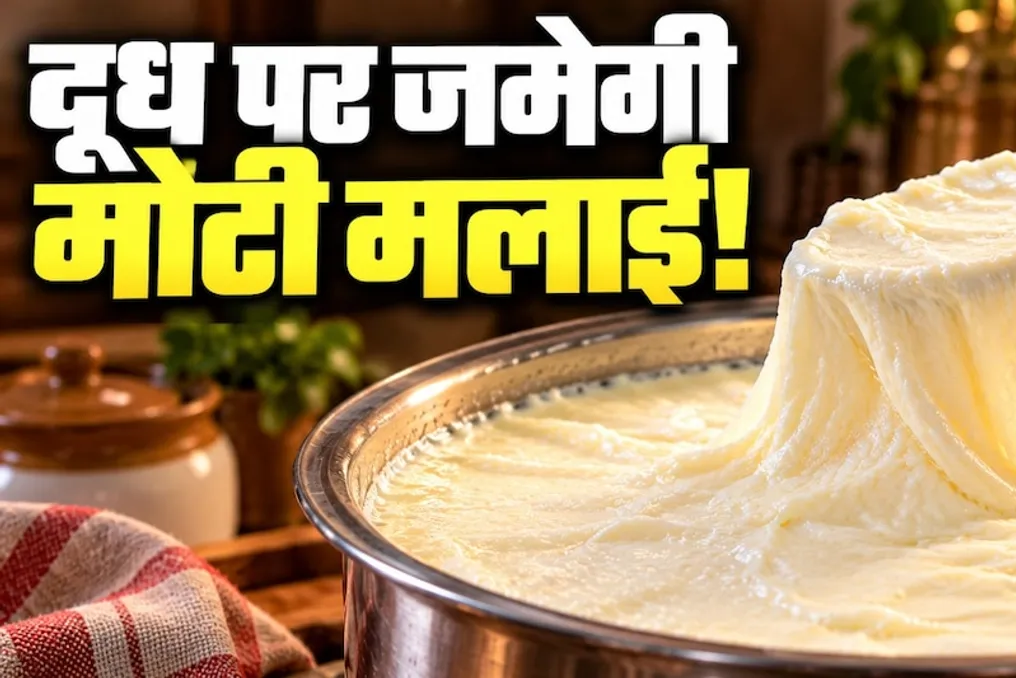
Many people enjoy consuming thick cream that forms on the surface of milk. Some use it to make homemade clarified butter (desi ghee), while others prefer to eat it with paratha or roti. However, sometimes, even after boiling milk, a thick layer of cream does not form on the surface. People often mistakenly believe that the reason lies in the quality of the milk itself, assuming that water was added to it.
Nevertheless, there are many factors influencing the formation of thick cream besides the quality of the milk. The formation of cream is related not only to the product's quality but also to the method of boiling, fat content, and cooling method. By following a few simple rules, you can achieve the formation of good cream from milk.
To get quality cream to form on milk, you need to properly organize the heating process. For this, you should use clean and deep cookware so that the milk does not spill during boiling. The milk should be heated over medium heat, stirring it occasionally with a spoon so that it does not burn to the bottom.
When the milk boils, you should reduce the heat and let it simmer for a while. There is no need to boil it constantly over high heat.
The amount of cream that forms on milk directly depends on its fat content. If the milk has little fat, the amount of cream obtained may also be small. Generally, whole milk contains more cream.
Therefore, if your goal is to obtain thick cream, be sure to check the fat percentage of the milk when purchasing. Simply boiling milk for a long time does not guarantee the formation of thick cream.
Cooling the milk after boiling is also very important. Sometimes people continue to stir the milk with a spoon or mix it during the cream formation process. Such actions can lead to the destruction of the cream layer forming on top.
Therefore, after boiling, the milk should be placed in a place where it will not move frequently. To protect it from dust, cover it with a clean lid. Let the milk cool down, avoiding constant stirring. This promotes better formation of thick cream.
After the milk cools, it should not be left at room temperature for long, as it can spoil quickly in hot weather. Therefore, the milk should be properly cooled and promptly placed in the refrigerator.
If you want the cream to be thick and high quality, try not to take the milk out of the refrigerator and do not stir it with a spoon. Additionally, store the milk in clean cookware in the refrigerator and use it promptly.