A recent article published in the scientific journal The Astrophysical Journal Letters presents striking data obtained by NASA's James Webb Space Telescope. The study revealed that the interstellar comet 3I/ATLAS is composed of ice crystals mixed with dust, which differs from the composition of comets originating from the Solar System.
This object, which was observed as it entered the vicinity of our Solar System in July 2025, is only the third visitor object to arrive from distant regions of the Milky Way, following the historical passages of asteroid 1I/’Oumuamua and comet 2I/Borisov. Due to this rarity, the global scientific community utilized Webb's infrared instruments for detailed tracking of this celestial body's trajectory.
The team led by Silvia Protopapa, a researcher from the Southwest Research Institute (SwRI) in the United States, confirmed previous hypotheses that the traveler formed in a protoplanetary disk of gas and dust around a young star, possibly more than 10 billion years ago. This estimated age exceeds twice the age of the Solar System. According to the study, after formation, the body was ejected from its native system by gravitational forces and wandered alone in space for billions of years.
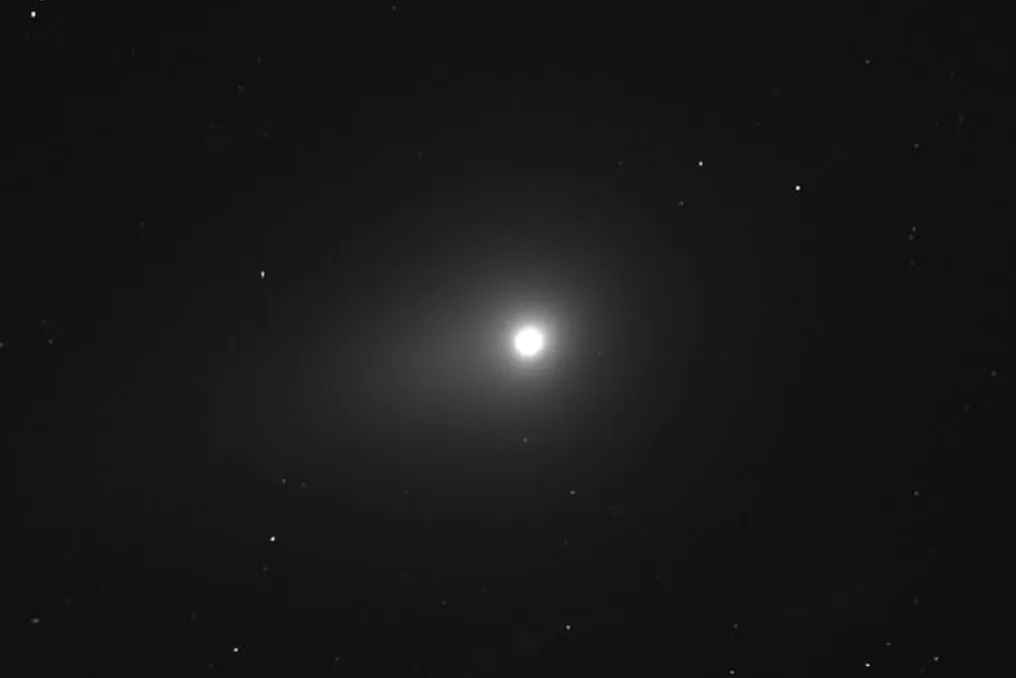
As happens with traditional comets orbiting our Sun, the star's heat causes gases on the surface to evaporate as the object approaches. This process ejects frozen materials and debris outwards, forming an extensive glowing cloud around the nucleus called a coma, and also drawing out a characteristic comet tail from which scientific instruments can extract compositional data.
Analysis of the light reflected by the gases of this celestial body revealed unexpected behavior. Comets born in the Solar System exhibit three distinct absorption bands of water ice in the light spectrum. However, measurements of 3I/ATLAS showed only one of these bands, posing a mystery regarding the true physical structure of the ice present in this visitor's cloud.
To unravel this mystery, scientists used computer modeling to reproduce the collected data. Virtual models demonstrated that the object consists of microscopic grains of water ice heavily coated with dust. In comets formed around our Sun, the ice is present in a significantly purer state with a very low level of dust contamination.
The ratio of dust mixed with icy grains serves as a kind of fossil record of the environmental conditions during the celestial body's birth. Since comets retain the raw material for star formation, studying this externally arrived body provides a unique opportunity to understand how other planetary systems formed in distant parts of the galaxy and to compare this process with the origin of Earth.
Despite differences from local comets, the interstellar object shares similarities with another group in the Solar System—trans-Neptunian objects, which are icy bodies located in the peripheral region beyond Neptune's orbit. These distant formations also possess large amounts of frozen carbon dioxide and carbon-rich organic compounds on their surfaces.
According to SwRI, other research has already indicated that 3I/ATLAS possesses one of the highest concentrations of carbon dioxide recorded by modern astronomy. This composition suggests that it formed in the most remote and cold regions of its original system, in dynamics very similar to those that led to the formation of trans-Neptunian objects in our own Solar System, revealing common patterns in planet formation.
Researchers even hypothesize that the traveler is a fragment formed by the collision and disruption of a much larger icy body in its home system. This discovery confirms that small dusty ice grains first aggregate in disks around young stars to form larger bodies, showing that the fundamental formula for creating worlds may be similar throughout the galaxy.