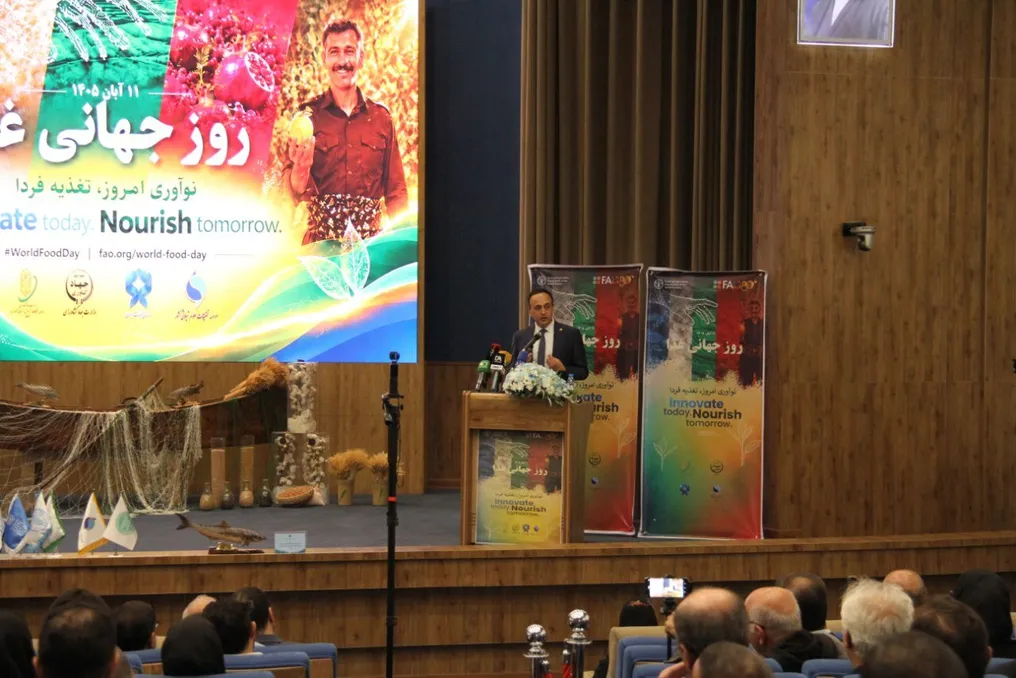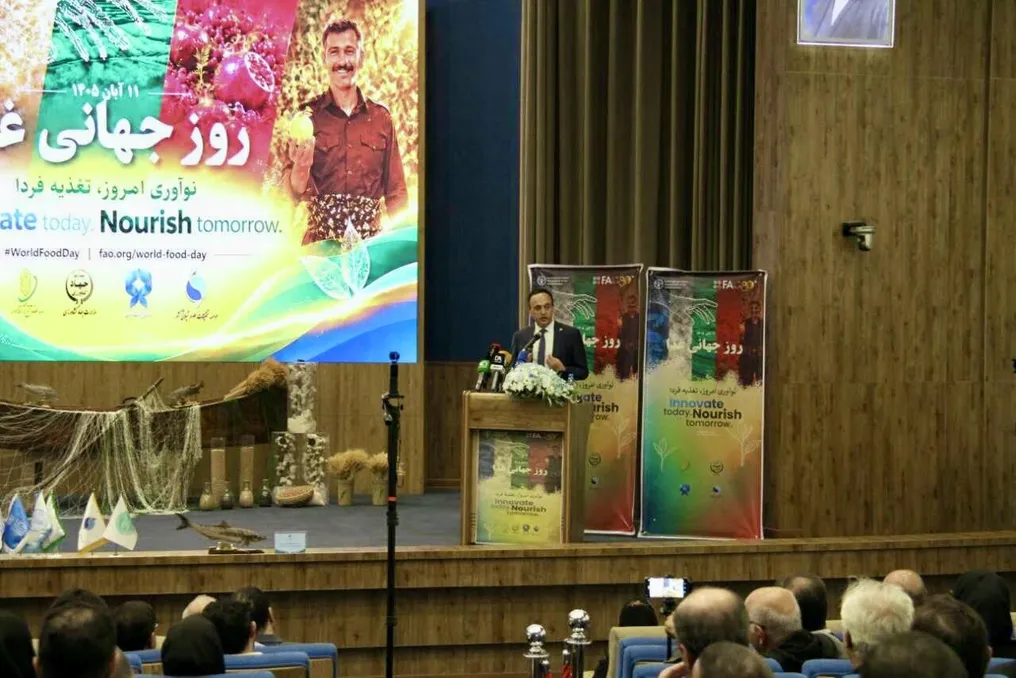
At the conference in Tehran dedicated to World Food Day, organized by the Agricultural Research, Education and Extension Organization (AREEO) and the Ministry of Agriculture, high-ranking officials emphasized the necessity of linking scientific research directly with the real needs of agricultural producers.
Golmohammadi Golmohammadi, Deputy Minister of Agriculture and head of AREEOC, stated that knowledge transfer to farms is a priority for the agricultural sector to achieve sustainable food security. He noted that agricultural research has moved beyond simply creating scientific papers and implementing projects, now focusing on solving farmers' problems, increasing resource productivity, and ensuring stable food supply for the population.
Golmohammadi pointed to serious challenges to global food security caused by climate change, water crises, resource scarcity, and rising production costs. Under these conditions, innovation is critical for maintaining production and enhancing agricultural resilience. Citing the FAO report on the state of food security in 2026, he reported that about 645 million people worldwide face difficulties in obtaining sufficient food, indicating that food access remains a global issue despite scientific progress.
He highlighted this year's World Food Day theme—'Innovation Today, Food Tomorrow'—stressing that innovations should not be limited to complex technologies. They also include adopting drought-resistant varieties, improving irrigation methods, scientific plant nutrition management, reducing damage from pests and diseases, and improving post-harvest storage. Innovations can effectively contribute to food security only when they solve producers' problems, reduce costs, and simultaneously increase yield and product quality.
In Golmohammadi's view, the future of food production depends on the development of knowledge and technology. Given limited water resources and growing environmental impact, research activities must be directed towards meeting the real needs of the agricultural sector. The success of agricultural research should be evaluated not only by the number of published works or technologies but also by how much each scientific achievement contributes to reducing water consumption, increasing yields, protecting basic resources, and producing safe food for consumers.
He mentioned that the current Iranian year 1405 has been declared the 'Year of Education and Extension' within this organization. The goal is to create conditions for transferring knowledge and technologies developed by AREEO, universities, and research centers to farmers and beneficiaries. He stressed the interconnectedness of research, education, and extension, noting that these three areas complement each other, and the organization's mission cannot be fulfilled without effective links between them. Researchers must first identify production problems and then propose scientific solutions that allow farmers to apply research findings in practice. Golmohammadi reported that AREEO has abandoned research conducted solely for publication or academic advancement, focusing its programs on targeted research, solving agricultural challenges, and increasing the impact of knowledge on production.
Golmohammadi illuminated the potential of modern technologies in managing agricultural production. He stated that the use of digital technologies, remote sensing, and artificial intelligence is a priority for AREEOC, and significant steps have been taken in this area over the past two years. In the Iranian year 1404, a Center for Monitoring Agricultural Production Patterns was established to develop, implement, and monitor cultivated areas using intelligent methods. As part of this system, the fifth version of the crop pattern for field crops was released this year. The first versions of production patterns for parts of aquaculture, greenhouses, and medicinal plants were also released. The development and release of production patterns for forest plantations and livestock based on land use planning are planned.
He also mentioned the development of remote sensing systems that allow for accurate assessment of cultivated areas and forecasting agricultural production approximately two months before harvest. These systems can serve as effective tools for production planning and managing the needs of the agricultural sector. These remarks reinforced the broader message that research and technology should be assessed by their practical impact on production, resource use, and farmers' livelihoods, not just by abstract academic results.
The FAO representative in Iran, Farrokh Toirov, also spoke at the conference, asserting that increasing agricultural production alone does not guarantee food security. It leads to food security only when all households have sustainable access to healthy, nutritious, and affordable food. He stated that innovations must transform scientific knowledge and practical experience into solutions that improve people's lives, strengthen food systems, and protect natural resources for future generations.
Referring to this year's theme, 'Innovation Today, Food Tomorrow,' the FAO representative noted that the world has made significant progress in agriculture, but the main task is transforming these achievements into sustainable food security and creating conditions for all people to have access to sufficient and healthy nutrition. Citing FAO data, he reported that global grain production reached approximately 3.1 billion tons in 2024, which is 27 percent more than in 2010. Nevertheless, higher production alone cannot guarantee sustainable household access to healthy, nutritious, and affordable food.
Toirov emphasized that food security is broader than just agricultural production. It encompasses four main dimensions: availability, access, utilization, and stability. Achieving food security requires simultaneous attention to these dimensions, public participation, and long-term protection of natural resources. He mentioned issues such as water scarcity, climate change, soil degradation, and limited arable land, stating that these problems require innovative solutions adapted to local climatic conditions and capabilities. He also said that traditional agricultural knowledge and practices are valuable public assets; the experience of past generations in managing complex environmental conditions, combined with new sciences and technologies, can provide effective solutions to today's problems.
The FAO representative stated that innovations must help increase resource productivity and strengthen producer resilience. Among measures that can improve agricultural productivity and protect ecosystems are improving soil health, precise irrigation planning, water resource accounting, developing early warning systems, and using satellite data and weather forecasts. He mentioned FAO and Iran's joint cooperation on water resource management, including work in the Lake Urmia basin to identify and test innovative methods combining underground irrigation systems with smart agricultural technologies. Remote sensing, precise forecasts, and digital information systems are being considered to enhance water efficiency in agriculture, supported by the sustainable restoration of the Lake Urmia basin.
He also mentioned other joint programs, including integrated pest management for date palms, conservation of endangered local livestock breeds, development of climate-adapted and nutrient-rich agricultural products, and sustainable water resource management. These efforts aim to increase productivity and sustainability in the agricultural sector. He stressed the importance of collaboration between scientific and executive institutions in transferring knowledge to producers. The Ministry of Agriculture, AREEO, universities, and research institutes play a vital role in connecting scientific research with extension services and must help farmers obtain solutions that are locally appropriate, cost-effective, and practical. He also emphasized the need to support communities affected by crises and restore livelihoods and strengthen the capacity of local communities to respond to emergencies as key factors in achieving sustainable food security.
The FAO representative's remarks underscored that food security cannot be reduced to a mere production target. Even with record or increasing food volumes, food systems can fail if households cannot access affordable, nutritious food, if supply chains are unstable, or if natural resources degrade. The four dimensions of food security—availability, access, utilization, and stability—require coordinated policy across production, trade, social protection, water management, and climate change adaptation.
In this context, innovations are understood broadly. They include not only advanced digital tools but also improved agronomic practices, better water accounting, early warning systems, climate-adapted crops, and enhanced extension services. Examples of FAO-Iran cooperation demonstrate how international technical cooperation can link remote sensing and smart irrigation with local restoration goals, especially in the ecologically sensitive Lake Urmia basin. Other programs on date palm pest control, conservation of local livestock breeds, and production of climate-adapted and nutrient-rich products reflect a similar logic: combining scientific expertise with local conditions and long-term sustainability.
The FAO representative also emphasized that traditional knowledge is not an obstacle to innovation but a resource. Farmers' experience and intergenerational knowledge of local conditions can complement modern science. This approach is particularly relevant for Iran, where diverse climates, water scarcity, and environmental stress demand locally adapted solutions rather than universal technologies. The overall message was that innovations should be judged by whether they improve livelihoods, strengthen food systems, and protect natural resources for future generations.
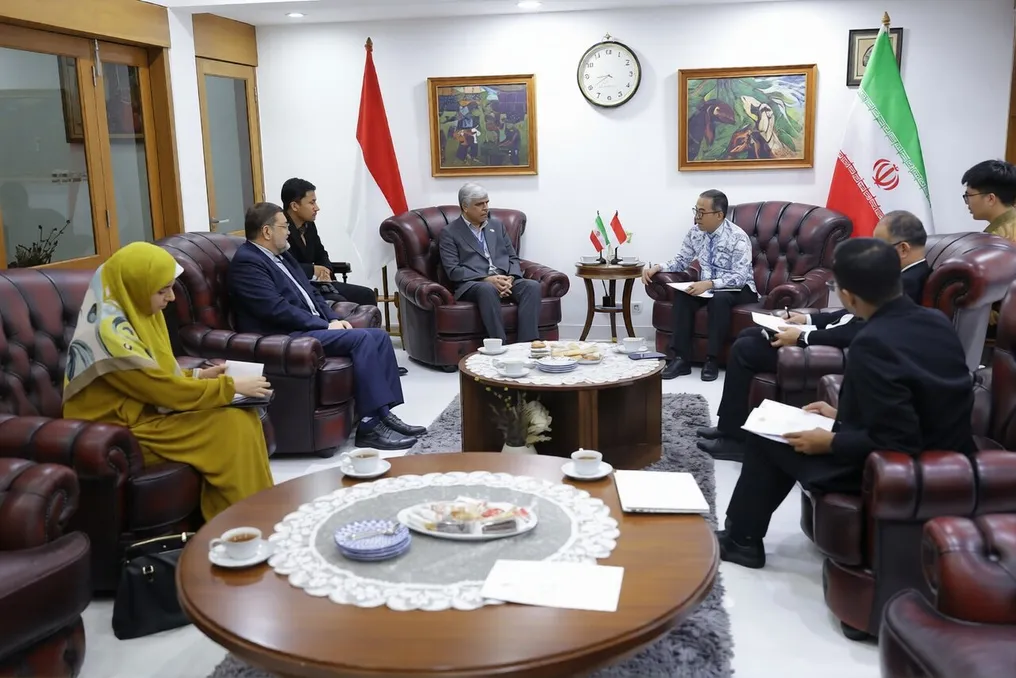
Kazem Garibabadi, Deputy Foreign Minister for Legal and International Affairs, emphasized the role of agricultural diplomacy in ensuring sustainable food security. He stated that Iran is ready to expand scientific, commercial, and joint investment cooperation in agriculture with countries in the region and around the world. He noted that food security means not only access to food but also ensuring sustainable, adequate, healthy, and affordable access to suitable food for all people.
Garibabadi noted that geopolitical crises, wars, climate change, drought, resource scarcity, supply chain disruptions, and economic inequality threaten the food security of millions of people. In such conditions, agriculture ceases to be merely an economic sector; it becomes one of the fundamental pillars of a country's security, independence, development, and stability. He stressed the need to strengthen agricultural diplomacy, stating that agricultural cooperation can become an effective tool for building trust, expanding international relations, reducing tensions, and strengthening ties between nations. Food security is a shared global responsibility, and no country can remain indifferent to the food security of other nations. Opportunities in foreign policy must be utilized to develop cooperation in agriculture, animal husbandry, fisheries, food industry, modern technologies, agricultural trade, and natural resource management.