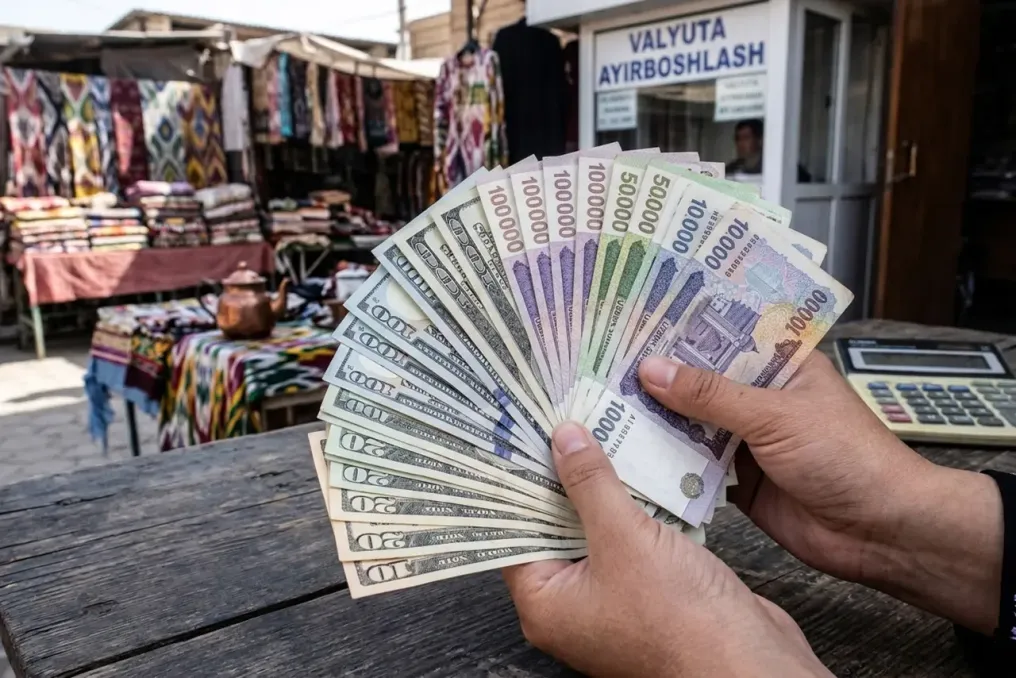
Uzbekistan residents sold $18.9 billion to banks over nine months
Read more
UzDaily
uzdaily.uz

Uzbekistan residents sold $18.9 billion to banks over nine months

From January to September 2026, residents of Uzbekistan sold foreign currency to commercial banks totaling $18.9 billion. This figure exceeds the sales volume for the same period in 2025, which was $15.3 billion, representing an increase of 1.2 times.

The Central Bank of Uzbekistan reported that individual purchases of foreign currency reached $11 billion during the same period, resulting in a positive balance of $7.9 billion.

According to the regulator, this positive balance from transactions between private individuals and banks serves as an additional source of foreign currency supply in the domestic market. Sales of foreign currency by residents have been growing for the third consecutive year.

Details show that from January to September 2024, private individuals sold $11.8 billion, in 2025—$15.3 billion, and in 2026—$18.9 billion. Acquisitions also grew: in 2024, they amounted to $6.9 billion, in 2025—$8.6 billion, and in 2026—$11 billion. Nevertheless, sales significantly outpaced purchases, with the positive balance increasing from $4.9 billion in 2024 to $6.7 billion in 2025 and $7.9 billion in 2026.

Individuals accounted for $18.9 billion of the total foreign currency supply in the domestic market, which stood at $43.8 billion (excluding Central Bank operations). Legal entities and banks contributed $22.8 billion, while international financial institutions and foreign direct investment totaled $2.2 billion.

Regarding demand, out of the total demand for foreign currency of $50.4 billion, individuals accounted for $11 billion, and legal entities accounted for $39.4 billion. Overall, the supply of foreign currency in the domestic market grew by 25.3% in the first nine months of 2026 compared to the same period last year, while demand increased by 17.9%. International money transfers brought $15.2 billion into the country during this period.

From January to September, the sum exchange rate fluctuated within the range of 11,765–12,320 soms per US dollar. By the end of September, the exchange rate reached 11,821 soms, reflecting a 1.5% strengthening since the beginning of the year.
Similar stories

Over $15 billion in remittances received by Uzbekistan in nine months
Read more
podrobno.uz

Over $15 billion in remittances received by Uzbekistan in nine months

From January to September 2026, Uzbekistan received $15.2 billion through international money transfers. However, the growth rate of these transfers is slowing down: over the nine-month period, the figure increased by only 8.9% compared to the same period last year.

This data is presented in a Central Bank review on the state of the domestic currency market. During the reporting period, approximately $2 billion was sent out of Uzbekistan, resulting in a positive net balance of international remittances amounting to $13.2 billion.

Slowing Inflows in the Third Quarter

Particular attention is drawn to the decrease in inflows during the third quarter. From July to September, the country received $5.884 billion, slightly exceeding the $5.716 billion received during the same period in 2025. The annual growth in this quarter was 2.9%.

For context, it should be noted that from January to September 2025, international remittance inflows showed more significant growth—23.7% compared to the same period in 2024.

Furthermore, the review indicates that over the nine months, residents sold foreign currency to commercial banks totaling $18.9 billion. This volume is 1.2 times higher than last year's figure of $15.3 billion.

Assets of commercial banks in Uzbekistan grew by 20.5% in 2026
Read more
uzdaily.uz

Assets of commercial banks in Uzbekistan grew by 20.5% in 2026

According to data from the Central Bank of Uzbekistan, the total assets of commercial banks in Uzbekistan reached 1,044.8 trillion UZS as of October 1, 2026. This figure represents an increase of 20.5% compared to 866.8 trillion UZS the previous year.

The fastest asset growth was demonstrated by non-state-owned banks, which increased their balances by 36.2% to 410 trillion UZS. Meanwhile, assets of state-participating banks grew by 12.2%, amounting to 634.9 trillion UZS.

Consequently, the share of non-state-owned banks in the total banking system assets increased from 34.7% to 39.2%, indicating the growing contribution of the private banking sector.

Foreign currency assets decrease as a percentage of total assets

The share of foreign currency assets in bank balances continued to decrease relative to the total volume. Assets denominated in foreign currency increased by only 6% year-on-year, reaching 352.7 trillion UZS. Their share in total banking assets fell from 38.4% to 33.8%, reflecting a slower growth rate compared to the overall fund of banking system assets.

Loan portfolio expands, but investments in securities grow faster

Loans remained the largest component of commercial banks' assets. The net loan portfolio increased by 13.1% to 638.1 trillion UZS, although its share in total assets decreased from 65.1% to 61.1%. This reduction in the relative weight of lending is largely explained by the significantly faster growth of investments and securities.

Bank assets in the form of investments and securities soared by 93.4% over the year, reaching 155.6 trillion UZS, almost double. Accordingly, their share in total banking assets increased from 9.3% to 14.9%. Funds held by commercial banks at the Central Bank grew by 33.7% to 36.2 trillion UZS. At the same time, cash increased by 11.7% to 30 trillion UZS, and accrued interest receivable grew by 47.2% to 39.1 trillion UZS. Meanwhile, requirements from non-residents decreased by 18.8% to 44.9 trillion UZS, and requirements from residents also decreased by 3.2% to 29.2 trillion UZS.

Bank liabilities and capital continue to grow

Regarding balance sheet liabilities and capital, total bank obligations increased by 21.1%, reaching 891.9 trillion UZS. The equity capital of the banking system grew by 17.3%, amounting to 152.9 trillion UZS. These figures demonstrate that the expansion of bank assets was accompanied by growth in both liabilities and capital.

Twelve banks control nearly 79% of total assets

The banking system of Uzbekistan maintains a high degree of concentration, as the largest institutions accumulate the vast majority of assets. Out of 35 operating commercial banks in the country, 12 had assets exceeding 30 trillion UZS as of October 1, 2026. Together, these banks controlled 821.9 trillion UZS, equivalent to 78.7% of the total banking system assets.

Another 11 banks had assets in the range of 10 to 30 trillion UZS, with their combined assets totaling 181.5 trillion UZS. Six banks had assets between 3 and 10 trillion UZS, summing up to 34.2 trillion UZS. The six smallest banks, each having assets of less than 3 trillion UZS, collectively owned 7.2 trillion UZS.

Data from the Central Bank highlights the ongoing expansion of the banking sector in Uzbekistan, especially among private institutions, as well as the shift in asset structure towards investments and securities. Despite the faster growth of small and private banks, the sector remains dominated by a relatively small group of large financial organizations.

Popular