Antarctic Ice Turned into Cosmic Particle Detector to Study the Universe
Read more
Olhar Digital
olhardigital.com.br

Antarctic Ice Turned into Cosmic Particle Detector to Study the Universe

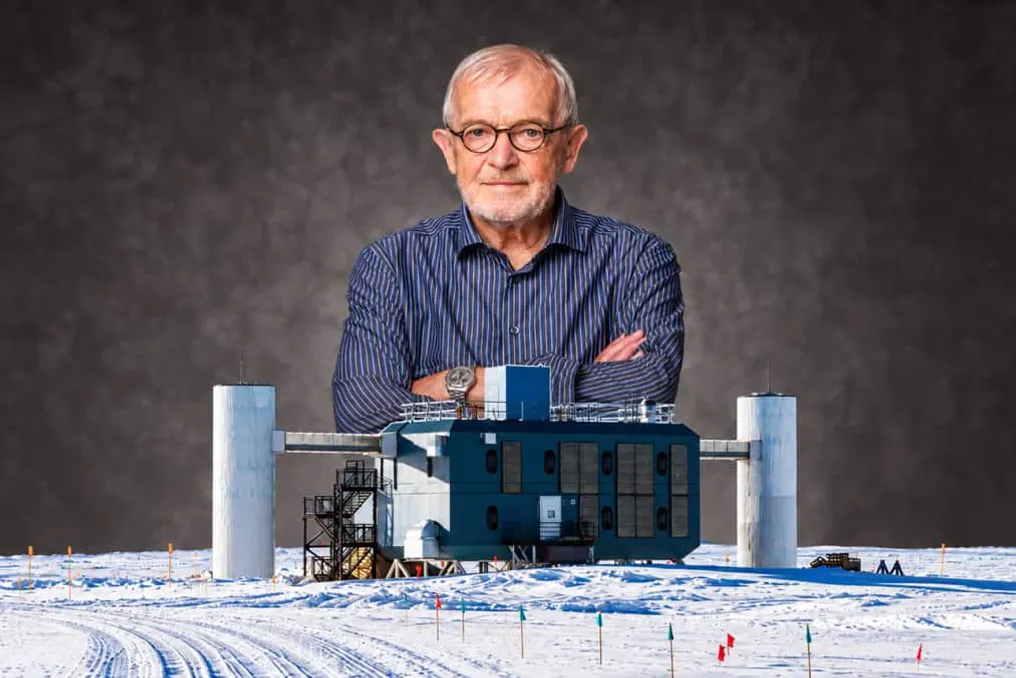
Belgian scientist Francis Halsen received the Nobel Prize in Physics in 2026, which recognized years of scientific work and marked an important step for modern astronomy. He played a crucial role in the creation and development of IceCube—an observatory installed beneath the Antarctic ice that allows for the study of extreme phenomena in the universe by detecting neutrinos.

This topic was covered on the program 'Olhar Espacial' on Friday (the 30th), where physicist Alexandre Charman discussed how the detection of these particles expands the possibilities for studying space.

Charman, who has extensive experience as an astronomer, theoretical physicist, data specialist, lecturer, and author of eight books, as well as co-author of 'Cosmic Real Estate Bank' published by Estrela Cultural, and Director of Astronomy at the Rio de Janeiro Planetarium Foundation, explained the characteristics of neutrinos.

Neutrinos are subatomic particles that have no electric charge and are among the least massive known. Due to their extremely rare interaction with matter, they can pass through planets, stars, and even the human body; it is estimated that about 100 trillion such particles pass through each person every second.

Charman noted that 'neutrinos have been described as the smallest amount of reality ever presented to humanity. They are the lightest material particles in the entire universe, surpassed only by massless bosons. Furthermore, they arise naturally as a result of radioactive decay known as beta decay.'

The difficulty in detecting these particles prompted scientists to create a structure capable of using the Antarctic ice itself as a detector. The concept was developed back in 1988, and it took over two decades of technological development before IceCube began full operation in 2010.

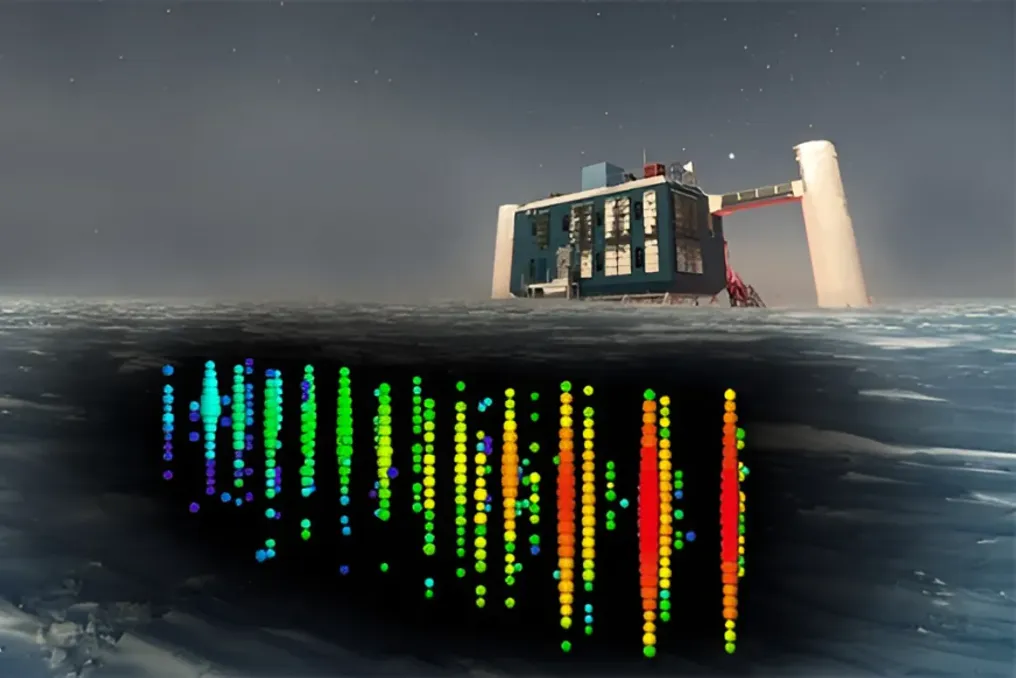
The observatory, located at the South Pole, covers an area of approximately one cubic kilometer of deep ice. Its structure includes 5160 optical sensors distributed along 86 vertical cables located at depths ranging from 1.45 to 2.45 kilometers. This configuration allows for the recording of light signals generated when neutrinos interact with matter.

Unlike traditional telescopes, which capture light emitted or reflected by celestial bodies, IceCube identifies particles reaching Earth from different regions of the universe. Since neutrinos have no charge, their trajectories are not deflected by magnetic fields. Thus, the direction of arrival provides important clues about the location of their cosmic sources, including extremely energetic natural particle accelerators.

Detection occurs when a neutrino interacts with an atomic nucleus or an electron in the ice, producing electrically charged particles. As they pass through the medium, they can move faster than light travels through that material. This process generates a short bluish flash known as Cherenkov radiation.

The optical sensors register these flashes and transmit the data to researchers. Based on the distribution and arrival time of the light signals, scientists can estimate the particle's energy and reconstruct its direction of arrival. This information helps study the phenomena responsible for producing neutrinos.

During the program, Charman also touched upon concepts of quantum mechanics and the possibility that a particle can exist in multiple states simultaneously. 'In quantum mechanics, there is a real possibility that a particle can occupy two states at once. The famous thought experiment of Schrödinger's cat perfectly illustrates this theoretical strangeness. Any quantum system remains in superposition until scientists perform a direct observation.'

IceCube continues to operate and is undergoing modernization to expand its observational capabilities. Among future prospects is the IceCube-Gen2 project, which aims to significantly increase the volume of detection and the sensitivity of the observatory. This initiative could potentially reveal new neutrino sources and deepen the study of the most energetic phenomena in the universe.

Similar stories

Google tests artificial intelligence on satellite and advances in space data center projects
Read more
olhardigital.com.br

Google tests artificial intelligence on satellite and advances in space data center projects

Google succeeded in running an artificial intelligence (AI) model on a satellite, receiving a response generated from outside Earth. This test marks an experimental advancement of Project Suncatcher, a corporate initiative focused on exploring the feasibility of transporting AI data centers into Earth orbit.

In a statement released on the company's blog, Google detailed that it began using Tensor Processing Units (TPUs) installed on the space equipment. During the tests, the Gemma 4 model was run directly on the satellite and received an instruction to compose a haiku about the experience of being in space.

The AI generated poems addressing Earth viewed from space, data flow, and the brilliance of the stars. Furthermore, other experiments were conducted, such as creating limericks with space themes and responding to telemetry-related commands.

Additionally, Google is working to improve communication between devices operating in orbit. After the initial testing phases, the company plans to achieve a new goal in 2027: deploying two interconnected satellites.

The purpose of this goal is to validate whether the systems are capable of performing tasks consistently and exchanging data in the space environment. Such a demonstration would be crucial in determining the practicality of establishing an orbital computing infrastructure.

Currently, the test conducted with Gemma 4 only confirms that an AI model can process commands aboard a satellite and produce responses. The realization of space data centers still requires the completion of several technical stages and the execution of more experiments.

The Science Behind the Neutrino Observatory Awarded the Nobel Prize in Physics
Read more
olhardigital.com.br

The Science Behind the Neutrino Observatory Awarded the Nobel Prize in Physics

Francis Halzen, a naturalized American and Belgian citizen, was awarded the 2026 Nobel Prize in Physics for his fundamental work in the development of IceCube. This observatory is located deep within the ice at the South Pole in Antarctica and has the capability to identify high-energy neutrinos, providing new information about the most extreme environments in the Universe.

The topic was discussed on the Space View program this Friday (30), where physicist Alexandre Cherman participated to detail how IceCube aids in investigating the most intense cosmic phenomena and what neutrinos can reveal about them. Cherman, who is an astronomer, holds a PhD in theoretical physics, is a data scientist, educator, speaker, and author of eight books, and is also a co-author of the educational game Cosmic Real Estate, produced by Estrela Cultural. He currently leads the Astronomy department at the Rio de Janeiro City Planetarium Foundation.

The concept of using Antarctic ice as a particle detector dates back to 1988. After more than twenty years of development, IceCube began operating in 2010. Its structure covers about one cubic kilometer of ice and is composed of 5,160 optical sensors distributed across 86 vertical cables extending between 1.45 and 2.45 kilometers in depth.

Neutrinos are subatomic particles that have no electric charge and possess very little mass. Generated in various natural events, they can pass through celestial bodies, such as planets and stars, and even the human body, interacting minimally with matter. It is estimated that approximately one hundred trillion of these neutrinos pass through a person every second.

The detection of these neutrinos occurs when they collide with an atom present in the ice, generating charged particles. These, in turn, emit a brief bluish glow known as Cherenkov radiation. The sensors capture these signals, allowing researchers to calculate the energy and determine the direction of the particle's origin.

Unlike conventional telescopes, which function by capturing light, IceCube focuses on observing particles. Due to the lack of electric charge in neutrinos, their paths are not altered by magnetic fields. This allows them to point towards the location of cosmic accelerators, meaning extreme environments capable of generating particles with energies far exceeding those achieved in terrestrial laboratories.

The discoveries made by the observatory have boosted the field of neutrino astronomy, which complements observations made with light and gravitational waves. IceCube remains operational and is receiving continuous improvements to increase its detection capacity, identify new sources of these particles, and aid in understanding the most extreme phenomena in the Universe.

Marcelo Zurita, president of the Paraíba Astronomy Association – APA, a member of the SAB – Brazilian Astronomical Society, technical director of the Brazilian Meteor Observation Network (Bramon), and national coordinator of Asteroid Day Brazil, presents the program, which is broadcast live every Friday at 9 PM (Brasília time) on the official channels of the outlet on YouTube, Facebook, Instagram, X (formerly Twitter), LinkedIn, and TikTok. The original content was published on Olhar Digital.

NASA's Swift Telescope to be Deactivated After Rescue Attempt Failure
Read more
olhardigital.com.br

NASA's Swift Telescope to be Deactivated After Rescue Attempt Failure

NASA has formally ended the mission of the Swift space telescope after a rescue attempt was unsuccessful. This observatory, which dedicated more than two decades to studying the Universe, is in the process of losing altitude and is expected to re-enter Earth's atmosphere in the coming weeks.

The rescue operation was conducted by Katalyst Space Technologies, a company based in Arizona, United States. This company developed the spacecraft named LINK with the purpose of reaching the telescope and elevating it to a higher orbit, enabling the continuation of its scientific investigations.

However, the initiative was not successful. Approximately three weeks after its launch, on July 3rd, the LINK spacecraft encountered problems with its propulsion system and the reaction wheels responsible for maintaining its orientation. These failures caused the spacecraft to spin at an unexpected speed, which made capturing and elevating Swift impossible.

Despite the setbacks, LINK managed to approach the observatory and take photographs of it. The separation between the two spacecraft varied between 12 and 15 kilometers, which proved insufficient to complete the planned operation.

Swift was losing altitude due to atmospheric drag and does not have adequate thrusters to neutralize this effect. In September 2025, NASA awarded Katalyst a contract worth US$ 30 million (equivalent to about R$ 162 million) to attempt to save the observatory.

The adopted strategy involved a spacecraft comparable in size to a refrigerator, equipped with three robotic arms. The concept was for LINK to reach Swift, capture it, and guide it to a higher orbit. This mission was pioneering, as no private spacecraft had managed to capture and elevate a satellite that was not designed to receive such maintenance. Speed was also crucial, given that Swift continued to lose altitude while the operation preparation proceeded.

Although the attempt failed to extend the telescope's lifespan, NASA considered the project valuable for fostering the development of robotic maintenance technologies in space and for testing the capacity to execute operations of this magnitude in short periods.

Swift was officially named the Neil Gehrels Swift Observatory in 2018, in memory of its first principal investigator, who passed away the previous year. With the end of the mission, the observatory will return to Earth's atmosphere in the coming weeks, but the collected data will remain accessible for future scientific research.

Popular