Healthtech company Clinics On Cloud raises $12.5 million to expand microclinic network
Read more
YourStory [india, en]
yourstory.com

Healthtech company Clinics On Cloud raises $12.5 million to expand microclinic network

The healthtech company Clinics On Cloud has successfully raised $12.5 million in a Series A round. The investment came from Dubai-based Model42, a platform for growth in the health and wellness sector, which is supported by Enlightened Minds Investments.

The firm, located in Pune, stated that the funds will be used to enhance artificial intelligence capabilities, develop research activities, and expand its network of connected microclinics. Furthermore, the company plans to establish partnerships with technology firms and healthcare providers to integrate new AI applications and screening tools.

The United Arab Emirates will become the company's global hub, with plans for expansion into Africa, the United States, and Southeast Asia.

Founded in 2018, Clinics On Cloud creates access points to healthcare using technology. Its Health ATM devices are compact screening stations that combine connected medical instruments, health checks, digital reports, and analytics powered by AI and telemedicine. The company's portfolio also includes mobile medical units, 'Clinic Boxes,' and 'Healthy Halls' for use in hospitals, workplaces, residential complexes, and underserved areas.

Founder and CEO Abhay Agarwal stated that the company has been operating for eight years guided by the belief that 'quality healthcare should never depend on a person's zip code.' He noted that this investment will help realize this concept internationally, as there is an opportunity to 'make these innovations accessible to people wherever they may be.'

Clinics On Cloud claims to have conducted over 3,500 deployments, performed more than 12 million medical examinations and procedures across eight countries. The company's systems have been used in public health centers, hospitals, corporate facilities, rural communities, and defense institutions in India, including the Army, Navy, and Border Security Force.

The funding comes amid a more selective investment environment. Venture Intelligence data showed that funding for Indian health startups dropped to $447 million in 2025 compared to $707 million in 2024.

Nevertheless, capital continues to flow into specialized models. In October, the preventive health startup Cent raised $15 million in a Series A round led by Blume Ventures and South Park Commons. In July, the radiology AI specialist CARPL.ai received $10 million in a round led by the International Finance Corporation.

Concurrently, the public digital infrastructure is expanding. By May 2026, the Ayushman Bharat Digital Mission will exceed 900 million digital health accounts and 1 billion associated health records. Initiatives announced in June, including tools for managing digital clinics and common data standards, aim to simplify the exchange of medical information.

Similar stories

Simplismart raises $14 million in Series B round to expand AI inference platform
Read more
business-standard.com

Simplismart raises $14 million in Series B round to expand AI inference platform

Simplismart, a company specializing in artificial intelligence inference infrastructure, announced that it has raised $14 million in a Series B funding round. The round was led by Dallas Venture Capital, with participation from NVIDIA, Accel, Shastra VC, and Micromax.

The funds raised will be used for the further development of the Simplismart inference platform. This will enable enterprises to launch AI-based applications more efficiently, and cloud providers to transform their Graphics Processing Unit (GPU) infrastructure into managed AI services. Furthermore, the funding will support the expansion of partnerships with cloud providers and sovereign AI, as well as growth in North American and other global markets.

Simplismart creates a software layer situated between AI models and GPU infrastructure. Its modular inference engine allows companies to customize AI model operation according to their needs for speed, cost, and performance. The company's orchestration platform manages deployment and scaling in both cloud and on-premise infrastructure.

Over the last six months, the company's annual revenue growth rate has increased 14fold. Companies such as HeyGen, Higgsfield, InVideo, Shiprocket, Apna, and Ema run production workloads on the Simplismart platform, covering video, voice, multimodal, and enterprise AI applications.

Amritaanshu Jain, Co-founder and CEO of Simplismart, noted that while the industry has spent many years improving AI model capabilities, the advantage is determined by how these models are utilized: the cost per interaction, application response speed, and reliability under increasing demand. He added that the team spent four years creating the software layer between the model and the GPU, helping clients optimize workload deployment and operation.

An example of usage is the Exotel communications platform. After Exotel found that the economics of closed API models were unsuitable for its voice agents, the company fine-tuned an open model on its own data and migrated the inference to Simplismart. By sharding GPUs, Simplismart reduced the cost per minute for Exotel by 57% compared to closed API models. Additionally, it lowered costs below that of self-hosting the same open model and reduced response time from 1.1 seconds to less than 300 milliseconds.

As part of its offering to cloud providers, Simplismart collaborates with NVIDIA to simplify the deployment and operation of AI infrastructure at scale. Unlike inference providers who buy or reserve GPU capacity and resell it, Simplismart itself does not own computing power. Instead, it provides a software layer that transforms third-party GPU clusters into ready-to-use AI production infrastructure. Cloud providers can use this platform to offer managed AI services under their own brands without building their own software stack from scratch. This approach is already used by Yotta, where the Simplismart platform forms the basis of the Shakti Studio server inference layer.

Dayakar Puskoor, Managing Partner at Dallas Venture Capital, stated that inference is becoming one of the most significant drivers of change in the AI economic model. He emphasized that Simplismart is rapidly becoming a global player, helping enterprises execute AI workloads more efficiently and enabling cloud providers to convert GPU power into scalable services.

Devansh Ghatak, Co-founder and CTO of Simplismart, reported that the company's modular inference engine allows configurations to be adapted to the requirements of individual workloads, and the orchestration platform manages deployment across various infrastructure environments. Ghatak also mentioned that the new funding will support the development of a dynamic GPU scheduling layer, which can align AI workloads with available computing power across different regions and time zones, helping cloud providers better utilize their GPU infrastructure.

Cent Company Attracts $15 Million to Expand AI-Powered Preventive Medicine Platform
Read more
business-standard.com

Cent Company Attracts $15 Million to Expand AI-Powered Preventive Medicine Platform

Cent, a company specializing in intelligent solutions for preventive health, has successfully closed a Series A funding round, raising $15 million. This capital was secured through both equity and debt. The round was led by Blume Ventures and existing investor South Park Commons.

Private investors also participated in the round, including Arun Sarin, former CEO of Vodafone; Srinivas Narayanan, former CTO (B2B) of OpenAI; Sharath Narayana, Krishna Sridhar, and Aprameya Radhakrishna.

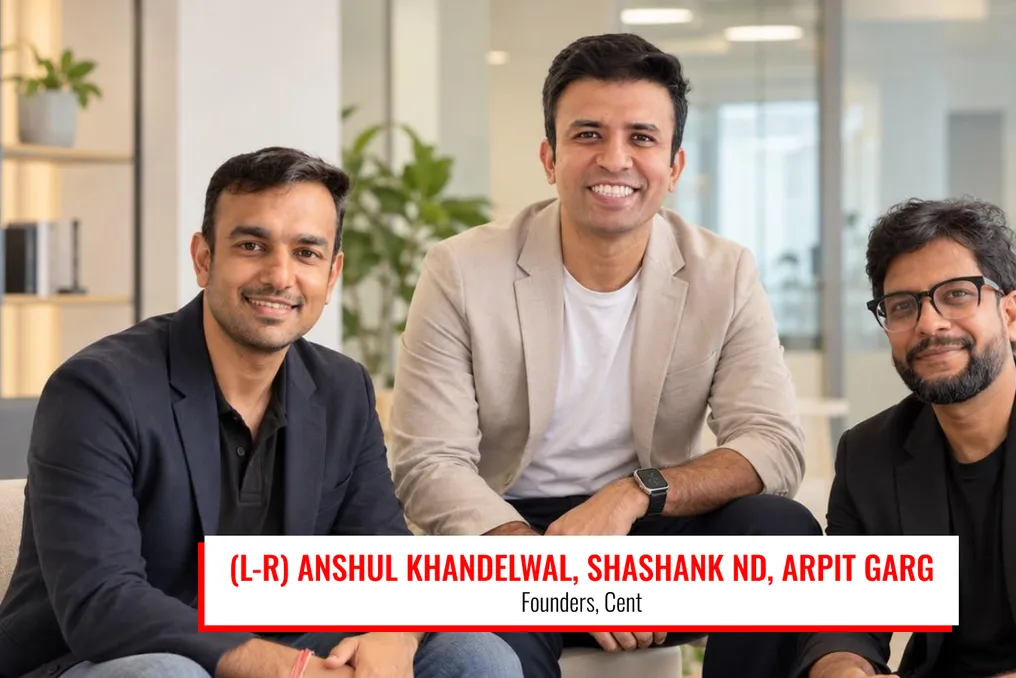
Cent was founded in 2025 by individuals such as Shashank ND, founder of Practo and OneFlow Holdings; Anshul Khandelwal, former Marketing Director at Ola Electric; and Arpit Garg, former Head of Product at Lenskart.

Company Vision and Mission

Karthik Reddy, co-founder and managing partner at Blume Ventures, noted that upon meeting Shashank and the team behind Cent, they observed an 'obsessive drive to solve the problem of accurate diagnosis and treatment protocols for cancer among other indications.' He added that Blume Ventures believes in Cent's vision to expand this technology from India globally, which aligns with their decade-long commitment to medical technology.

The company began operations because in India, diseases such as heart conditions, cancer, and metabolic disorders are often detected only after symptoms appear, at which point treatment becomes significantly more complex. Cent's goal is to bridge this gap by enabling early detection of serious illnesses while they can still be treated or prevented entirely.

Cent is building a vertically integrated preventive health platform that combines specialized equipment, AI-based radiology, and diagnostics, along with bioinformatics. This allows Cent to detect diseases years before symptoms manifest and track each individual's health status over time, moving towards a future where healthcare is continuous, personalized, and preventive.

The raised funds will be allocated to Research and Development (R&D), as well as expanding Cent's teams in AI, engineering, and clinical research.

The Importance of Early Diagnosis

Prateek Mehta, General Partner at South Park Commons India, emphasized that 'with every scan, Cent demonstrates how early diagnosis changes lives. Behind every such scan is a family that otherwise would not have known about the problem.'

He stated that the team 'is the right people to build this, as they are dedicated to the belief that no one should find out about a tumor or arterial blockage when it is too late.'

Furthermore, Cent acquired the Medsee platform, founded by Chitra Singh. This platform provides an AI-powered radiology reporting workflow designed for qualified medical professionals. It generates structured reports and highlights detected findings for radiologist review, allowing Cent to provide faster and more consistent reports as scan volume grows.

A Shift in India's Healthcare System

Anshul Khandelwal, co-founder of Cent, believes that 'India's healthcare system is still built on treating diseases rather than detecting them early. We believe the next step is precise and scalable preventive care.'

He noted that the first 10,000 scans demonstrated the necessity of this transition. He added that this investment will allow the company to deepen its focus on AI, medical imaging, and clinical research, as well as build a preventive health infrastructure in India capable of serving the entire world.

Today, users receive Cent services through Cent Check—a flagship comprehensive full-body examination. In one visit lasting about two hours, a person undergoes a full-body MRI, low-dose CT, DEXA, ECG, ECHO, and tests for over 100 biomarkers according to Cent's patented protocol. Cent's artificial intelligence synthesizes all results into a single body picture, after which each result is reviewed by specialist doctors, and participants leave with a doctor-developed plan and year-long support.

The firm reported that among participants who came feeling well, a quarter had findings requiring attention, and one in forty required immediate medical attention, including early-stage tumors, significantly narrowed arteries, and aneurysms. Each scan also contributes to one of the largest databases of asymptomatic residents in India. Cent plans to use this data to create Indian baseline indicators of a healthy body, train models that can signal disease risk earlier, and support clinical research, thereby increasing the accuracy of preventive care as the company grows.

Healthtech Startup Cent Raises $15 Million in Series A Round
Read more
yourstory.com

Healthtech Startup Cent Raises $15 Million in Series A Round

Healthtech startup Cent has successfully closed a $15 million funding round in Series A. The funds were secured through a combination of debt and equity capital, with Blume Ventures and existing investor South Park Commons leading the investment.

Private investors also participated in the round, including Arun Sarin, former CEO of Vodafone; Srinivas Narayanan, former CTO (B2B) of OpenAI; and Sharath Narayana, Krishna Sridhar, and Aprameya Radhakrishna.

Cent plans to use the raised capital to advance its research and development activities, as well as to expand its teams in artificial intelligence, engineering, and clinical trials.

Cent was founded in 2025 by Shashank ND, Arpit Garg, and Anshul Khandelwal and is positioned as a company focused on preventive medical intelligence. Notably, Shashank ND is the founder of Practo, Anshul Khandelwal previously served as Marketing Director at Ola Electric, and Arpit Garg worked as Head of Product at Lenskart.

Cent is building a vertically integrated preventive healthcare platform that combines specialized hardware, AI-based radiology and diagnostics, and bioinformatics. The startup claims that this platform is capable of detecting diseases long before any symptoms appear.

Furthermore, Cent acquired Medsee—an AI-powered radiology reporting platform developed by Chitra Singh for qualified medical professionals. This platform generates structured reports and highlights detected findings for radiologists to review, enabling Cent to provide faster and more consistent reporting as scan volumes increase.

Anshul Khandelwal, co-founder of Cent, stated: 'The Indian healthcare system is still built on treating diseases rather than early detection. We believe the next step is preventive care, which is precise and scalable. These investments will allow us to delve deeper into AI, medical imaging, and clinical trials, and to build a preventive health infrastructure in India that can serve the world.'

According to Cent, since its inception, the company has conducted 10,000 full-body preventive scans in the cities of Bengaluru, Mumbai, and Delhi. The company's goal is to reach 10 million scans by 2035.

Karthik Reddy, co-founder and managing partner at Blume Ventures, noted: 'We believe in Cent's vision of spreading this concept from India to the world over time, which aligns with our belief in medical technology over the past decade.'

Popular