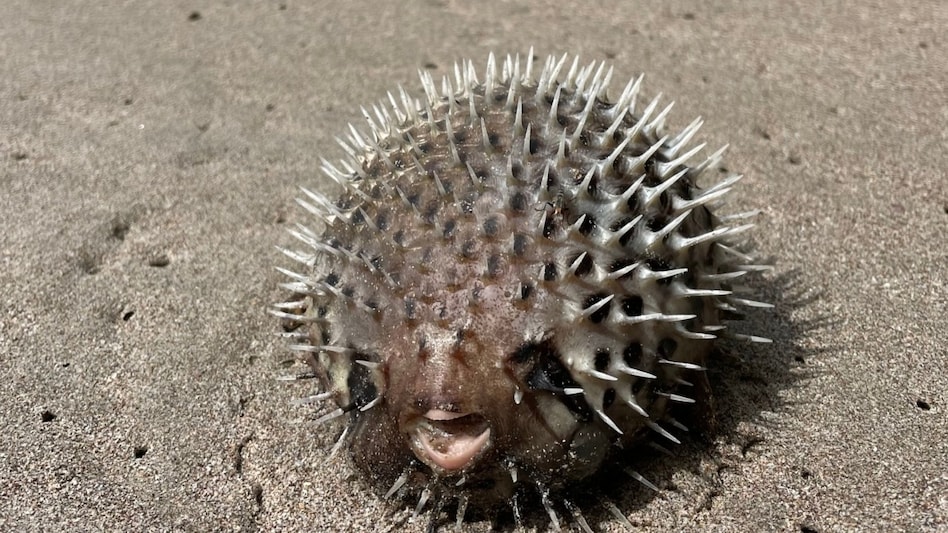
When walking along the sea, one should not touch suspicious fish, even if it is dead. A recent discovery of such a fish on a well-known beach in the UK has caused concern. This fish is a pufferfish, and its body contains a toxic substance that can be thousands of times more dangerous than cyanide. It is important to note that the poison remains deadly even after the fish dies.
According to The Sun, the incident occurred in the Dorset area, in Shstdandane, on Noll Beach. Local resident Owen Butty noticed a strange, about 17-inch object near the shore. Initially, he thought it was a small maritime marker or a plastic bag. However, upon getting closer, he realized it was a dead fish whose body was inflated like a balloon. Owen had previously seen pufferfish while diving abroad, so he assumed it was one.
To confirm, he photographed the fish and sent the images to the Dorset Wildlife Trust and a marine life expert. After inspection, the fish was identified as a pufferfish.
The most dangerous feature of the pufferfish is the poison called tetrodotoxin, contained in its body. This is an extremely potent neurotoxin that affects the body's nervous system. It can lead to muscle paralysis and, in severe cases, death due to respiratory problems.
The poison can be present in specific parts of the fish's body, such as the liver, ovaries, intestines, and skin. This is why touching or consuming it is extremely dangerous. If the pufferfish is not properly cleaned, the poison from its toxic organs can enter the edible meat, causing serious food poisoning. In some countries, the consumption of this fish is only permitted under strict rules and special preparation.
The danger associated with touching the pufferfish cannot be ignored. Its body may have small sharp spines. If these spines get into the skin and the poison enters the body, it can cause serious problems. Therefore, the safest way is to keep a distance from such fish if spotted on the shore. The key point is that the poison in the fish's body does not disappear after its death.
Pufferfish are usually found in warm seawater. Their natural habitats are the Indian, Pacific, and warm parts of the Atlantic Ocean. The discovery of such a fish on the cold coast of the UK is quite unusual. It is speculated that recent storms Austen and Boalo might have brought this fish from its usual range hundreds of miles away. However, the true reason for its appearance off the coast of the UK has not yet been established.
The name pufferfish is related to its unique defense mechanism. When the fish senses a threat from a predator, it fills its body with water or air, inflating like a balloon. This significantly increases its size, making it a difficult target for a predator to swallow. Once the body is inflated, it takes on a spherical shape, which is its most distinguishing feature.
Owen Butty, who spends a lot of time in the Dorset marine areas and is knowledgeable about local marine fauna, reported that he did not expect to see a pufferfish on the local beach. A representative from the Dorset Wildlife Trust also called it a rare sight for the marine areas of the UK. The organization advised people never to touch a pufferfish if they see it on the shore, but instead to report it to the relevant authorities.
Meanwhile, the National Trust, which owns Shstdand beach, stated that it had not received official notification of the fish's discovery. Overall, although the fish found on the shore may seem small and strange, the poison contained within it can be extremely dangerous. Therefore, curiosity that prompts one to approach or touch such a fish could result in serious consequences.