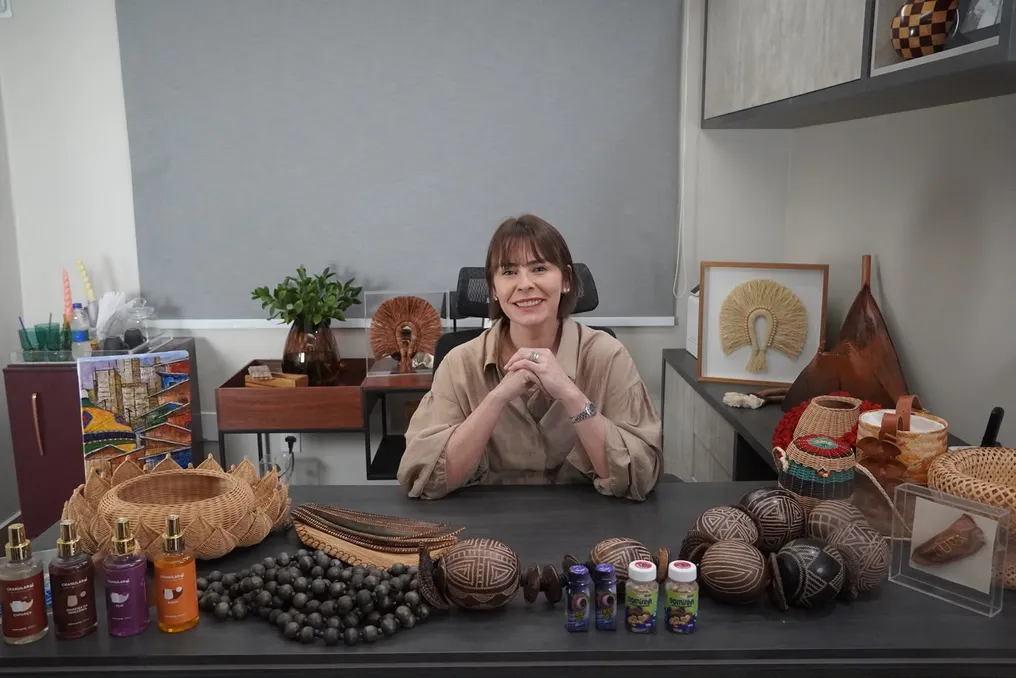
Brazilian visual artist Bianca da Costa developed a scenography for Villa-Lobos's work 'Amazon Forest,' aiming to transcend the immediate representation of the forest. Her objective was to establish a dialogue between the music, the projected images, and the contemporary reality of the Amazon, focusing on the theme of resistance.
The scenographic design was conceived in a circular format, symbolizing the idea that the Amazon must be at the center of the discussion about environmental and political issues. This concept was influenced by the book 'The Amazon is the Center of the World,' written by Brazilian journalist Eliane Brum.
Bianca da Costa explained to Lusa that the intention was to reposition the Amazon and its ecological and resistance dilemmas at the center of attention, creating an environment where various universes could interact through light, sound, and images.
The artist emphasized that she avoided realism, refusing to simply overlay one image within another created by the music. She deliberately sought to escape representations considered 'exotic' or 'postcard-like,' opting instead to work with textures, colors, repetitions, and overlaps, aligning her visual language with the musical rhythm and texture.
This approach also included the intentional omission of images at certain moments, from the beginning of the concert, allowing the audience to concentrate on listening to the music and constructing their own imagination, following Villa-Lobos's original suggestion.
With training in scenography and experience as a visual artist, Bianca da Costa's research has investigated for over ten years the connection between nature and human beings, encompassing political aspects related to territorial exploitation.
Her first immersion in the Amazon occurred in 2021, during the production of the short film 'Interior of the Earth,' which addressed the advance of deforestation under the management of Jair Bolsonaro. Since then, she has collaborated with indigenous leaders and communities, whose worldviews and ways of living with the forest nourish her art.
For 'Amazon Forest,' the sumaúma tree was chosen as a symbolic element, given its age and height, and is known in some communities as 'vovozona.' The artist associated this ancient tree with the ideas of hope and resistance found in the territory, where the sumaúma shelters the curupira, guardian of the forests.
A more concrete reference to the current political and economic situation arises with the inclusion of images of soy exploration boats. This inspiration came from a trip to Santarém, in the state of Pará, where Bianca da Costa sailed down the Tapajós River and observed the large ships transporting soy to global markets, such as Europe and the United States.
She recalled the mobilization of indigenous leaders from various regions of Brazil against a plan aimed at deepening the rivers to accommodate larger vessels, a measure that, in her view, threatened the preservation of resources and territories.
The sequence of images of the soy boats connects to the 'Sailing Ships' part of Villa-Lobos' composition, which Bianca da Costa interpreted by drawing an analogy between Amazonian boats and sailing ships from the colonization era. By inserting videos of soy transporters with visual effects, the artist sought to make visible a frequently neglected reality, despite its great regional impact.
The political dimension of the work extends to the situation of indigenous peoples after the 2022 Brazilian presidential elections, which brought Luiz Inácio Lula da Silva back to the Presidency after four years of Bolsonaro's government. Bianca da Costa argues that the change in government did not end the threats against indigenous communities, citing attacks and intimidation from groups linked to agribusiness and Bolsonarism.
She emphasizes that the struggle is simultaneously won and unwon, as indigenous peoples continue to face violence and danger, even with the political change in the country. In her analysis, the resistance of these communities is fundamental to understanding the future of the forest, given the continuous conflict between economic interests and territorial defense.
In conclusion, Bianca da Costa mentioned being deeply impacted by the political, ecological, and social issues, but also by humanity and the strong connection with nature and the resistance of indigenous peoples, who sustain this fight. This perspective will be presented in the scenic composition for the Symphony Orchestra of Casa da Música, scheduled for November 14.