The Cradle Of Life concept goes beyond simply providing safe and comfortable housing. According to Sharda Gadsing, the founder of Cradle Of Life, the possibility lies in rethinking what life after 55 can look like by creating thoughtful homes, active communities, specialized services, implementing technology, and flexible ownership models that put the residents' aspirations at the center. He shared his thoughts in an exclusive interview with YourStory.
Challenges in India's senior long-term care market
The idea arose after the founder's parents decided to spend their retirement on a farm, hoping to live independently, peacefully, and close to nature. While this seemed like a perfect plan on paper, it soon became clear that a beautiful house and a quiet setting were not enough. Daily life could become inconvenient and detached from reality, as independence depended on the availability and reliability of support staff.
Exploring living options for seniors, they found that most solutions were either focused on aging needs or positioned as elite real estate. Safety, accessibility, medical care, and emergency assistance are necessary conditions that sustain life, but they should not define it. Today's seniors are healthier, more independent, and more informed, and they do not want age to dictate their lifestyle. This prompted the question: what motivates a person to enjoy every day when basic aging issues are resolved?
Cradle Of Life emerged as an attempt to answer this question and rethink the true essence of life after 55.
Core principles of the 'Active Living' concept
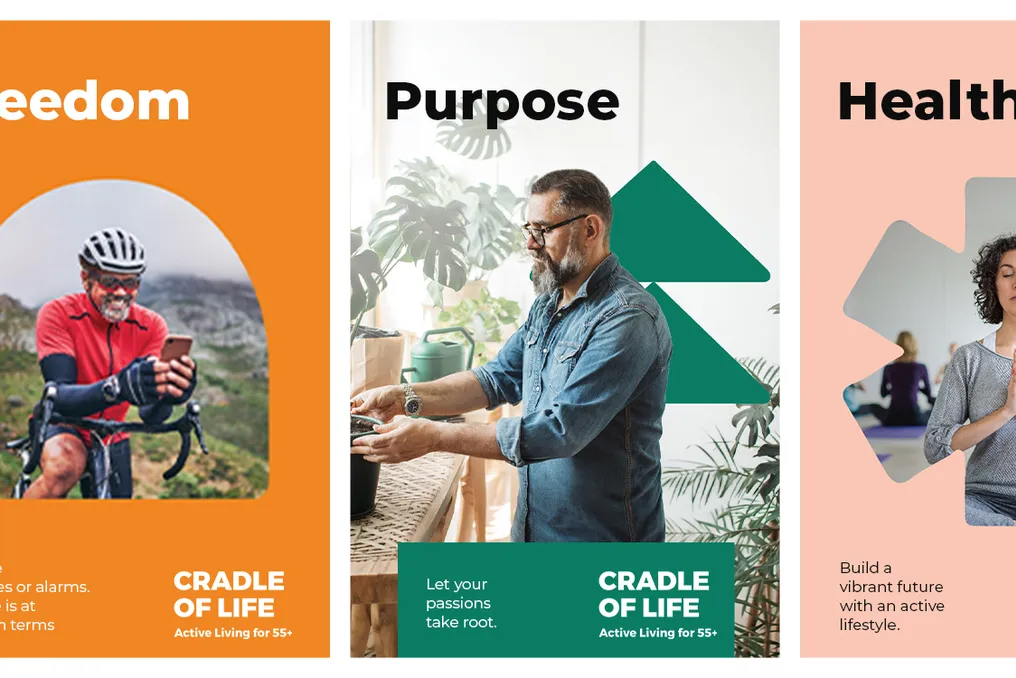
Traditionally, active living for seniors is defined as housing for healthy, independent individuals who do not require care. However, the team felt this definition was too narrow. By studying the factors that determine quality of life after 55, they concluded that four fundamental human aspirations are key: freedom, purpose, health, and happiness. These aspects became the foundational pillars of Cradle Of Life.
Freedom means the ability to live on one's own terms without daily chores becoming a burden. Purpose is achieved through continuous learning, contributing to the common good, and pursuing what is personally important. Health is the ability to continue enjoying life physically, mentally, and emotionally. And happiness stems from meaningful relationships, shared experiences, and a sense of belonging. In COL, it is believed that active living facilities must facilitate the realization of these core aspirations through the services offered.
Innovative approach to housing design
Creating patented intellectual property in real estate design is rare. Cradle Of Life decided to challenge traditional design by studying daily routines and human movement patterns, as well as the difficulties they faced in their current homes. This led to questioning the very layout: should rooms have fixed sizes? Can balconies serve multiple functions and become part of daily life? Can better use of space reduce lifetime ownership costs? Can the entire home feel like a unified space for movement?
The question of safety was also raised: can it begin with spatial planning and extend to furniture, rather than depending primarily on additional fixtures? And can residents customize the number and size of rooms to suit their needs? From these questions, the patented Open Home™ concept was born. It combines a central balcony that extends to all rooms, layouts with approximately 10–15% more usable area compared to traditional homes, easy mobility, safety ensured by spatial design, and age-friendly furniture. Modular configurations allow space to be shaped according to individual needs. The goal is simple: a home adapted to each resident's personal requirements, making independence easier every day for many years.
Design of communal areas and amenities
In COL, the purpose of amenities is extremely clear: to give every resident a reason to look forward to a new day. People at this stage of life possess one of the greatest resources—time. The question is how meaningfully they use this time. Amenities must transform free time into opportunities for maintaining physical activity, self-expression, continuing education, knowledge exchange, building friendships, and achieving joy, satisfaction, and fullness of life. They are not just recreational facilities; they are platforms for finding purpose, participation, and community formation.
This principle dictated the design. The question asked was: 'What will allow residents to lead an active, connected, and fulfilling life every day?' The result was an amenity ecosystem spanning over 32,000 sq ft, offering over 60 different activities across six zones dedicated to wellness, creativity, sports, nature, social interaction, and community celebration. Life at COL extends beyond the house and transforms into a vibrant campus. Unlike a traditional centralized club used occasionally, COL distributes activity zones throughout the campus and on different levels, bringing meaningful interaction and social connections closer to the residents. Easy access makes participation in clubs, seminars, fitness programs, educational opportunities, and social events a spontaneous part of daily life.
Service model and partnership
In long-term care, physical infrastructure makes the first impression, but the daily service experience determines long-term resident satisfaction. Medical care, emergency response, facility management, dining, cleaning, wellness, and community engagement must work in harmony. The traditional model often entrusts these diverse responsibilities to a single operator, although each requires different expertise. When key staff leave or service quality declines, residents are helpless because the rigid structure does not allow for replacing the primary service provider.
Cradle Of Life remains by the residents as a steward of their collective experience, representing their interests and coordinating partners to support their health, independence, engagement, and happiness. The company unites specialized agencies through a results-based service model. Each partner contributes by providing specialized expertise, trained teams, proven processes, and technology. Clear service standards, resident feedback, and regular performance evaluations help maintain quality, consistency, and accountability. If an agency does not meet expectations, the company has the option to replace it. The unique operational model places residents, their well-being, and quality of life at the center, with a commitment to ensuring stable service quality and flexibility to adapt as their needs change.
Market entry strategy and client trust
Long-term care is a complex and competitive business that goes far beyond real estate. It is an experience-oriented offering where homes, healthcare, hospitality, and community life must function seamlessly. Entering the market alongside existing players, Cradle Of Life saw an opportunity to create a unique niche around changing customer perceptions and expectations. Instead of simply copying existing models, the company offered a fresh perspective on housing design, amenity distribution, specialized partner services, and purchase or rental options. All of this meets the daily needs and aspirations of the 55+ generation while allowing for growth alongside the needs of future generations.
Trust is critical in the long-term care sector, as clients entrust us with their future well-being. Trust is earned through thoughtful solutions that address problems at the root and the support of experienced specialized partners and consultants who strengthen confidence in the company's ability to deliver results. Confidence in expansion is based on a growing market, positive customer reviews, and partnership requests from landowners and developers in various locations. The company intentionally delays some opportunities until the launch of the first community to refine systems, processes, and service standards into a reproducible model. This community will serve as a benchmark for faster expansion while maintaining stable quality.
Flexible ownership models
Since long-term care is largely focused on homeownership, significant initial investments can hinder people's access to this lifestyle, limiting segment growth. A hybrid purchase or rental model offers clients greater choice. Some have purchased homes for immediate use, while others bought in advance to secure their future lifestyle and hedge against inflation. Those planning to move in later can receive professionally managed rental income during that time. Renting lowers the financial barrier to accessing an active living lifestyle, allowing residents to use the same community and services without buying a home. This flexibility is particularly attractive to seniors without children or whose children live abroad. The initial reaction was encouraging: over 90% of the rental pool was booked long before the keys were handed over. Expected rental yields for owners are approximately 2–2.5 times higher than those for traditional residential real estate. For Cradle Of Life, this expands the market, connecting people seeking a senior lifestyle with owners looking for rental income or a future home. The company believes this model can change the industry, opening new business opportunities and making active living accessible to a larger number of seniors.