Digitization of Farming: The Process of Transitioning from Paper Records to Digital
Read more
Food For Mzansi
foodformzansi.co.za

Digitization of Farming: The Process of Transitioning from Paper Records to Digital

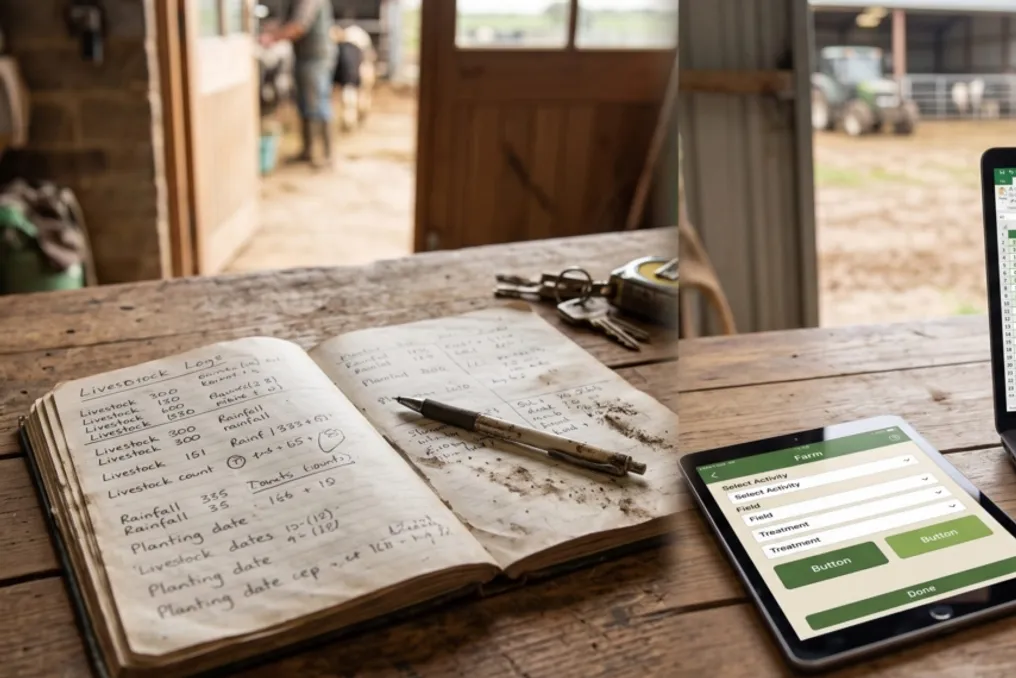
The transition to digital farm management is a long process, not an instantaneous transformation. With the support of Agritistics, scattered notes, WhatsApp messages, and spreadsheets can be organized into unified digital formats for tracking costs and yields.

For many farmers, the idea of 'going digital' seems like a large and expensive step, often associated with complex software, applications, sensors, dashboards, and systems. However, digitalization does not necessarily have to start with the use of advanced technologies.

It can start with something simple, such as improving note-taking methods in a notebook, creating a more structured Excel spreadsheet, or consolidating already collected information in one organized place.

The essence of digitalization is not about increasing the number of technologies used, but about making farm information easier to record, search, compare, and utilize, thereby supporting more informed management decisions.

Before investing in software or changing data collection methods, it is necessary to determine what information is needed to understand one's business. For example, a livestock farmer might want to know the number of animals on the farm, locations of mortality, volume of feed consumed, which animals perform best, and production costs per animal.

A crop grower, on the other hand, may need to compare resource costs, rainfall data, sowing dates, yield per hectare, and profitability across different fields. These questions should determine exactly what data should be collected. Collecting a large volume of data without a clear understanding of the recording purpose can only increase the workload without improving decision-making quality.

A notebook itself is not a bad tool for management. The problem usually arises when the information is incomplete, inconsistent, or recorded long after the action took place. A useful farm record must clearly state what happened, when, where, who or what was involved, and, if necessary, the quantity or cost.

Recording information as close to the moment of the event as possible reduces the risk that records will be forgotten or become inaccurate.

For many farms, a very practical next step is using a structured Excel spreadsheet. If data is recorded sequentially, Excel helps in searching for information, calculating sums, comparing periods, and identifying trends. The most important thing here is the structure of the information itself, not the software.

For example, a record of animal treatment will be much more useful if the animal ID, date, condition, type of treatment, product, and quantity are entered into separate columns, instead of writing all this in one long sentence. A sequential recording format significantly simplifies subsequent analysis.

As the farm grows, information often becomes scattered across multiple spreadsheets, notebooks, WhatsApp messages, photos, and individual computers. At this stage, the problem is no longer a lack of data, but the difficulty of accessing and comparing it.

A centralized platform allows various types of farm information to be gathered in one environment, providing users with access from a single source.

After basic records are structured, one can consider using custom-configured digital forms or applications to simplify repetitive data entry. Employees can select predefined options, such as animal, field, date, treatment, or activity, instead of constantly entering the same information manually.

The best digital system is not necessarily the most advanced; it is one that is practical enough for correct and consistent use. The technology should reduce administrative burden, not create it.

Once farm data is accurate, consistent, and well-organized, it can be visualized for easier trend detection. Instead of reviewing hundreds of lines of information, it can be presented as a graph or chart to monitor indicators such as mortality, feed expenses, yield per hectare, diesel consumption, bee productivity, or sales by category. This is where farm records turn into management information, as one can move beyond simply knowing what happened to understanding where productivity is improving, where losses are occurring, and where attention should be directed.

Digitalization should happen in stages. For one farmer, the next step might just be a better spreadsheet, while another might benefit from data centralization. A more developed farm might be ready for custom applications, automated data collection, or interactive dashboards.

Agritistics helps farmers determine what information is worth collecting, improve and structure existing records, develop custom Excel solutions, centralize farm data, create custom applications, and visualize information through reports and dashboards. You do not need to digitize the entire farm in one day. Start with the right information, create a system that matches your farm's way of working, and develop further. Contact Agritistics to discuss your farm's current status and the next practical step on your digital journey.

Similar stories

Nedbank asserts that agricultural transformation must contribute to the creation of sustainable farms
Read more
foodformzansi.co.za

Nedbank asserts that agricultural transformation must contribute to the creation of sustainable farms

Cobus de Bruyn from Nedbank argues that significant agricultural transformation must go beyond mere land redistribution and focus on creating productive, profitable, and commercially viable farming enterprises. He details the obstacles faced by Black farmers, the necessity of blended finance, and the importance of strengthening partnerships across the agricultural value chain to achieve long-term change.

According to Cobus de Bruyn, Head of Value Proposition for Agriculture Clients at Nedbank, a more inclusive economy in South Africa is necessary to create opportunities for new entrants, develop smallholder farmers into sustainable commercial enterprises, and support the growth of large agribusinesses owned by Black owners. He believes that true transformation should be measured by the success of the farms, not just by land ownership metrics.

Speaking on the Food for Mzansi’s Farmer’s Inside Track podcast, De Bruyn highlighted the progress made since 1994, the ongoing barriers for farmers, and the critical importance of collaboration within the agricultural value chain.

He stated that South Africa needs a more inclusive agricultural economy that can attract new participants and transform small farmers into commercially sustainable businesses while supporting the growth of large-scale agribusinesses owned by Black owners.

De Bruyn identified six drivers for achieving inclusive agriculture: expanding production and stimulating growth, building a broader and more resilient agricultural economy, improving access to finance, markets, and technology, job creation, enhancing resilience and climate adaptability, and boosting South Africa's international competitiveness.

In his view, transformation must build upon existing commercial agriculture while opening real opportunities for farmers across the sector. He emphasized that inclusive agriculture should be measured not only by land transfer or the number of Black farmers, but by how many farmers manage to become productive, profitable, creditworthy, and commercially sustainable.

De Bruyn acknowledged that progress has been made in land transfer in South Africa since 1994. He referenced a 2024 study by Vandile Sikhlobo and Professor Johan Kirsten. According to this study, approximately 19.3 million hectares have been transferred through various mechanisms, accounting for 25% of the country's available agricultural land. These mechanisms included restitution, government land redistribution, private deals, Proactive Land Acquisition Strategy, and government acquisition for agricultural use.

Nevertheless, he countered that land ownership alone does not guarantee long-term economic transformation. Secure title deeds are particularly important as land has the potential to generate wealth across generations, supporting business development and creating additional income.

Addressing this issue, De Bruyn mentioned the argument by Minister of Agriculture Willie Aukamp that transformation cannot be achieved by lifting one part of the sector at the expense of another. He noted that the solution lies in simultaneously uplifting both parts, with the one requiring more attention and resources being accelerated.

He also welcomed President Cyril Ramaphosa's announcement of 2.5 million hectares being transferred to farmers, stressing that careful planning will be required to ensure these lands reach people who can utilize them productively. Nedbank is ready to contribute its expertise to this process, aiming to ensure that transferred land genuinely goes to farmers capable of running operations and that these farmers turn their farms into productive enterprises.

One of the hurdles to transformation, according to De Bruyn, is the terminology used to describe farmers who are still developing their businesses. He opposes the term 'emerging farmer,' believing it risks defining people by what they have not yet achieved rather than recognizing them as farmers. Instead, De Bruyn prefers to refer to them as small, medium, and large commercial farmers. For him, a farmer who produces surpluses and sells them commercially qualifies as a commercial farmer.

He listed several challenges facing farmers, including access to suitable land and secure tenure, delays in title deed transfer, affordable financing, water infrastructure, technical skills, extension services, machinery, production technologies, and market access. However, access to finance remains a particularly acute problem.

De Bruyn reported that commercial banks participated in developing a conceptual document on blended finance with the Department of Agriculture but were largely excluded from this scheme. This limits their ability to finance Black farmers at various stages of commercial development. He explained that a new farmer often lacks the financial backing available to established businesses. Without grants or subsidized loans in addition to commercial financing, growth can slow down. He insisted on the need for access to blended finance to support the government's efforts in implementing transformation.

For De Bruyn, meaningful transformation requires coordinated efforts between the government, organized agriculture, commercial farmers, financiers, and other value chain participants. He stressed that partnerships are crucial for building a sustainable and inclusive agriculture, demanding coordinated action.

He believes that collaboration between commercial banks and the government could yield substantial benefits, especially if they are included in blended finance schemes. Such cooperation could help create new farming enterprises and allow existing African businesses to expand. Partnerships across the value chain can also help farmers overcome barriers in markets, production, and commercial growth.

Nedbank implements this approach through a differentiated inclusive agriculture strategy, investing in resources and processes to support transformation. De Bruyn noted the bank's collaboration with PALS (Partners in Agricultural Land Solutions), under which farmers receive support in training and mentorship, company structuring, legal agreements, and equity arrangements. This partnership also helps farmers gain market access, apply for water rights, and direct loan applications to financiers.

He observed that this collaboration has already yielded significant benefits through transformation projects, allowing the bank to see results on the ground rather than just discussing transformation in theory. Nevertheless, he believes the impact could be greater if commercial banks were included in the blended finance scheme.

Looking ten years ahead, De Bruyn hopes that South African agriculture will reach a point where transformation ceases to dominate the conversation because its results will be evident in thriving farms. His vision is an agricultural sector with active small, medium, and large Black farming operations that can access finance, reach markets, and overcome current growth constraints. For him, the goal is not merely land transfer or increased participation on paper, but building enterprises capable of producing, generating income, creating opportunities, and growing sustainably. He concluded that the path forward depends on the collaborative work of stakeholders to develop agriculture.

Uzbekistan and the World Bank Discuss Agricultural Digitalization Projects
Read more
uzdaily.uz

Uzbekistan and the World Bank Discuss Agricultural Digitalization Projects

The Ministry of Agriculture of Uzbekistan and representatives of the World Bank office in the country held discussions on expanding cooperation in the field of digital transformation of the agricultural sector. Topics discussed included satellite monitoring, artificial intelligence, and modern information systems.

The main focus of the meeting was on the possibilities of implementing advanced digital technologies in agricultural processes and increasing the effectiveness of existing digitalization projects. Representatives of the ministry presented information on the digital platforms currently being implemented in the sector, current technological initiatives, and priority goals for the near future.

Special attention was paid to the 'Digital Agriculture – Agroportal' information system, which integrates over one hundred different services. Participants also reviewed projects related to satellite observation of agricultural lands and the use of Geographic Information Systems (GIS) for analyzing the condition of individual land plots.

Another subject of discussion was the application of artificial intelligence technologies for yield estimation. Representatives of the ministry and the World Bank studied the possibilities of integrating advanced international technological solutions into Uzbekistan's agricultural practices. The conversation also covered the development of new digital tools and measures aimed at increasing the efficiency of already implemented projects.

At the end of the meeting, the parties reached a preliminary agreement on continuing joint work and developing prospective initiatives in the field of agricultural digitalization. Furthermore, they agreed in principle on the phased implementation of future projects according to mutually approved plans.

Simple farm records are more effective than complex systems for increasing profitability
Read more
foodformzansi.co.za

Simple farm records are more effective than complex systems for increasing profitability

To increase the profitability of a farm, it is not necessary to use expensive digital platforms or complex systems. Data analyst Stefan Corbett explains how simple and consistent record-keeping transforms daily farm data into useful information for profit growth without the need for costly technologies.

Many producers may view collecting farm data and digital agriculture as a complicated and expensive task. However, Corbett argues that using farm data does not require expensive equipment or an overly complex accounting system; consistent and reliable tracking of basic agricultural operations is sufficient.

According to Corbett, most farmers are already collecting more data than they realize through daily activity logs, weather data, bank notifications, and regular correspondence.

Corbett emphasizes that raw data, such as bank transactions, purchase invoices, or daily precipitation figures, only become valuable management information when they are directly linked to production outcomes.

He notes: 'Information is what I can influence. Data is just a record of what happened.' He further explains that 'when I start linking different data points throughout an animal's life to see where that animal was, what I changed, and then see the reaction a month later, it becomes information about whether my management decision or my investment had a positive impact.'

Instead of trying to track every parameter, producers should focus on simple, high-value metrics that provide a clear picture of operational activities.

A critical error in record-keeping is the collection of inconsistent data. When measurements are taken under different conditions, such as weighing livestock before feeding one week and after feeding the next, the data becomes distorted and unreliable.

To prevent unreliable data, Corbett advises implementing clear Standard Operating Procedures (SOPs) for data collection across the entire farm. He warns: 'All data works on the basic principle of 'garbage in, garbage out'. If I don't record my data correctly, or if several people record the same parameter but differently, my data becomes unreliable.'

Small and medium-sized enterprises do not always need to immediately switch to complex digital platforms. Simple tools, such as notebooks, WhatsApp messages, or basic Excel spreadsheets, provide accessible and persistent records that build trust and allow for long-term trend analysis.

Corbett quotes: 'We have a saying: a dull pencil is still better than a sharp mind.' He adds that 'everything that is recorded is worth much more than what we try to remember.'

Producers who wish to start structured record-keeping should begin with one easily trackable metric, such as the weight of individual animals tied to specific dates, or daily rainfall, and gradually expand their data systems over time.

Popular