MTN Nigeria's revenue growth resumed in the third quarter despite fintech segment challenges
Read more
TechCentral
techcentral.co.za

MTN Nigeria's revenue growth resumed in the third quarter despite fintech segment challenges

MTN Nigeria's business activity growth accelerated again in the third quarter, following a noticeable slowdown observed during the first three months of 2024. Nevertheless, the company's fintech division continues to recover after the suspension of airtime credit services.

Service revenue increased by 19.7% year-on-year, reaching ₦1.61 trillion in the first three months leading up to September, which is higher than the 13.2% growth rate in the second quarter. The growth showed monthly acceleration, reaching 21.6% in September. Over nine months, service revenue grew by 23.7%, totaling ₦4.6 trillion.

Earnings before interest, taxes, depreciation, and amortization (EBITDA) increased by 32.8% to ₦951 billion in the reported quarter, and the EBITDA margin expanded by 5.8 percentage points to 58.7%. Net profit after tax rose by 36.5% to ₦457.6 billion.

MTN Nigeria is the largest operation in the JSE-listed MTN group, where its wholly-owned subsidiary, MTN International (Mauritius), holds 73.39% of the shares.

Management Commentary on Results

CEO Karl Torola stated that the company demonstrated a 'very strong third quarter, reversing the temporary slowdown of the second quarter.' He noted that the growth is increasingly driven by volume increases, supported by growing user numbers, deeper data penetration, increased usage frequency, and rising demand for home broadband, facilitated by continuous investments in network coverage, capacity, and quality.

Data revenue grew by 31.4% to ₦981.4 billion in the quarter, while voice revenue increased by 9.3% to ₦503.3 billion. Subscriber numbers grew by 10.9%, reaching 94.7 million, and active data users grew by 12%, totaling 57.2 million. In the third quarter, active data users consumed an average of 17.2 GB per month.

The growth this quarter was slightly below the company's medium-term forecast for service revenue growth, which was 'no less than 20%,' but the nine-month figure meets this forecast. MTN Nigeria confirmed its forecast, as well as its expectation for the EBITDA margin 'to be in the mid to upper 50% range.'

Fintech Sector Challenges

Fintech segment revenue decreased by 58.1% in the quarter, amounting to ₦20.3 billion, and by 25.9% over nine months, reaching ₦97.5 billion. MTN Nigeria attributed this to the suspension of its airtime and data lending service from April to June.

The service was resumed 'under a new multilateral model,' and its revenue increased by 78.5% compared to the second quarter. MTN Nigeria plans to restore the service 'to expected levels by the end of November 2026.' The results do not disclose partner names. Optasia, listed on the JSE and providing airtime loans to MTN customers, relaunched the XtraTime service on June 24, and its own forecasts already indicate a slower second half.

Loan losses also increased. Expected loan losses for MTN Nigeria on trade receivables rose to ₦15 billion over nine months compared to ₦2.4 billion, which is 'mainly due to the revaluation of XtraTime receivables.'

The company's mobile bank, MoMo PSB, migrated to the new Alipay+ platform in August following MTN's deal with the Alipay owner to transform MoMo into a super-app. This transition led to wallet losses. Active MoMo wallets fell to 3.2 million by the end of September from 3.8 million by the end of 2025 after decommissioning outdated wallets. When measured only on the new platform, monthly active users were 3.2 million, an increase of 11.6% year-on-year.

Wallet balances increased more than fourfold to ₦43.8 billion since December, helping to double the core mobile money revenue. The planned structural separation of the fintech business from MTN Nigeria, approved by shareholders in April, is still awaiting regulatory approval.

Johannesburg Cash Flows

MTN Nigeria paid out ₦859.7 billion in dividends over nine months: a final dividend of ₦15/share for 2025 and an interim dividend of ₦26/share, compared to ₦5/share the previous year. MTN International (Mauritius) received ₦655.6 billion, excluding withholding tax. This amounts to approximately $490 million at the end-of-September exchange rate.

These payouts mark a turning point compared to 2024, when foreign exchange losses caused MTN Nigeria's total equity to be in negative territory. Equity stood at ₦843.9 billion by the end of September versus minus ₦458 billion at the beginning of 2025.

MTN Nigeria has repaid all its foreign currency debt, and its borrowings are now fully denominated in Naira at fixed rates. A stronger Naira, at a rate of ₦1,329 per dollar at the end of September compared to ₦1,475 the previous year, generated a net foreign currency gain of ₦80.1 billion over nine months.
Similar stories

Wanatu uses Google Maps services to scale its taxi service across South Africa
Read more
techcentral.co.za

Wanatu uses Google Maps services to scale its taxi service across South Africa

The ride-hailing platform Wanatu, which is demonstrating rapid growth in Pretoria and Centurion, plans to expand its operations to other Gauteng areas and centers across South Africa. This has been made possible by the implementation of a new technology stack utilizing a suite of Google Maps Platform Mobility Services.

Launched in 2024 as a safer alternative to public transport, Wanatu currently serves 131 drivers and completes up to 12,000 trips monthly. Thanks to the new technology, the company is actively strengthening its market position.

Built on Google Maps Mobility Services

The new technology stack was implemented in July of this year by the software development company Project Troy. It is built using the Google Maps Mobility Services toolkit from 28East, which is a partner of Digicloud Africa and an authorized Google Maps specialist in Africa.

Marius van der Merwe, founder and CEO of 28East, explains that Google Maps Mobility Services is a specialized set of tools for development and backend infrastructure created for on-demand ride-hailing applications, scheduled transport, and last-mile logistics. According to him, this implementation allows Wanatu to grow and develop its business model.

He notes: 'Google developed this suite for very specific use cases, including components such as a fleet engine, driver SDK, and consumer SDK. It is a private program available only through partners, providing the building blocks necessary for companies like Wanatu.'

Gustav Grotius, co-founder and systems and logistics manager at Wanatu, emphasized that the previous navigation system did not meet their needs. He stated: 'We identified a huge need for safe and reliable transport across the country, but our technology stack hindered our expansion.'

Wanatu faced the need to eliminate navigation blind spots, inaccurate Estimated Time of Arrival (ETA) calculations, and dispatching issues caused by unreliable routing in Gauteng. Furthermore, real-time driver tracking, reliable location updates upon signal loss, and full operational visibility were required.

Kent Klein, CEO of Project Troy, and Johan Bloem, his CTO, explained that Wanatu's technology stack was completely rebuilt to provide more advanced features for Wanatu's drivers, passengers, and management.

Bloem reported that the previous stack was based on a .NET Azure stack with Microsoft SQL databases and proprietary navigation software.

Klein added: 'They needed a different stack with a completely different look and feel, which eliminated guesswork in mobility elements. Wanatu also needed accurate data to improve routing and resource utilization. For example, an incorrectly mapped route means the customer ultimately loses revenue because if a fixed fare was quoted, and the driver chooses a longer route, it is simply not good business.'

The new solution includes Google Maps Platform Mobility and Fleet Engine, providing advanced and accurate navigation, up-to-date street names, and real-time traffic information. The system eliminated navigation blind spots through real-time driver tracking and live maps. It also significantly improved ETA, optimized dispatching and routing accuracy, and enabled data-driven planning.

Grotius noted: 'Thanks to our new technology stack and Google Maps Mobility Services, we are now confidently exploring expansion opportunities in Gauteng, and we are negotiating with authorities in other South African centers. We are also considering adding parcel delivery services to our portfolio.'

Update on Stale Detection

One of the key hurdles to overcome was 'staleness'—the situation where the previous system lost information about which drivers were available in which areas.

Bloem explained that a live dashboard was created to implement stale detection, showing all drivers, their current locations, and the time of the last location update. If staleness is detected, the dispatch center can call the driver to confirm their location. This allows Wanatu to direct the nearest driver to a trip request, improving both the customer and driver experience.

Van der Merwe added that another advantage of Google Mobility Services is the billing model. He explained: 'Google packaged this last-mile product with a unique commercial model. Standard Google Maps APIs and their pricing work on an input API basis, meaning there is a certain cost every time you call the API. It is pay-as-you-go. But a company like Wanatu charges customers a fixed or agreed rate. Therefore, instead of paying for all input APIs, Google bills for each successful trip.'

Grotius considers this model important for Wanatu. 'This was a major issue from the start because usually in the environment we operate in, as a new industry player, people want to see what the app looks like and how it works. So many consumers experiment without booking a trip, and in the past, we had to pay for that. With the Google Mobility package, it is no longer the case.'

Readiness for Growth

Grotius concluded: 'With our new systems, we are better equipped to identify additional revenue opportunities, discover reasons for revenue loss, improve fleet positioning, and raise our service standards. Customer satisfaction has also increased. We have received many wonderful positive reviews about the modernized platforms; customers say they are easier to use, ETAs are more accurate, and drivers are closer. This is because we now have the necessary information to place drivers in the right places at the right time and even predict demand.'

He also noted that 'Drivers gain much more efficiency in their daily lives. They are also satisfied that ETAs are accurate, as this in turn allows them to complete more trips and earn more tips and bonuses.'

Grotius stressed: 'Google Maps is a giant in this industry. It is constantly introducing new features, functionalities, and plug-in components. We haven't even explored the entire suite of Google Maps Mobility Services and all the plug-in components we can use. But since we have already integrated the Mobility Suite, we will be able to innovate and develop rapidly, staying at the forefront while Google continues to push boundaries.'

Nigerian Startups Regain Leadership in Africa, Attracting $635 Million in Funding in 2026
Read more
ventureburn.com

Nigerian Startups Regain Leadership in Africa, Attracting $635 Million in Funding in 2026

Despite Nigeria remaining the most populous country in Africa, Kenya and Egypt attracted venture capital over the last three years. However, the situation has drastically changed: by the end of the third quarter, Nigerian startups once again took the top spot in Africa, raising an impressive $635 million.

This achievement goes far beyond a minor success, as it demonstrates a return of venture capital to the country. The funding secured in the first three quarters more than doubled the $247 million attracted during the same period last year.

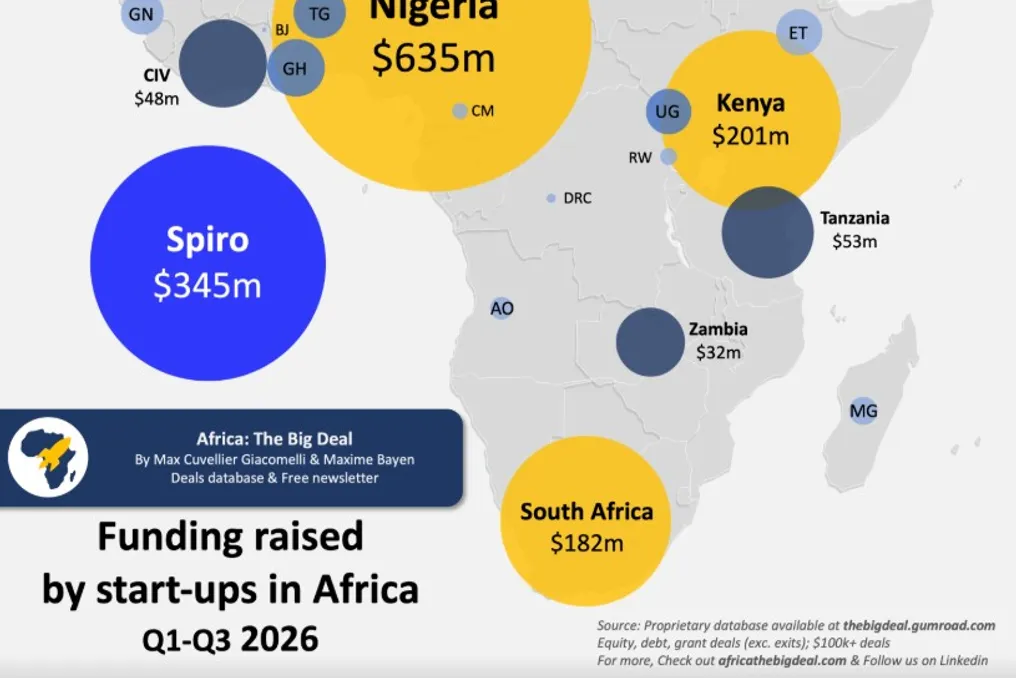
According to Africa: The Big Deal, Nigerian startups raised $635 million in the first three months, taking the leading position. This sudden influx of funds is not random; investors are directing large investments exclusively into proven companies with serious growth momentum.

Four specific companies accounted for 69% of the total national volume, representing an increase of $440 million. Mobile finance giant Moove led this list, securing an impressive $250 million. Fintech giant Flutterwave followed, attracting $100 million despite ongoing market adjustments.

Among the leaders were e-commerce veteran Jumia, which raised $50 million, and the crypto infrastructure platform Yellow Card, which received $40 million. This proves that late-stage growth capital is still actively being utilized in Africa.

This capital inflow demands close attention from everyone involved in creating, investing, or simply observing the African tech ecosystem. This is not just a statistical anomaly but a signal of a massive geographical and sectoral shift across the continent. The era of easy money has ended, giving way to calculated bets on large companies.

One of the most unexpected turns in the 2026 funding narrative is what venture capitalists are actually acquiring. For almost seven years, fintech was the undisputed leader of African venture capital. But now the situation has changed: logistics and transport enterprises have aggressively taken this position.

Across the continent, mobility startups attracted a colossal $780 million in just nine months, accounting for 36% of all venture funding, while fintech dropped to 35%. This shift fundamentally changes the approach to launching startups. Thanks to large rounds from companies like Moove and the electric mobility player Spiro, there is an active drive to solve complex problems related to infrastructure and physical mobility.

Nigeria's financial resurgence looks even more significant when viewed in the broader picture. While Lagos celebrates its successes, other major tech hubs are experiencing a severe shortage of venture capital. Kenya faced a sharp 73% year-on-year decline, raising only $201 million. South Africa also showed weak results, losing 58% of the previous volume and receiving a modest $182 million. Only Egypt managed to hold its ground, attracting a respectable $445 million.

Accounting for 37% of all funding by country on the continent, Nigeria has effectively re-centered the African tech dialogue. The message to the world is crystal clear: the Giant of Africa has awakened and is fiercely writing the next chapter of the continent's digital revolution.

Popular