As software creation has become a rapid process, as demonstrated by the example of a founder from Srinagar who quickly built a website and application on Hostinger, the focus for businesses is shifting from the question of whether a product can be created to the question of why the consumer will choose this specific product.
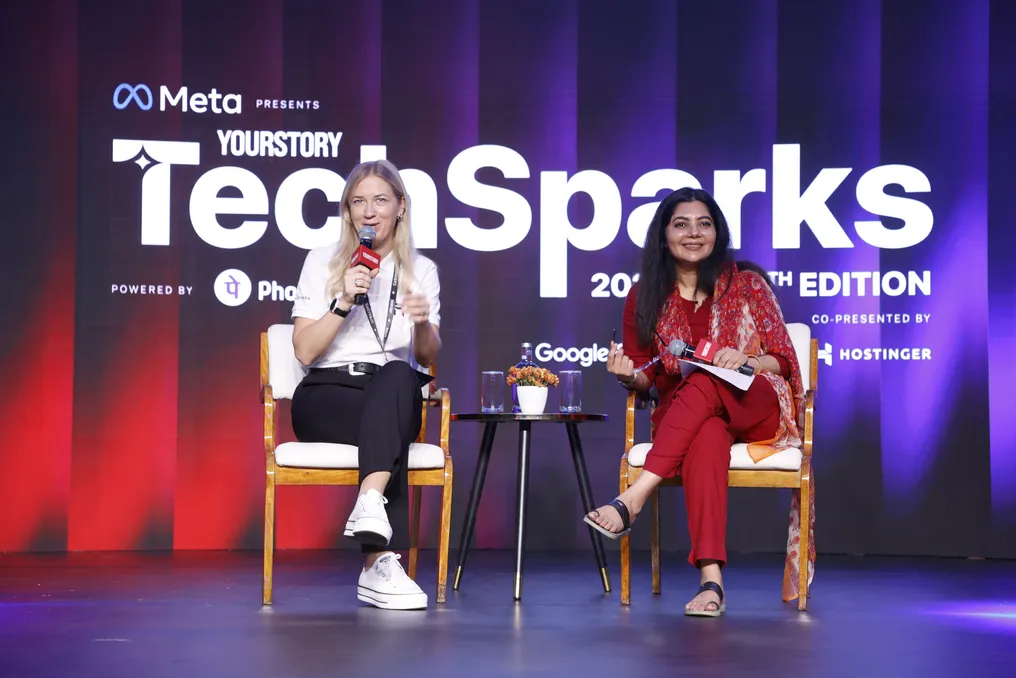
This shift became a topic of discussion at the TechSparks 2026 event in Bengaluru, YourStory's flagship event. Auxe Zhirgule, Vice President of Product at Hostinger, held a conversation with Shraddha Sharma, Founder and CEO of YourStory and The Bharat Project, about the implications of any business being able to create its own software independently.
Zhirgule began her talk by describing how customer requests to Hostinger have changed. Previously, publishing a website was a complex task for people without technical skills, and the company's mission was to help everyone succeed online. However, now that artificial intelligence has eliminated many of these barriers, founders no longer need to worry about how to build a product; they focus on attracting customers, increasing revenue, and managing the business.
Part of the problem is fragmentation: a new founder might purchase a domain on one platform, set up email on another, and run campaigns on a third, resulting in five subscriptions and five accounts. When something breaks, the founder is forced to act as an integration specialist or technician. Hostinger's response is to take over the entire workflow and integrate AI agents into it.
Since code is no longer a scarce resource, the competitive advantage shifts towards understanding customer needs. Zhirgule argues that founders must know precisely what problem they are solving and test the product as early as possible. Innovation, in her opinion, does not necessarily mean inventing something entirely new; for instance, the iPhone succeeded not because it invented the mobile phone or the touchscreen, but because it provided the best user experience.
Referencing the book 'Monetizing Innovation,' she highlighted a point often forgotten by developers in the rush to test: a great product does not always guarantee a successful business. It is necessary to start thinking about how the product will reach the market at early stages. This is why she insists that customer obsession must remain constant. 'Customer obsession is the foundation, and I know AI is everywhere now, but that is the part we must preserve,' she stated, referring not to automated emails surveys, but to genuine conversations.
Sharma shared a lesson learned during The Bharat Project's travels through the states of Bihar, Eastern Uttar Pradesh, Assam, and Chhattisgarh. The team expected responses via email or WhatsApp, but many people observed them on Facebook. Sharma noted that customers are not always where founders assume they are.
As agents take on more decisions, the question arises of who makes the final decision. Currently, according to Zhirgule, it is still the founder. 'AI can do a lot, but the founder has the final say,' she said. She added that trust must be earned. She gave the example of a Hostinger agent that agreed to an email conference, and the CEO only learned of the agent's participation through LinkedIn. Her conclusion was to treat the agent like a new employee: 'I look at it as a new colleague,' which implies vetting their work and observing their behavior before assigning them more responsibilities. This trust is what concerns her most, despite the enthusiasm for the speed of technological development.
Zhirgule noted that sales approaches vary greatly depending on the market, citing India and Brazil as examples, so products must adapt. Sharma observed that the conversation about AI in tech circles can differ significantly from the real world. Zhirgule agreed that adoption cycles vary, and those who are not yet convinced need to be shown the value of AI.
Audience questions covered where automation should stop, whether customer expectations will rise, and how non-technical founders can write good prompts. Zhirgule advised that agents should be thoroughly tested and monitored before automating anything else, and rising expectations mean that products with strong user experience and high quality will prevail.
If software launches become as fast as the founder from Srinagar, the session showed that what will differentiate a business is customer knowledge, final decision-making, and earning trust, whether from a user or an AI agent. Code may cease to be scarce, but these three qualities remain so.