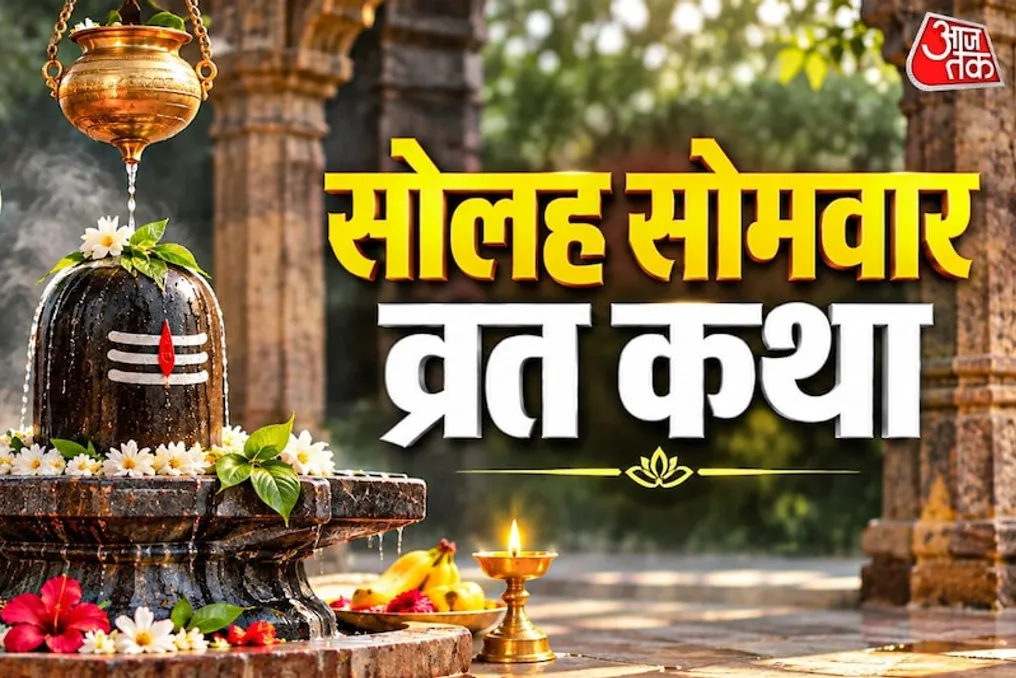
Veneration of the Sacred Story of Sixteen Mondays: How Observing This Ritual Bears Fruit
Read more
Aaj Tak
www.aajtak.in

Veneration of the Sacred Story of Sixteen Mondays: How Observing This Ritual Bears Fruit

In Hinduism, the fast of sixteen Mondays (Solah Somwar Vrat) is observed in honor of worshipping the god Shiva. It is believed that regularly observing this fast for 16 weeks can lead to the fulfillment of desires. Many people adhere to this fast hoping to achieve a happy family life and have children, as well as overcome life's difficulties. There is also a mythological story associated with this fast that reveals its significance.

The story tells of how once the gods Shiva and Parvati went for a walk on Earth and reached a place called Amavratti. There they stopped at a beautiful temple of Shiva. One day, Parvati suggested playing the game Chosar with Shiva. Before starting the game, she asked the temple priest who would win. The priest, without hesitation, named Shiva.

However, Parvati won the game. Angered by the priest's incorrect prediction, she cursed him with leprosy. Shiva tried to appease Parvati, but she did not yield. After this, the priest contracted leprosy, and his life was filled with adversity.

Some time later, several apsaras came to the same temple to worship. They saw the priest in a dejected state and asked him about the reason for his suffering. The priest told them his entire story. Hearing this, the apsaras advised him to observe the fast of sixteen Mondays. They explained that if this fast is performed with a sincere heart, Lord Shiva will be pleased, and his blessings can help fulfill the wishes of the devotees.

Afterward, the apsaras instructed the priest on how to observe the fast correctly. He was told to bathe and wear clean clothes every morning, and to worship Shiva in the evening. After worship, he needed to prepare an offering of wheat flour: part was given to Shiva, and the rest was shared among the people. This process should continue for 16 Mondays. Upon completion of the sixteenth Monday, on the seventeenth, churma made from wheat, ghee, and maple syrup should be prepared, offered to Shiva, and then distributed to everyone.

The priest followed the apsaras' advice and observed the fast for 16 Mondays, sincerely worshipping Shiva. Soon, thanks to Shiva's grace, his illness receded. One day, Shiva and Parvati came to that temple again and were amazed by the priest's health. When they asked the reason for his recovery, the priest stated that it was due to the fast of sixteen Mondays.

Hearing this, Parvati also decided to observe the fast of sixteen Mondays. She wished for her son Kartikeya to love her again as before. According to beliefs, the influence of the fast changed Kartikeya's mood, and a feeling of love and respect for his mother was rekindled in his heart.

Learning about the fast of sixteen Mondays from his mother, Kartikeya also decided to observe it. He wanted to meet his old friend whom he hadn't seen in a long time. After completing the fast, thanks to Shiva's grace, his wish was fulfilled. Then Kartikeya told his Brahmin friend about the fast. Hearing this, the Brahmin began the fast of sixteen Mondays in hope of marriage. Soon he arrived in a kingdom where a samvarvar (bride competition) was taking place. At the competition, the princess chose this Brahmin as her husband, and they married.

After the wedding, the princess wanted to have children. To this end, she worshipped Shiva and began the fast of sixteen Mondays. According to beliefs, hearing her prayers, Shiva granted her wish, and soon she gave birth to a son. When the boy grew up, he decided to become a king and began the fast of sixteen Mondays. Shiva was pleased with his devotion and granted his wish. Soon he married the daughter of a king who had no brothers or sisters. After the king's death, this young man became the ruler of that kingdom.

According to this story, on the seventeenth Monday, the king asked the queen to visit Shiva's temple for worship, but the queen herself did not go, only sending items for the ritual. At that moment, a heavenly voice sounded, warning that if the queen remained in the palace, a great calamity would befall the kingdom. After this, the queen had to leave the palace.

Wherever the queen went after leaving the palace, problems arose. Distressed, she approached a saint and told him her entire story. The saint advised the queen to observe the fast of sixteen Mondays. The queen agreed and began the fast with complete devotion. According to beliefs, thanks to the influence of this fast, the king learned the whereabouts of his wife and brought her back to the palace. After this, they lived together and worshipped Shiva. The story says that at the end of their lives, thanks to Shiva's grace, they attained liberation (moksha).

Therefore, the fast of sixteen Mondays is considered special. Religious beliefs state that a devotee who observes this fast with a pure heart enjoys Shiva's favor. Furthermore, Bholenath fulfills the wishes of his followers and removes their life hardships.


Similar stories

Start of Kartik Maas in 2026: Rules for Worshiping Tulsi and Lighting Lamps
Read more
www.aajtak.in

Start of Kartik Maas in 2026: Rules for Worshiping Tulsi and Lighting Lamps

In Hinduism, the month of Kartik Maas is considered an exceptionally sacred period dedicated to worshipping Lord Vishnu, performing charity, and observing religious rituals. Special importance is given during this time to the rituals of honoring Tulsi and lighting lamps. According to religious beliefs, if one lights a lamp near the Tulsi plant, worships Lord Vishnu, and helps those in need during Kartik Maas, prosperity and well-being will come to the home. It is believed that good deeds performed with sincere faith during this month yield special rewards.

According to the lunar calendar, Kartik Maas will begin on October 27, 2026, and end on November 24, 2026. Important festivals such as Dhanteras and Diwali will be celebrated during this month. To learn about the religious significance of Kartik Maas, rules of conduct, and dietary recommendations, astrologer Shailendra Pandey was consulted.

Why is Kartik Maas considered special?

Every month in the Hindu Panchang is associated with a specific constellation. The name Kartik Maas originates from the Kritika constellation. In Hinduism, the months of Shravan, Margashirsha, and Kartik hold great significance. Kartik Maas is the last month of Chaturmas. There is a belief that performing prayers, observing fast days, bathing in the Ganges, and engaging in charity during this month earns merit. Furthermore, many devotees visit holy places for worship and participate in religious ceremonies.

Significance of Worshipping Tulsi and Lighting Lamps

Special attention is paid to the rituals of honoring Tulsi and lighting lamps during Kartik Maas. Religious tradition states that regularly lighting a lamp near Tulsi and worshipping Lord Vishnu during this month maintains peace and tranquility in the home. Therefore, many people light lamps near Tulsi in the morning and evening. Charity is also considered auspicious during this period. Additionally, some people perform circumambulation of Panchkosi or 14 Kosi, as well as the circumambulation of Govardhan.

What to Pay Attention to During Kartik Maas

During Kartik Maas, it is recommended to pay close attention to diet and daily routine. Since the season changes during this period, it is important to consume nutritious food and maintain a regular sleep and wake schedule. According to beliefs, consuming milk, ghee, nuts, and seasonal fruits is beneficial during this month. It is also recommended to spend some time in the morning sunlight and maintain a regular daily routine. At the same time, daytime sleeping should be avoided.

Why is Tulsi Worshipped in Kartik Maas?

In Hinduism, the Tulsi plant is considered very sacred. In religious scriptures, Tulsi is also called Vrinda. According to mythological history, Vrinda was devoted to Lord Vishnu, and her husband was Shankhachud. This legend describes events related to Vrinda's curse and Vishnu's form as Shaligram. Religious beliefs emphasize the special significance of Tulsi leaves in worshipping Lord Vishnu. Therefore, worshipping Tulsi and Tulsi Vivah during Kartik Maas is considered auspicious. There is a tradition of caring for the Tulsi plant, lighting a lamp near it, and offering Tulsi leaves to Lord Vishnu. It is believed that worshipping Tulsi brings peace to the home and the grace of Lord Vishnu.

How to Light Lamps in Kartik Maas?

Lighting lamps holds special significance during Kartik Maas. During this month, after morning ablutions, one should light a lamp at the main entrance of the house and in the prayer corner. A lamp using ghee or sesame oil can be used. While lighting the lamp, one should remember Lord Vishnu and Mother Lakshmi. During this month, it is also necessary to donate grains, clothes, or other necessary items to needy people. According to beliefs, regularly lighting lamps during Kartik Maas promotes peace and prosperity in the home.

How to Worship Lord Vishnu in Kartik Maas?

Worshipping Lord Vishnu during Kartik Maas is considered auspicious. After morning ablutions, one should worship Lord Vishnu by offering him Tulsi leaves. During this time, one can recite mantras of Lord Vishnu or the Vishnu Sahasranama Patha. In the evening, one should worship Mother Lakshmi and light a lamp near Tulsi, while also reciting the Lakshmi Ashtakam. Religious beliefs assert that performing daily rituals during Kartik Maas brings mental peace and well-being to the family.

Rama Ekadashi Date 2026: Information on the Date, Auspicious Time, and Fast Completion Time
Read more
www.aajtak.in

Rama Ekadashi Date 2026: Information on the Date, Auspicious Time, and Fast Completion Time

In Hinduism, the date of Ekadashi holds special significance for worshipping Lord Vishnu. Every month has two Ekadashi days, and each possesses its own unique religious meaning. Among them is Rama Ekadashi, which is observed during the dark moon of the Kartik month. This Ekadashi falls shortly before Diwali, and on this day, worship is performed to Lord Vishnu and Goddess Lakshmi. According to religious beliefs, observing the fast with sincere faith and performing rituals on this day brings auspicious results. It is believed that the fruits of the Rama Ekadashi fast are equivalent to the Yajña of Vajapeya.

According to the Drik Panchang, the start of the Ekadashi date in the dark moon of Kartik will be on November 4, 2026, at 11:03 AM. The completion of this date is scheduled for November 5 at 10:35 AM. Therefore, according to the ascending date, the Rama Ekadashi fast will be observed on November 5, 2026, Thursday.

For prayers and rituals on Rama Ekadashi, the Abhijit Muhurta is considered auspicious. According to Drik Panchang, on this day, the Abhijit Muhurta will last from 11:43 AM to 12:26 PM.

In addition to observing the fast on Ekadashi, it is crucial to complete it at the designated time. According to the Panchang, the completion of the Rama Ekadashi fast will take place on November 6, 2026, Friday. The auspicious time for completing the fast on this day is set from 6:37 AM to 8:48 AM.

Rama Ekadashi falls on the dark moon of the Kartik month. This fast is of great importance in Hinduism. Since this Ekadashi occurs during Chaturmas, Lord Vishnu is worshipped along with Goddess Lakshmi on this day. Goddess Lakshmi is also called Rama, so worshipping her on this day is considered auspicious. There is a religious belief that by observing the fast with a pure heart and performing rituals, the grace of the gods Vishnu and Lakshmi will be attained.

Date and Time for Ravana Dahan and Puja on Dussehra 2026
Read more
www.aajtak.in

Date and Time for Ravana Dahan and Puja on Dussehra 2026

Vijayadashami is celebrated in honor of Lord Shri Rama's victory over Ravana, symbolizing the end of evil. This festival reminds everyone that even the most powerful manifestations of arrogance and injustice eventually yield to truth and good. On this day, effigies of Ravana are burned across the country, and worship is performed to Lord Rama, Goddess Durga who destroys Mahishasura, and weapons are venerated.

According to the Hindu Panchang, the date Ashvin Shukla Dashami falls on October 20, 2026, starting at 12:51 PM and concluding on October 21 at 2:11 PM. Therefore, celebrating Dussehra is recommended specifically on Tuesday, October 20.

The Hindu Panchang indicates that the date Ashvin Shukla Dashami will be valid from 12:51 PM on October 20, 2026, until 2:11 PM on October 21. Based on the rising date and Panchanga calculations, Vijayadashami is celebrated on October 20, a Tuesday. On this day, people also worship the Shami tree.

On Dussehra, there is a ritual of worshipping Lord Rama, Goddess Durga, and weapons. The best time for performing the puja is considered to be Vijayad Muhurta. On October 20, Vijayad Muhurta is scheduled from 1:59 PM to 2:45 PM. However, it is advised to avoid conducting any auspicious deeds or religious rituals during the Rahu Kaal period, which lasts from 2:56 PM to 4:21 PM.

The auspicious time for burning the Ravana effigy is considered to be Pradosha Kaal. During this time, the triumph of Lord Rama is celebrated by burning the Ravana effigy. According to the Panchang, the muhurta for Ravana Dahan on October 20 will be from 5:47 PM to 8:23 PM. If one wishes to perform a special ritual at night, worship may take place during Nishita Kaal from 11:41 PM to 12:31 AM.

Dussehra has been revered for centuries as a symbol of the triumph of truth over falsehood and Dharma over Adharma. It is believed that in the Treta Yuga, Lord Rama destroyed Ravana, ending evil, and since then, the tradition of burning Ravana has become a symbol of the end of evil and arrogance. Lord Rama's life inspires people to embrace principles of virtue, goodness, and high qualities.

Popular