The research institutes of China Telecom, YOFC, and ZTE have completed the implementation of what they call the world's first real-time bidirectional data transmission over fiber optic cable spanning over 1000 kilometers, as announced by the China Telecom Research Institute on November 2, according to sources IT Home and C114.
On a line measuring 1007.48 km, the partners achieved a speed of 800 Gbps per wavelength using PCS-16QAM modulation in the extended C+L band, transmitting signals in both directions through a single optical fiber cable, resulting in a total capacity of 128 Tbps. These three organizations collaborated as joint builders of a national key laboratory.
The partners reported three significant achievements. This experiment set a record for the longest single-point, non-loop real-time data transmission over fiber optic cable while maintaining a loss margin of at least 3 dB on each segment and an Optical Signal-to-Noise Ratio (OSNR) margin of at least 3 dB for system operation. Furthermore, it became the first real-time bidirectional transmission over a single optical fiber line at the 1000 km scale.
Although reflections reduced the OSNR by between 0.5 dB and 4 dB, the team believes this proves the feasibility of long-haul bidirectional operations. Finally, the longest fiber optic line in the extended C+L band free from gas line absorption was constructed.
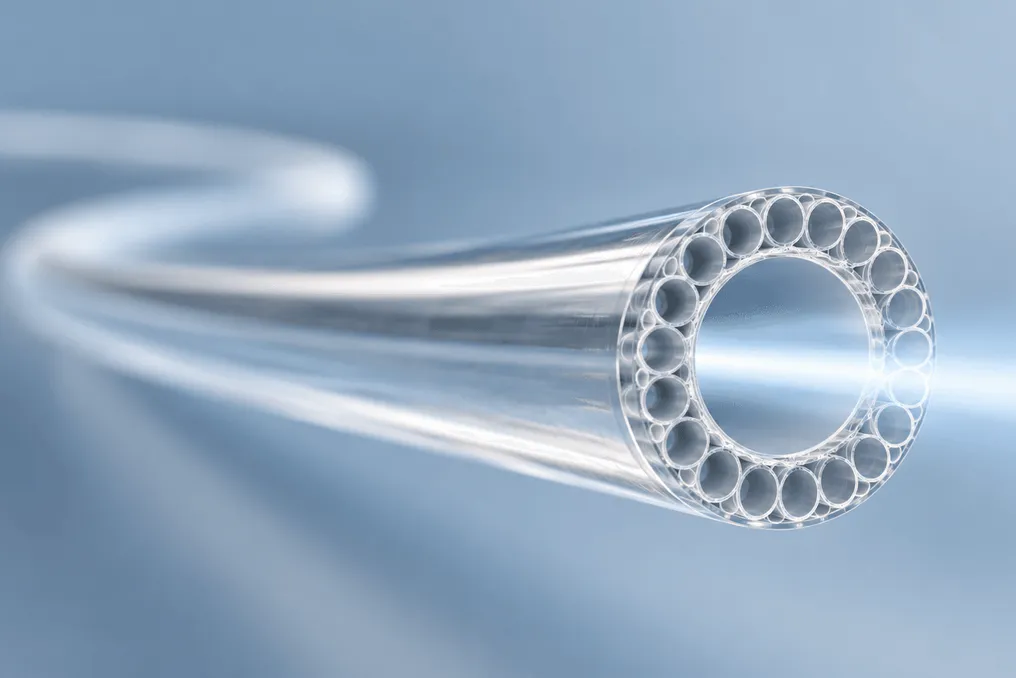
The last point concerns an issue specific to this technology. Since light in hollow-core fiber passes through gas rather than solid glass, traces of carbon dioxide and carbon monoxide in the core can absorb certain wavelengths and degrade transmission. To solve this problem, the team improved the manufacturing process to eliminate these absorption lines across the entire extended C+L band.
Regarding equipment, the partners eschewed high-power amplifiers and used commercial amplifiers with standard output power, matched to the fiber loss profile, to achieve optimal performance from a fully loaded 800G system. Light pre-equalization at the transmitter level maintained channel stability across the entire band. The team also developed an end-to-end model of the impact of reflections and intermodal interference on the line and tested an extreme scenario where part of the band failed without detecting any performance loss.
Operators are most interested in latency. Light in hollow-core fiber travels almost at the speed of a vacuum, approximately 30% faster than in traditional glass fiber, saving about 1.5 milliseconds in each direction over a 1000 km route. The announcement did not specify the measured latency value. Until now, hollow-core fiber in China has mainly been used for short connections, such as between data centers in Chunwei, Ningxia, whereas computing clusters in the west are often more than 1000 km away from demand in the east. China Telecom stated that the result provides a practical technical basis for creating high-capacity, long-distance, and low-latency backbone networks based on fiber optic cable.