Altron increases dividends by 15% amid growth in IT services revenue
Read more
TechCentral
techcentral.co.za

Altron increases dividends by 15% amid growth in IT services revenue

Altron has increased its interim dividends by 15%, bringing them to 55 cents per share, as revenues in the IT services segment began to recover after a two-year period of restructuring. Over the six months ending in August, IT services divisions' revenues grew for the first time since the restructuring, and Altron Digital Business became profitable after incurring a loss a year earlier.

However, the security division faced a sharp decline in profit. Earnings per share from continuing operations increased by 14% to 109 cents, aligning with the range of 107–112 cents that Altron indicated in September. The company's total revenue grew by 5% to 5.1 billion Rands, which the group described as the strongest interim growth in three years.

Operating profit increased by 13% to 622 million Rands, and net profit rose by 17% to 385 million Rands. EBITDA increased by 16% to 1.09 billion Rands.

Platform segments show growth

The platform divisions—Netstar, Altron FinTech, and Altron HealthTech—have once again become the main driver of growth, contributing 47% of total revenue and over 95% of operating profit. Annuity revenue in this segment increased by 11% to 2.2 billion Rands, now accounting for 92% of the segment's turnover.

CEO Werner Kapp noted that the group demonstrated the strongest revenue growth in three years while improving the quality and predictability of earnings through an increased share of annuity revenue and strong cash generation, which grew by 32% to over 1 billion Rands over the six months.

Growth in IT Services

Altron Digital Business, the group's largest IT services division, increased revenue by 8% to 1.6 billion Rands and posted an operating profit of 22 million Rands, compared to a loss of 42 million Rands a year earlier, reflecting improvements made in the second half of the previous fiscal year. Growth was driven by hardware: revenue from goods sales and related services increased by 42% to 502 million Rands, while revenue from maintenance, support, and outsourcing decreased by 10% to 505 million Rands. The company reported improved order volume and contract renewals.

Challenges in Altron Security

The situation at Altron Security was the opposite. Revenue fell by 18% to 207 million Rands, and operating profit dropped from 70 million to 29 million Rands. Altron attributed this to the timing of recognizing software revenue in its identification and digital signature business, as well as limited enterprise spending in its much smaller IT services component, where management initiated 'corrective actions.'

During the reporting period, the division completed the implementation of Zambia's national public key infrastructure—a system of digital certificates underpinning digital signatures and secure online identification. Meanwhile, Altron Document Solutions increased operating profit by 45% to 48 million Rands on a 4% revenue increase to 722 million Rands, and the Altron Arrow distribution business grew revenue by 35% to 388 million Rands.

Overall, IT services revenue grew by 4% to 2.5 billion Rands, and operating profit increased by 62% to 99 million Rands.

Performance of Key Segments

Altron FinTech remained the group's largest source of operating profit. Revenue grew by 14% to 858 million Rands, and operating profit by 17% to 300 million Rands. The number and volume of debit transactions processed increased by 14%, and the rental of point-of-sale devices grew by 61% to over 30,000.

Netstar's subscriber base increased by 8% to 2.3 million, with a stable churn rate of around 16%. Revenue grew by 6% to 1.3 billion Rands, with the 11% increase in annuity revenue to 1.2 billion Rands partially offsetting a 43% drop in equipment sales to 71 million Rands. EBITDA grew by 15% to 619 million Rands, and operating profit by 10% to 248 million Rands.

Netstar's revenue outside Africa, where its main operations are concentrated in Australia, decreased by 22% to 156 million Rands. Altron noted that the Australian business has 'stabilized and is profitable,' although its growth lags behind South Africa. The group characterized the current financial year as a 'targeted period of reset and investment' for Netstar, which announced plans in June to sell anonymized vehicle movement data.

Altron HealthTech increased EBITDA by 13% to 76 million Rands on a 2% revenue increase to 205 million Rands.

Cash and Loans

Cash generated from operating activities grew by 32% to 1.0 billion Rands. Capital expenditures increased by 21% to 447 million Rands, most of which was directed towards leasing devices for Netstar and point-of-sale terminals for Altron FinTech.

Altron reported that net cash at the end of the period exceeded 800 million Rands after paying out 755 million Rands to shareholders in June, including the final dividend for the 2026 fiscal year and a special dividend announced in May.

Similar stories

Collective raises $100 million to expand AI-based financial services
Read more
ventureburn.com

Collective raises $100 million to expand AI-based financial services

San Francisco-based startup Collective has raised $100 million to develop its financial services designed for individual entrepreneurs. The platform integrates various business functions, including accounting, payroll, tax reporting, and other services.

The funding includes a $40 million Series B round, as well as $60 million from General Catalyst's Customer Value Fund. General Catalyst, QED Investors, and Gradient Ventures led the equity round; Intuit Ventures, FT Partners, and SemperVirens also participated.

Collective's founder is Hooman Radfar, who learned about the financial benefits of business tax planning through his family. Reports indicate that his father's business structure helped him save significantly more on self-employment taxes than his mother's.

The $60 million comes from General Catalyst's Customer Value Fund. Unlike traditional equity financing, this arrangement supports client acquisition through a revenue-based repayment model. Thus, the total funding package reached $100 million.

The company has not disclosed its current valuation or the specific repayment terms for the customer acquisition mechanism. General Catalyst has used similar mechanisms to support other companies in the financial and business software sectors, but the specific terms of the Collective agreement have not been made public.

A separate $40 million Series B round provides traditional equity financing for broader company expansion. Collectively, these funds support both product development and customer base growth. General Catalyst partner Pranav Singhvi noted that small businesses represent a significant opportunity and expects AI adoption to accelerate growth in this market.

Previously, Collective raised $8.65 million in a seed round in 2020, followed by $20 million in a Series A round in 2021, and $50 million in July 2023. The market potential is assessed as substantial.

Collective serves individual entrepreneurs, independent consultants, and freelancers. The company's comprehensive membership provides business registration, bookkeeping, invoicing, payroll, and tax filing. Collective members are also offered health and business insurance.

In July 2026, the company launched its Insurance Center in partnership with Coverdash and Solo Health. In April 2026, Collective acquired the AI bookkeeping startup Open Ledger. The new funding will help expand these offerings into the banking sector and add additional insurance products.

Collective reports 127% year-over-year business growth and cumulative tax savings of $350 million for its members. According to the company, its most profitable clients save up to $40,000 annually. However, the company has not disclosed revenue or customer numbers, so these figures remain metrics provided by the company itself. The company estimates that over 30 million businesses in the United States have no employees, and AI tools can help a larger number of independent founders manage complex financial operations without hiring specialized teams.

Collective faces competition from financial platforms serving independent workers and small businesses, notably Lettuce Financial. The market has also experienced turbulence, including the sudden closure of Bench in December 2024. Other AI bookkeeping startups target audit firms and corporate finance teams, which differs from Collective's approach focused on the needs of individual entrepreneurs. Collective's strategy is to automate more workflows within a single integrated platform, potentially reducing the need for separate tools for accounting, taxation, and insurance. Radfar believes that AI can enhance the efficiency of independent founders, and the next phase of the company will focus on testing its integrated financial platform's ability to deliver on this promise at scale.

Healthtech Startup Cent Raises $15 Million in Series A Round
Read more
yourstory.com

Healthtech Startup Cent Raises $15 Million in Series A Round

Healthtech startup Cent has successfully closed a $15 million funding round in Series A. The funds were secured through a combination of debt and equity capital, with Blume Ventures and existing investor South Park Commons leading the investment.

Private investors also participated in the round, including Arun Sarin, former CEO of Vodafone; Srinivas Narayanan, former CTO (B2B) of OpenAI; and Sharath Narayana, Krishna Sridhar, and Aprameya Radhakrishna.

Cent plans to use the raised capital to advance its research and development activities, as well as to expand its teams in artificial intelligence, engineering, and clinical trials.

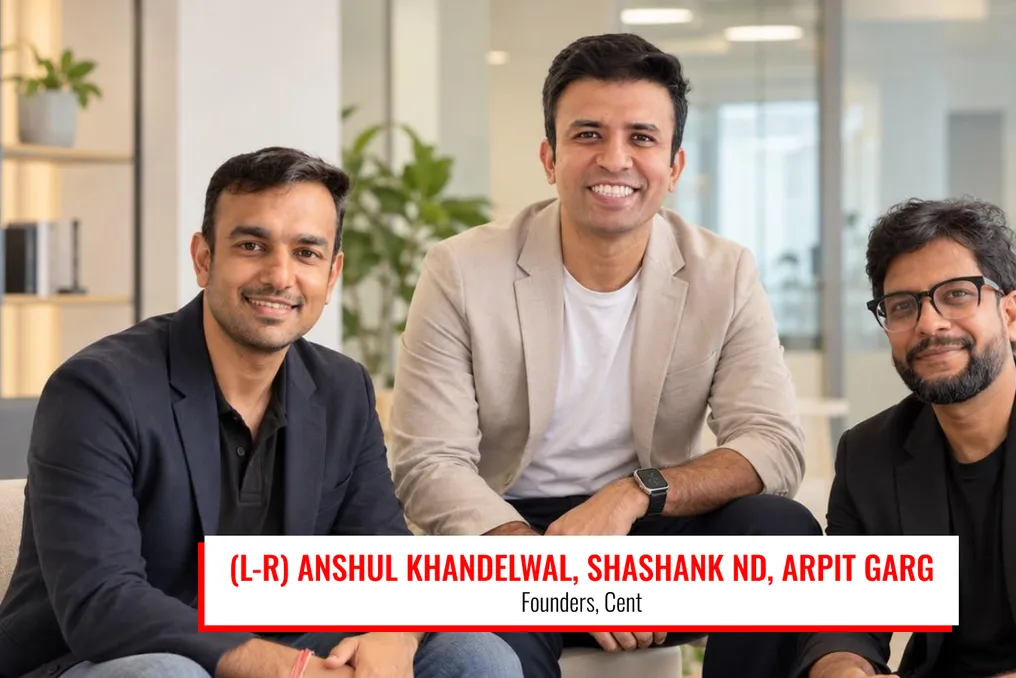
Cent was founded in 2025 by Shashank ND, Arpit Garg, and Anshul Khandelwal and is positioned as a company focused on preventive medical intelligence. Notably, Shashank ND is the founder of Practo, Anshul Khandelwal previously served as Marketing Director at Ola Electric, and Arpit Garg worked as Head of Product at Lenskart.

Cent is building a vertically integrated preventive healthcare platform that combines specialized hardware, AI-based radiology and diagnostics, and bioinformatics. The startup claims that this platform is capable of detecting diseases long before any symptoms appear.

Furthermore, Cent acquired Medsee—an AI-powered radiology reporting platform developed by Chitra Singh for qualified medical professionals. This platform generates structured reports and highlights detected findings for radiologists to review, enabling Cent to provide faster and more consistent reporting as scan volumes increase.

Anshul Khandelwal, co-founder of Cent, stated: 'The Indian healthcare system is still built on treating diseases rather than early detection. We believe the next step is preventive care, which is precise and scalable. These investments will allow us to delve deeper into AI, medical imaging, and clinical trials, and to build a preventive health infrastructure in India that can serve the world.'

According to Cent, since its inception, the company has conducted 10,000 full-body preventive scans in the cities of Bengaluru, Mumbai, and Delhi. The company's goal is to reach 10 million scans by 2035.

Karthik Reddy, co-founder and managing partner at Blume Ventures, noted: 'We believe in Cent's vision of spreading this concept from India to the world over time, which aligns with our belief in medical technology over the past decade.'

Meta plans to raise a record $95 billion through stock issuance to fund AI infrastructure
Read more
business-standard.com

Meta plans to raise a record $95 billion through stock issuance to fund AI infrastructure

Meta Platforms announced on Monday plans to raise up to $95 billion in the largest stock offering in the company's history. This is due to the social network's intensive spending on expanding its artificial intelligence (AI) infrastructure.

The company, which is the parent company of Facebook, launched public offerings totaling about $35 billion in common and preferred shares. Additionally, it intends to launch a separate market share sale program worth up to $60 billion.

A larger share sale program will be launched after the trading of new non-voting Class C shares begins, which is expected in the first quarter of 2027, although the company has not yet specified the exact timing and conditions of this sale.

Interest in Funding

Meta's fundraising plan, one of the largest among AI companies, attracted interest from Nvidia, Advanced Micro Devices, and Broadcom for a total of up to $5 billion in Class A shares. This interest heightens concerns about the increasingly closed cycle of capital movement in the AI industry, as chip suppliers help finance the development of one of their largest clients.

Experts at William Blair noted that they expect investors to continue questioning the prospects for future capital raising and self-funding. Nevertheless, analysts believe that this financing strengthens Meta's confidence in the long-term return on AI investments and underscores the increasingly capital-intensive nature of pursuing this opportunity.

The company's shares fell by approximately 1.4 percent during morning trading. The latest fundraising campaign further demonstrates a trend among large technology corporations to utilize debt markets and raise equity capital to support their AI infrastructure, unlike the previous reliance on internal cash flow.

Meta's AI Spending

Earlier this year, Alphabet increased the size of its stock issuances to $84.75 billion. Separately, on Monday, it was announced that affiliate Apollo Global Management would acquire AI chips and server equipment to be leased to the aerospace firm Apollo, as part of a deal with total principal payments of about $40 billion.

Meta has committed to spending around $825 billion in the future, with the main driver of these expenses being growing investments in data centers, AI-related infrastructure, and cloud service computing power. However, such rapid expansion has led to the depletion of the company's historically strong free cash flow.

In the third quarter, the company reported a cash burn of $2.12 billion, marking the first negative free cash flow in over a decade, compared to positive cash flow of $10.63 billion the previous year. Nevertheless, the initial popularity of its consumer AI agent Muse and the release of a competitive new series of AI models partially justified Meta's significant investments.

William Blair analysts believe that Meta will ultimately create a profitable AI business, and the long-term return should help the company diversify, although this path may not be linear. According to the latest quarterly report, as of September 30, the company held $82.45 billion in cash, cash equivalents, and securities, while long-term debt stood at $80.92 billion.

Last week, Meta raised the lower bound of its annual capital expenditure forecast to a range of $135 to $145 billion. The company stated that it would issue Class C common stock in January 2027, which would effectively result in a two-to-one stock split, to finance acquisitions and retain key talent while maintaining Mark Zuckerberg's control as CEO.

Popular