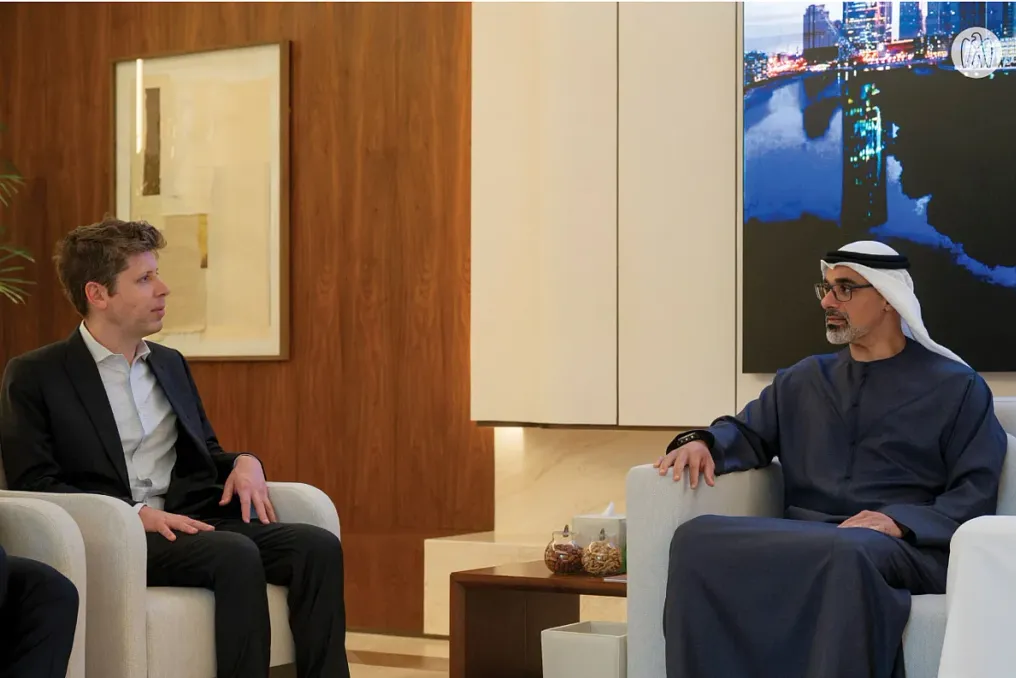
Abu Dhabi's Crown Prince Meets with Sam Altman of OpenAI, Signing Four Agreements in Key Sectors
Read more
Khaleej Times
www.khaleejtimes.com

Abu Dhabi's Crown Prince Meets with Sam Altman of OpenAI, Signing Four Agreements in Key Sectors

The Crown Prince of Abu Dhabi, Sheikh Khaled bin Mohammed bin Zayed Al Nahyan, met with OpenAI CEO Sam Altman in the UAE capital. The meeting aimed to discuss opportunities to strengthen cooperation in artificial intelligence (AI) and accelerate its implementation in vital industries.

Discussions focused on using advanced AI technologies to drive government transformation and innovation in Abu Dhabi's strategic sectors, aligning with the emirate's economic goals and development priorities. Progress in Abu Dhabi's adoption of AI in public services and key industries was also discussed, supported by investments in digital infrastructure and national talent development. The emirate aims to become the world's first fully AI-governed government.

Following the meeting, Sheikh Khaled witnessed the signing of four agreements between entities based in Abu Dhabi and OpenAI. These agreements cover the governmental, energy, and investment sectors.

OpenAI CEO Sam Altman stated that Abu Dhabi and the UAE are setting a global standard for integrating AI in both the public and private sectors. He emphasized that OpenAI is proud of the UAE's ambitions, thanks to a shared commitment to safety, accessibility, and responsible innovation.

In the energy sector, agreements were signed between ADNOC, a subsidiary of G42 Inception42, and OpenAI. This makes ADNOC the first company in the energy industry to implement advanced OpenAI technology. This partnership will allow the integration of advanced AI capabilities across all ADNOC operations, supporting more connected decision-making in commercial, investment, and operational spheres to enhance efficiency and productivity.

The technology will run on OpenAI's GPT models using local inference infrastructure in the UAE, aligning with ADNOC's goal to become the most technologically advanced and AI-focused energy company globally.

In the public sector, the Abu Dhabi government and OpenAI launched an initiative they termed the world's first machine-readable government initiative based on AI. This is a step toward the emirate's goal of becoming the world's first fully AI-oriented government. This initiative involves transforming selected government policies and regulations into machine-readable formats, enabling AI-based systems to assist officials in assessing routine regulatory compliance, including permit and certificate applications.

Each such assessment will be traceable back to the relevant regulation, while officials retain oversight and responsibility for final decisions. An initial pilot project, led by the Department of Government Operations Abu Dhabi (DGO), has already been launched jointly with the Abu Dhabi Agriculture and Food Safety Authority (ADAFSA) and focuses on food import. AI data processing is ensured by OpenAI's residency in the UAE, and real-time computations are performed on GPUs in UAE data centers.

Under a separate agreement, Mubadala, Inception42, and OpenAI will apply advanced AI capabilities to investment analysis, identifying opportunities and assessing risks to support informed decision-making and create long-term value. Furthermore, Inception42 and OpenAI have signed a five-year agreement to expand the adoption of advanced AI in the government, corporate, and education sectors in the UAE. This partnership will support major UAE organizations through AI-based enterprise solutions, combining OpenAI's cutting-edge models and AI engineering expertise with Inception42's applied AI capabilities and consulting services.

These four agreements demonstrate Abu Dhabi's commitment to expanding AI usage in strategic areas, boosting productivity, and strengthening its economic competitiveness in the process of building a knowledge and innovation-based economy.


Similar stories

Uzbekistan plans to launch production of rubber-modified bitumen from old tires using Hungarian technology
Read more
podrobno.uz

Uzbekistan plans to launch production of rubber-modified bitumen from old tires using Hungarian technology

Uzbekistan is preparing to implement Hungarian technology for creating rubber-modified bitumen (RMB), which will be produced using rubber crumb obtained from worn-out car tires. This project is valued at $35 million and is intended to provide the country with new prospects in the field of road construction.

Negotiations in Budapest

The issue was discussed on November 2nd in the city of Budapest. Delegations from the Hungarian company MOL Group and Uzbekistan's SHB Road Invest participated in the negotiations. The parties discussed the potential of opening a new production facility in Uzbekistan.

The technology planned for use is based on utilizing crushed old tires in the process of manufacturing bitumen intended for road construction. Thus, worn tires can be used as secondary raw material for producing road materials.

As a result of the meeting between the companies, a memorandum of cooperation was signed, and the parties agreed to work out in detail all aspects of launching this project.

In addition, the possibility of using plastic waste in road construction is being studied in Uzbekistan. A startup called 'Eco-asphalt', created by eco-activist Mukadam Bekmuradova, focuses on recycling plastic that was previously considered non-recyclable, with the aim of improving the quality of road infrastructure.

Foreign online services paid 232.8 billion UZS in taxes in Uzbekistan
Read more
uzdaily.uz

Foreign online services paid 232.8 billion UZS in taxes in Uzbekistan

According to a report by the Tax Committee of Uzbekistan, foreign companies providing electronic services in Uzbekistan paid 232.8 billion UZS in taxes for the period from January to September 2026. This figure significantly exceeds the 124.8 billion UZS paid during the same period in 2025.

Over the nine-month period, these companies provided services totaling 1,942.2 billion UZS, which is higher than 1,048.6 billion UZS the previous year.

There has also been an increase in the number of foreign providers of electronic services. As of October 1, 2026, there were 109 such companies, compared to 78 companies on January 1, 2026, and 63 companies on January 1, 2025.

Top Taxpayers

Among the largest taxpayers among these providers, Apple leads, having paid 54.2 billion UZS in taxes for services valued at 451.4 billion UZS. Google is in second place, having paid 52.6 billion UZS with service revenue of 438 billion UZS. Meta took third place, contributing 46.7 billion UZS in taxes to the budget for services valued at 389.4 billion UZS.

Valve Corp. and Anthropic are also among the top five leaders. Valve paid 22.8 billion UZS in taxes for services amounting to 188.9 billion UZS, while Anthropic paid 14 billion UZS for services valued at 116.1 billion UZS.

OpenAI ranked sixth, paying 10 billion UZS in taxes for services worth 83.1 billion UZS. Among the ten largest payers were also Midasbuy, which paid 4.8 billion UZS for services worth 39.5 billion UZS; Booking.com, which paid 4.2 billion UZS in taxes for services worth 35.3 billion UZS; and TikTok, which contributed 2.4 billion UZS for services valued at 20.3 billion UZS. Anysphere took tenth place, paying 2.2 billion UZS in taxes for services totaling 17.9 billion UZS.

In accordance with Article 281 of the Tax Code of Uzbekistan, foreign legal entities providing electronic services are obliged to submit tax declarations and pay taxes no later than the 20th day of the month following the end of the reporting quarter.

Popular