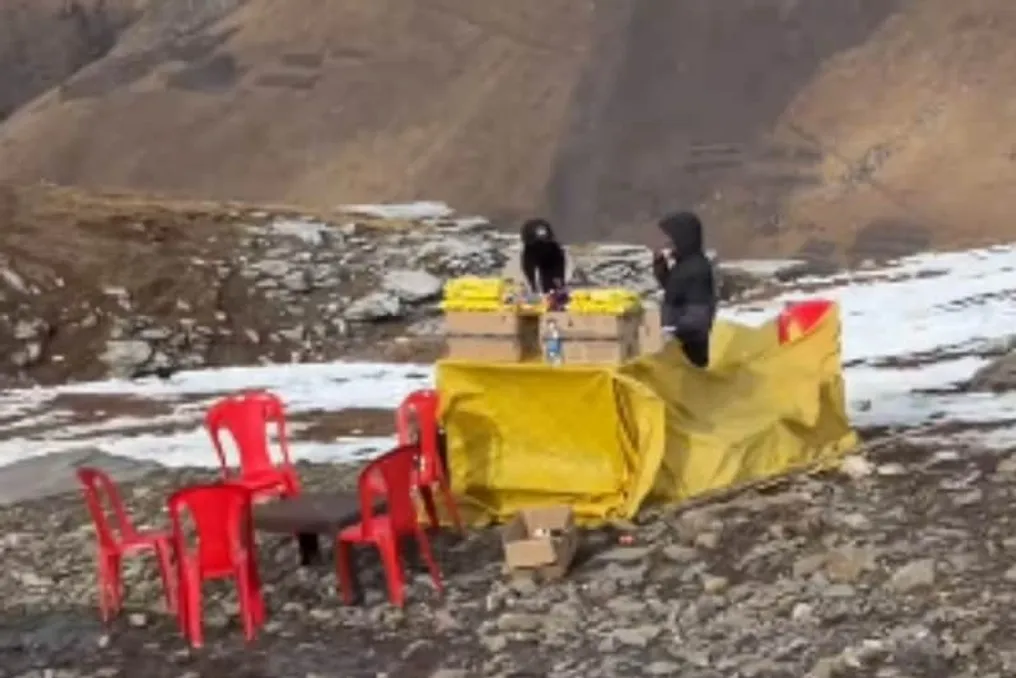
For people visiting the mountains, the taste of instant noodles and tea becomes part of the journey. In cold weather, tourists often stop to enjoy a hot bowl of noodles. However, the question arises about what daily income a noodle vendor by the roadside in the mountains can earn. The story of the noodle seller at Rohanga Pass in Himachal Pradesh is currently being actively discussed on social media.
It is claimed that even in the low season, his shop generates about 14-15 thousand rupees in daily revenue. Nevertheless, it is incorrect to consider this amount as net profit, as it includes expenses for goods delivery and shop maintenance. This fact was recorded and published by a tourist on social media.
Content creator Harsh Chauhan visited Rohanga Pass. During his visit, he spoke with the noodle vendor about his business. When Harsh asked about the sales volume, the vendor noted that it was the low season. After a follow-up question about sales specifically during the low season, the vendor stated that he sells approximately 60 to 70 bowls of noodles daily.
The price of one bowl is 100 rupees. Additionally, about 200 cups of tea are sold daily at a price of 40 rupees per cup. The shop also takes orders for eggs, although the quantity remains small.
According to the vendor's data, selling 60-70 bowls of noodles brings in 6,000 to 7,000 rupees daily. Meanwhile, sales of 200 cups of tea generate about 8,000 rupees. Thus, the total estimated revenue reaches 14,000–15,000 rupees per day. This amount does not include income from egg sales. Harsh Chauhan shared a video of this conversation on social media, emphasizing that these figures pertain to the low season, and questioned what the business volume would be during peak tourist season.
Social media users discussed not only the sales volumes but also the difficulties of operating in places like Rohanga Pass. Many noted that delivering goods to such locations is not easy. Transportation costs are related to the fact that goods such as noodles, tea, eggs, and gas cylinders must be delivered from Manali up the slope.
Some users also mentioned that water has to be brought from afar, and work is conducted in cold and windy conditions. In such weather, gas consumption for cooking may increase. One user stated that delivering goods from Manali to the shop costs approximately 2,000 rupees, although this expense is based on a claim made on social media.
Through this conversation, Harsh Chauhan wanted to demonstrate that the potential of a business is determined not by its size, but by its location, customer needs, and method of operation. The noodle and tea shop at Rohanga Pass serves as such an example. However, a daily revenue of 14-15 thousand rupees does not equate to equivalent profit, as the seller's actual costs and savings remain unknown.