CASIA Researchers Improve Robot Part Insertion Success Using Tactile Sensor
Read more
Pandaily
pandaily.com

CASIA Researchers Improve Robot Part Insertion Success Using Tactile Sensor

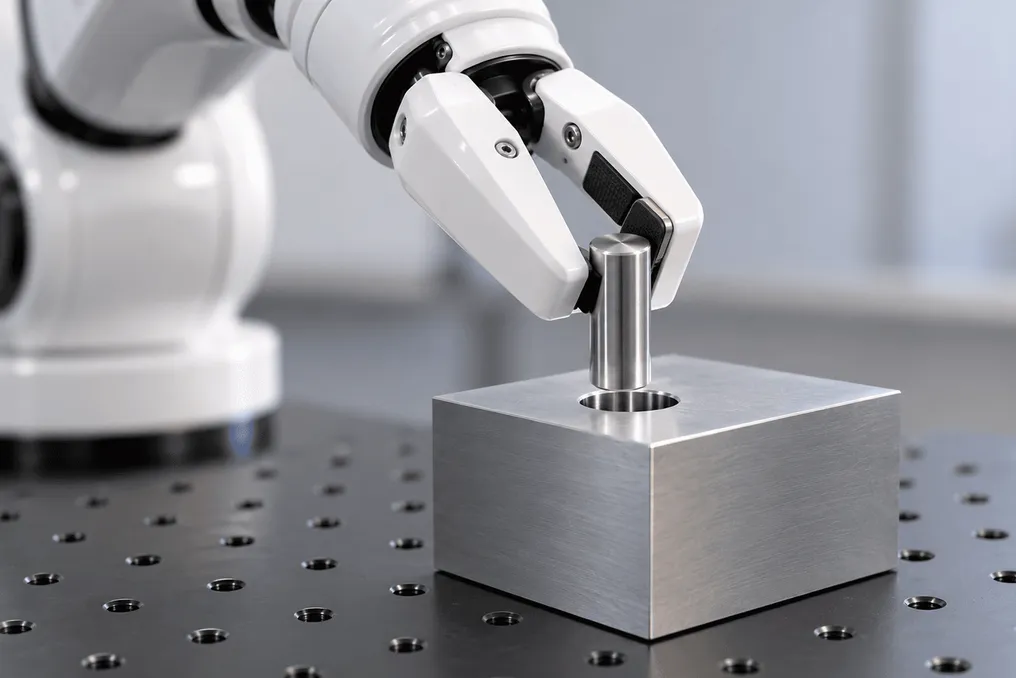
A team of researchers from the Institute of Automation of the Chinese Academy of Sciences (CASIA) demonstrated that adding tactile feedback to fingertips significantly improves a robotic arm's ability to insert parts into holes with sub-millimeter clearance.

The work, conducted by Long Chen's team with contributions from Xinpan Meng, Houcheng Li, and Zhenhua Ma, was accepted at the IROS 2026 conference and published on arXiv under the title 'From Reach to Insert: Tactile-Augmented Precision Assembly under Sub-Millimeter Tolerances.'

Precise insertion of parts into small tolerance holes is a challenging task because minor positional errors can lead to jamming or excessive contact forces, and cameras are often obstructed by the gripper and the part itself when the pin approaches the hole.

The team divided this task into two stages. First, a reaching policy trained using Imitation Learning with Diffusion Policy grasps a randomly placed pin and brings it near the hole. Then, a Reinforcement Learning policy based on Soft Actor-Critic performs the insertion process and is capable of recovering from failures during contact.

An asymmetric actor-critic architecture is used during training. The actor primarily relies on visual data, which ensures the policy's efficiency during insertion, while the critic receives tactile feedback for a more accurate assessment of actions. Since each grasp leaves a different initial reading on the sensor, the system first evaluates the tactile baseline before contact, and the critic works with the change relative to this baseline. Furthermore, the team groups training samples by torque readings and distributes samples evenly within groups so that the policy can see a wider range of contact conditions.

For the experiment, a 7-DOF Franka Emika Panda robotic arm equipped with a six-axis PaXini PX-6AX GEN3 tactile sensor on the fingertip, an Intel RealSense camera mounted on the wrist, and a second RealSense camera for general overview was used. This sensor was provided as part of research collaboration with PaXini Tech.

Testing was conducted on five different hole shapes: square, circular, hexagonal, L-shaped, and triangular, with tolerances of 1 mm, 0.25 mm, and 0.05 mm. Using pure imitation learning, the average success rate was 76% at a 1 mm clearance, but dropped to 24% at 0.25 mm and 0% at 0.05 mm. At a 0.05 mm clearance, imitation learning combined with reinforcement learning without the tactile sensor achieved 52% success. However, thanks to the tactile critic and sample grouping, success increased to 67%, while the peak interaction force decreased by 60% and the peak torque by 44%.

Similar stories

Researchers from Tsinghua, Infinigence AI, and AgiBot trained 96 robots on collective experience
Read more
pandaily.com

Researchers from Tsinghua, Infinigence AI, and AgiBot trained 96 robots on collective experience

Researchers from Tsinghua University, Infinigence AI, and AgiBot have introduced a learning approach called Collective Experience Learning (CEL). This method allows robots to learn from the successes of other robots instead of relying primarily on human demonstrations.

According to a report published by QbitAI on October 30th, the team tested this methodology on a cluster of 96 real robots. The corresponding scientific paper is available on arXiv under the number 2610.25736.

The original problem that the researchers are solving relates to labor resources. Robots improve by accumulating practical experience, but today this is most often achieved through repeated movements by humans or operator intervention to correct errors. Although hundreds of robots can be deployed, qualified operators cannot be scaled at the same pace.

When using CEL, successful experience gained by one robot is saved and shared, allowing a robot facing a task to learn how its colleagues resolved similar situations.

Task Testing and Results

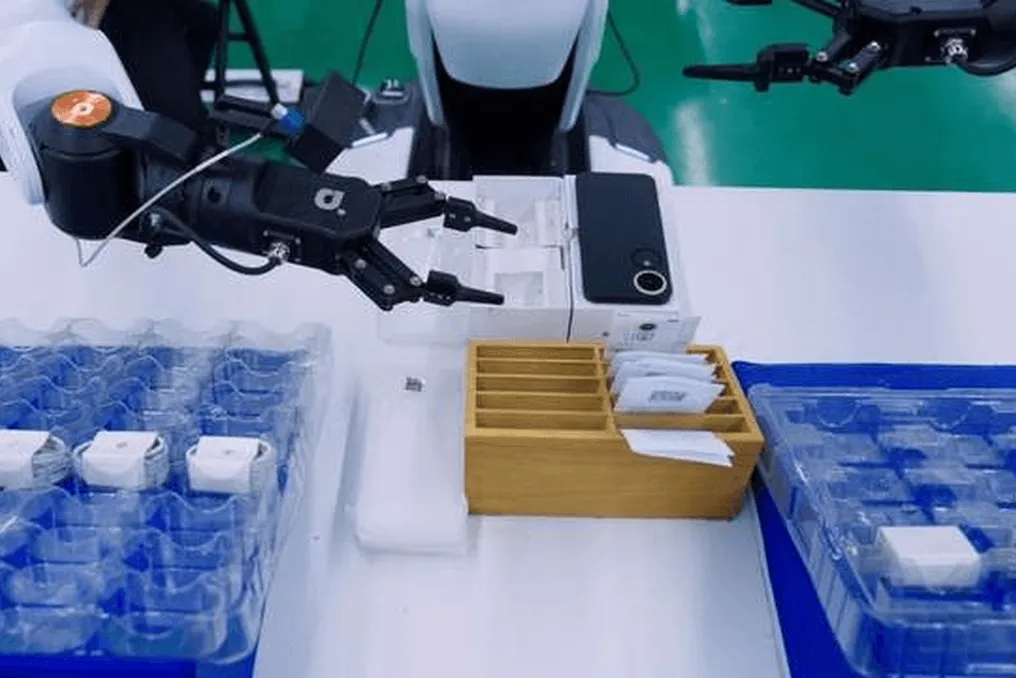
The team tested five different tasks covering both domestic and factory work: sorting colors, folding clothes, charging a phone, assembling a stool, and packaging a phone. Two robots not involved in the training performed 600 trials, incurring 15 failures, which resulted in an overall success rate of 97.5 percent. The success rate across all five tasks exceeded the average performance of six human operators.

Specifically, in phone packaging, which is a multi-stage industrial task, the success rate increased from 79.2 percent to 98.3 percent after applying collective learning, with only two failures recorded in 120 consecutive attempts.

A scaling trend was also noted: while keeping the same amount of real-time training, increasing the number of participating robots from 16 to 96 raised the success rate from 86.7 percent to 98.3 percent.

Technical Components of the System

The operation of this system is ensured by two key elements. The first is a fault-tolerant asynchronous learning system named FATS. This system is built on the open-source large-scale reinforcement learning platform RLinf. Robots upload their experience immediately after completing a task, without waiting for others, and the cluster continues to operate even if devices disconnect.

During the test with 96 robots, the cluster collected 9,834 episodes. Twenty-two robots had a total of 30 failures, but the loss of robot time was only 1.3 percent of the total operating time.

The second component is an algorithm called failure-guided experience retrieval fine-tuning (FERT). One manipulation can last minutes and involve thousands of action steps, but feedback often boils down only to final success or failure. FERT uses both aspects: when a robot encounters difficulties, it retrieves successful experience from analogous situations and focuses the learning specifically on these examples.

The report was provided by Infinigence AI. The results are presented by the research group and have not yet undergone independent verification.

USTB Researchers Use Deep Reinforcement Learning to Redesign Robotic Butterfly Wings
Read more
pandaily.com

USTB Researchers Use Deep Reinforcement Learning to Redesign Robotic Butterfly Wings

A team of researchers from the University of Science and Technology of Beijing (USTB), in collaboration with partner laboratories, demonstrated that a deep reinforcement learning cycle utilizing real flight data instead of purely simulation is capable of redesigning the wings of a flapping-wing biomimetic robot.

The results of this work were published in Nature's npj Robotics under a title describing the bio-inspired study of butterfly wing morphology aimed at applying deep reinforcement learning to robot flight.

The platform, named USTButterfly-II, weighs 48.3 grams, has a wingspan of 57.5 centimeters, and achieves a flapping frequency of 5 Hz at an angular stroke of 84 degrees. Both wings are driven synchronously by a single motor and a dual crank-slider mechanism. Veins made of carbon and fiberglass carry a CPE membrane 0.03 millimeters thick, which deforms passively.

After several iterations, the team successfully performed an untethered, wirelessly controlled indoor flight of the robot, which was tracked by fourteen Optitrack cameras.

Analysis of Morphological Parameters

Before the training process began, each wing was encoded with three morphological parameters, and 19 pairs of shapes were created within the natural range of 172 specimens of swallowtail butterflies, including several species of Parides, which were measured.

Each pair of shapes performed five flights, totaling 95 flights. Performance was evaluated based on five flight metrics, including angle of attack and speed. It was found that sharper tips promoted lift, while more rounded shapes further from the center promoted thrust; longer forewings aided in lift.

Initially, a neural surrogate learned to map wing parameters to these metrics, achieving correlation coefficients of 0.97 on training data and 0.9 on validation flights. Subsequently, a deep Q-network explored the three-dimensional space of shapes. The use of multi-step memory and boundary buffers prevented the agent from stopping at the edges of the design domain; the authors attribute these techniques to an improvement in lift and thrust optimization of 33% and 11%, respectively.

The lift-oriented design increased the lift performance metric in the paper from 2.23 to 9.8, representing a 339% increase, and achieved an average angle of attack of 32.7 degrees on the physical robot. The thrust-focused design improved the thrust metric by 46% and the average speed from 1.98 to 2.92 meters per second in the presented tests. Physical checks matched the model predictions by approximately 7%.

The authors emphasize that the obtained figures are performance parameters specific to this robot, not a claim that living butterflies achieve the same lift, and that single-factor tests leave many-parameter interactions for future research. Nevertheless, the closed loop, based on ninety-five real flights and a verified new wing, provides a concrete design tool for flapping-wing robots requiring either speed and payload or lift capability.

Popular