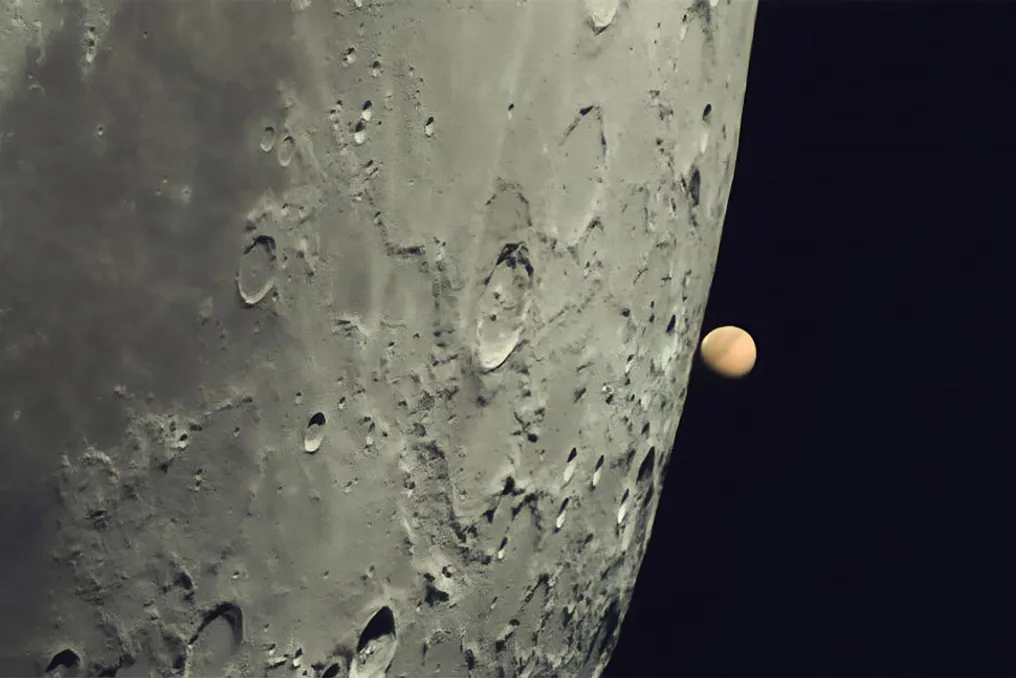
Beginning its November 'monthly tour' of the Solar System planets, the Moon is close to Mars on Monday morning (2) and to Jupiter at night. In some locations on Earth, this approach results in a phenomenon similar to an 'eclipse,' although it is technically called a lunar occultation.
This event is not visible across the entire globe. In Brazil, for example, the two celestial bodies will not overlap, but they will appear very close in the sky. This visual alignment is called astronomical conjunction, which occurs when two or more celestial bodies share the same right ascension, meaning the coordinate equivalent to terrestrial longitude.
The conjunction between the Moon and Mars begins at 11:24 AM, according to Brasília time, but it will not be observable due to daylight brightness. According to information from the InTheSky.org observation guide, they can be seen near sunrise, appearing at 1:09 AM and reaching an altitude of 40° above the northeast horizon, before disappearing shortly before 5 AM.
Later, at 8:09 PM, the Earth's natural satellite will enter conjunction with Jupiter. In Brazil, both stars will be below the horizon line at that time. However, in other areas of the planet, besides being close, they will cause a more notable phenomenon: lunar occultation, where the Moon passes in front of Jupiter, temporarily covering it.
This event can be observed during the early morning hours in islands such as Maldives, Sri Lanka, Seychelles, and Mauritius, as well as on Réunion Island, a French territory in the Indian Ocean. In parts of South and Southeast Asia and Oceania, the occultation will occur during the day, which may make observation difficult due to sunlight.
The Moon will have a magnitude of -11.8, Mars will have a magnitude of 0.9, and Jupiter -2.1, with all three in the constellation Leo. It is important to note that the brighter an object is, the lower its magnitude (an inverse relationship). The Sun, being the brightest body in the sky, has an apparent magnitude of -27.
Throughout this month, the Moon will pass by Venus (on the 7th) and Saturn (on the 20th), concluding the period near the Red Planet and Jupiter (on the 30th). This sequence of monthly lunar conjunctions is due to the fact that it orbits the Earth in a plane that is approximately the same as the plane in which the planets orbit the Sun, known as the ecliptic plane.
The characteristic reddish hue of Mars has always aroused interest, linking it to mythologies and military operations. In Greek mythology, Ares, the god of war, was associated with this color. Interestingly, the brightest star in the constellation Scorpius, Antares, received this name for its reddish tone, referencing Ares, meaning 'Anti-Ares.' Later, with Roman domination in Europe, Ares was renamed Mars, a name also given to the planet and still in use today.