Alex Mattsson Discusses the Impact of Superintelligence and the World Bank's Strategy
Read more
UzDaily
uzdaily.uz

Alex Mattsson Discusses the Impact of Superintelligence and the World Bank's Strategy

In an exclusive interview, Alex Mattsson, a Swedish associate professor and international affairs strategist, puts forward a compelling hypothesis: superintelligence (SI) has the potential to transform the future of nations, but the ability to benefit from it will depend on the foundation they lay today. Access to powerful technologies does not inherently mean progress; the true value of technology lies in its capacity to convert innovations into economic opportunities, strengthen institutions, and bring about significant improvements in people's lives.

Mattsson examines this issue within the context of the World Bank's significant contribution to international development through research, policy guidance, and engagement with governments. In the institution's latest publication, 'World Development Report 2026: The Promise of Artificial Intelligence,' the adoption of technologies, employment, public services, and conditions for comprehensive progress are analyzed. The World Bank Group's digital strategy emphasizes the need for connectivity, accessible digital access, skills, and institutional readiness, supported by privacy protection and cybersecurity measures. According to Mattsson, the strategic imperative is clear: technological access must translate into sustainable national capacity, rather than deepening dependence on external suppliers.

The Need for Ambitions to Match Capabilities

The report's framework concerning the implementation, adaptation, and promotion of technologies offers governments a structured course of action. Mattsson urges leaders to utilize proven applications where they provide practical benefits, adapt them to national conditions, and pursue cutting-edge innovations when the necessary capabilities exist. He cautions against conflating technological prestige with strategic achievement. Instead of spending limited resources on the appearance of self-sufficiency, governments should enhance procurement, regional cooperation, interoperability, and the expertise needed to evaluate suppliers. National aspirations should be measured not by the scale of technological spending, but by the long-term value they create for the population, businesses, and the broader economy.

Prioritizing National Development

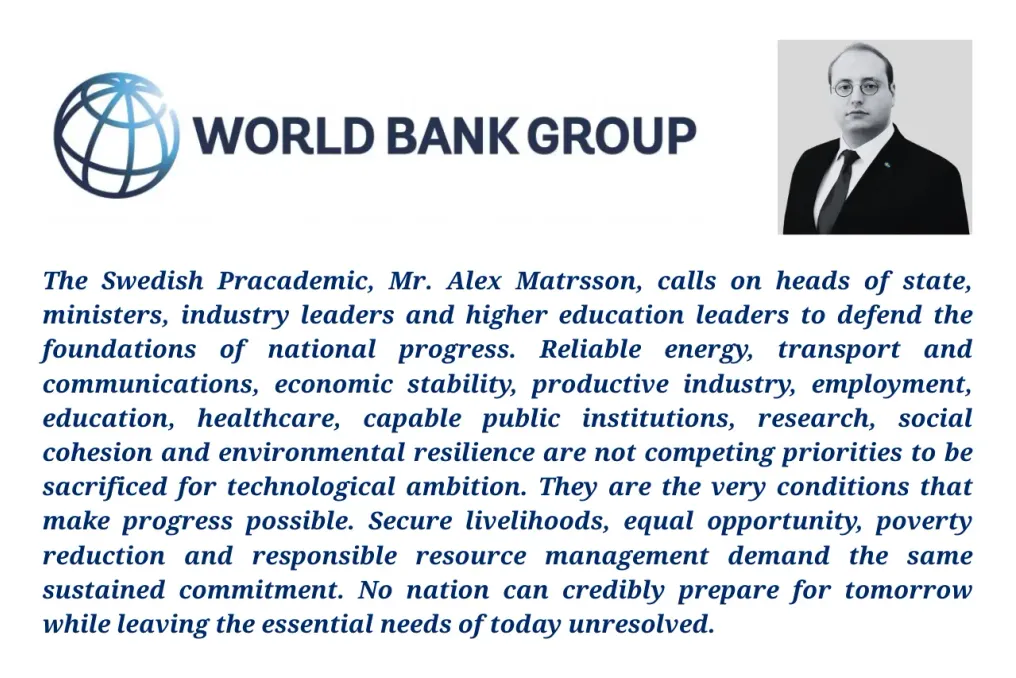
Mattsson addresses heads of state, ministers, industry leaders, and higher education executives, urging them to safeguard the foundations of national progress. Reliable energy, transport, and communications, economic stability, productive industry, employment, education, healthcare, competent public institutions, research, social cohesion, and environmental sustainability are not competing priorities that can be sacrificed for technological ambitions. Rather, they are the very conditions that make progress possible. Ensuring a decent standard of living, equal opportunities, poverty reduction, and responsible resource management require the same constant attention. No nation can reliably prepare for tomorrow while leaving the vital needs of today unresolved.

This developmental principle is not primarily an argument against innovation. Carefully selected and well-managed applications can strengthen agriculture, improve healthcare, support education, and increase the efficiency of public administration. However, Mattsson insists that substantial investments in ambitious SI programs must follow a thorough assessment of national readiness, financial capacity, alternative costs, implementation potential, demonstrable public benefit, and long-term sustainability. He advocates for a clear strategic sequence: first fulfill urgent national duties, then strengthen the foundations of development, invest in people and institutions, and only then strive for grand technological ambitions when the country is ready to support them. Innovations must accelerate national progress, not divert resources from its core foundations.

Governance Must Protect Public Interests

Mattsson warns that poorly managed implementation can create dependencies through restrictive contracts, proprietary systems, and the concentration of market power. He strongly recommends that governments demand transparent procurement, robust data protection, cybersecurity, interoperability, and expert knowledge within the public sector necessary to negotiate from a position of strength. Applications affecting essential services must demonstrate clear public value, meet appropriate standards of evidence, and operate under accountable oversight. Their energy requirements and environmental impacts must also influence national investment decisions.

For business and higher education, Mattsson calls for continuous investment in applied research, professional expertise, and workforce development. Industry must link innovation to productivity, employment, and long-term economic value, while universities must reinforce fundamental learning and research aligned with national priorities. Both parties bear the responsibility of ensuring that technological changes expand human capabilities and economic prospects.

In conclusion, Alex Mattsson, a Swedish associate professor and international affairs strategist, emphasizes that the decisive measure of national leadership is not the technology a country acquires, but its wisdom and ability to apply that technology for the benefit of society. He calls for ambition without extravagance, investment without neglect, and innovation firmly rooted in public interest. SI must strengthen national resilience, expand opportunities, and promote human well-being. It must remain a tool for development, not a substitute for the foundations of a prosperous, inclusive, and sustainable society.


Similar stories

Researcher Nicholas Carr analyzes the influence of communication technologies on society and human psyche in his book
Read more
nplus1.ru

Researcher Nicholas Carr analyzes the influence of communication technologies on society and human psyche in his book

Communication technologies have had a significant positive impact on humanity, helping to overcome geographical and linguistic barriers. Nevertheless, they have also substantially changed the ways we think and interact both with ourselves and with the external world.

In his book 'Superbloom: How Technology is Destroying Society and Driving Us Mad,' published by Alpine Non-Fiction and translated into Russian by Maria Desyatova, technology researcher Nicholas Carr examines this issue. He explains that modern means of communication, ranging from the telegraph of the 19th century to today's social networks, instead of fostering mutual understanding, lead to an increase in conflicts and the spread of misconceptions.

The book includes an excerpt where engineer Claude Shannon, while working on increasing the capacity of the telephone network, proposes a new concept for communication theory.

CM Yogi recounted the police's helplessness against land mafias
Read more
www.aajtak.in

CM Yogi recounted the police's helplessness against land mafias

Uttar Pradesh Chief Minister Yogi Adityanath made significant remarks on the use of Artificial Intelligence (AI) during the 'TechSangam 2026' event held in Lucknow. He stated that while AI can be helpful, it should not be the final decision-maker. The Chief Minister also highlighted controlling criminals through technology and the expansion of forensic facilities in the state. On this occasion, he shared an incident of a land mafia who had registered government land in his name, and at that time, the police situation was extremely pitiable.

At the 'TechSangam 2026' event at the Uttar Pradesh State Institute of Forensic Science (UPSIFS) in Lucknow, Chief Minister Yogi Adityanath spoke about the importance of Artificial Intelligence, cybersecurity, and forensic science. His view was that technology should be used to improve human life, but humans should not become completely dependent on technology.

Chief Minister Yogi Adityanath emphasized that 'Artificial Intelligence can be our assistant, but AI should not be our decider. We must follow our own judgment, not AI's judgment. If we start doing everything by depending entirely on it, that power itself can become a threat to us.' He mentioned that currently, discussions are happening on AI and modern technologies in Lucknow, whereas ten years ago, imagining such events in Uttar Pradesh was a dreamlike idea.

The Chief Minister also referred to the land on which the Uttar Pradesh State Institute of Forensic Science is currently established. He explained that initially, this land was in disarray. A land mafia had manipulated documents to register this land in his name. Yogi Adityanath stated that he was informed of this matter by the then DGP of Uttar Pradesh. He said that even the world's largest civil police was helpless against the land mafia.

According to the Chief Minister, he requested the file related to the DGP and investigated the matter. Subsequently, an FIR was registered. When the accused reached the High Court, another FIR was also registered. Eventually, the person surrendered and started apologizing.

The Chief Minister explained by giving the example of the popular TV serial CID that five family members used to watch this show together. This show depicted how doctors could reach the culprit by examining a person's death, such as hair or nails. He mentioned that such examination was not possible at that time, but today, this work is being done through modern forensic technology. With the help of science and technology, it has become difficult for criminals to escape.

Chief Minister Yogi Adityanath gave an example of a mafia who committed his first crime in Uttar Pradesh in 1980. When his government took action against him in 2017, he was sent to Punjab. He mentioned that it took three years to bring that mafia back from Punjab to Uttar Pradesh, for which the government had to go to the Supreme Court. According to the Chief Minister, finally, after an interval of 42 years, that mafia received punishment.

The Chief Minister also stated that previously, adequate facilities for forensic investigation were not available in Uttar Pradesh. DNA samples used to remain in the waiting list for ten years for testing. Due to the lack of timely availability of scientific evidence, the accused would escape legal consequences. He informed that now, 12 forensic laboratories are ready in the state, and more than 150 forensic vans are available. Samples can now be tested with the help of modern means and reports can be presented before the court.

The Chief Minister further stated that before 2017, there were only two cyber police stations and four forensic laboratories in Uttar Pradesh, and the conviction rate was less than 30 percent. Currently, cyber police stations are established in all 75 districts of the state, and work is progressing towards establishing a forensic laboratory in every division. He concluded that 'TechSangam 2026' is discussing topics such as AI, cyber forensics, quantum technology, and data protection. The goal of this event is to connect technological innovation with citizen safety, a robust judicial system, and new opportunities for education, research, and employment for the youth.

New theory may help scientists understand the process of artificial intelligence thinking
Read more
olhardigital.com.br

New theory may help scientists understand the process of artificial intelligence thinking

Understanding what happens inside artificial intelligence is one of the main tasks of modern times. Although developers can observe the data fed into the model and the answers it generates, they are not always able to explain how the system arrived at a particular conclusion. However, new research suggests that this may be solved with a new theory.

The study involved Roberto "Pena" Spinelli, who is a physicist from the University of São Paulo and has a specialization in machine learning from Stanford University.

Popular