EPFO launches services on WhatsApp and automatic settlement of PF accounts up to 1000 rupees
Read more
Business Standard
business-standard.com

EPFO launches services on WhatsApp and automatic settlement of PF accounts up to 1000 rupees

The Employees’ Provident Fund Organisation (EPFO) introduced interactive services via WhatsApp for subscribers on Sunday, allowing them to access information about their Provident Fund (PF) accounts. Additionally, an automatic calculation feature was implemented for eligible inactive accounts with balances up to 1000 rupees.

These initiatives were unveiled during an event marking the 74th anniversary of EPFO's establishment, held at the Dr. Ambedkar International Centre in New Delhi.

The WhatsApp service will enable users to check their PF balance, the last five transactions, and booklet information. It will also provide personalized consultations and assistance with requirements related to the Pradhan Mantri Viksit Bharat Rozgar Yojana (PMVBRY), the Ministry of Labour reported.

The introduction of these interactive services expands EPFO's digital service delivery beyond existing online platforms and the WhatsApp information channel, making routine account information accessible through the verified EPFO service on WhatsApp.

Automatic Account Settlement

As part of another event, EPFO will begin automatically settling inactive accounts verified through Aadhaar, provided the balance is up to 1000 rupees, after identity and bank account confirmation. Eligible subscribers will not need to submit separate applications to receive their entitled funds. This feature is expected to benefit around 100 thousand accounts, amounting to approximately 50 million rupees.

This automatic settlement initiative followed the approval of a pilot project by the EPFO Central Board of Trustees at its 239th meeting in March this year. The Board approved the automatic commencement of settlement for approximately 133,000 inactive accounts with balances up to 1000 rupees, totaling nearly 5.68 crore rupees.

The pilot program involved direct fund transfers to members' bank accounts linked to Aadhaar and EPFO, without the need for new applications or documentation submission.

According to EPF regulations, an account is considered inactive if no contribution has been received for three consecutive years after the member reaches the age of 55 or retirement date, whichever is later.

The Ministry also highlighted improvements in the EPFO claims settlement process following the implementation of the Centralized IT System (CITES 2.01), which reduced the average time for EPFO claims settlement to 2.57 days in October 2026.

According to the Ministry, EPFO currently serves about 80 million contributing members and 8.5 million pensioners, holding a pension fund of nearly 32 trillion rupees.

Support for PMVBRY Program

Speaking at the event, Commissioner of the Central Pension Fund, Ramesh Krishnamurthy, announced that the fourth tranche of incentives under PMVBRY was disbursed on Sunday.

According to the Ministry, 286,290 employees received the first incentive payment totaling 163.39 crore rupees, while 144,831 employees received the second tranche amounting to 96.01 crore rupees. An additional 702.39 crore rupees was paid to 83,242 employers under this scheme.

PMVBRY, launched in August 2025 with allocations of 99,446 crore rupees, aims to support 35 million jobs over two years, including 19.2 million entering the formal sector for the first time. Under this program, employees earning up to 1 lakh rupees per month for the first time are eligible for an incentive of up to 15,000 rupees, paid in two installments. Employers hiring additional staff beyond their base strength receive monthly incentives of 1000–3000 rupees per eligible employee for two years, with manufacturing units potentially qualifying for an additional two-year support period.

Union Minister of Labour and Employment Mansukh Mandaviya urged EPFO employees and officials at the event to contribute to the organization's reform process, continuously implementing innovations, and updating their operations to meet changing demands.

The Ministry also released several publications in observance of the founding day: 'EPFO State Profile 2026', 'Compendium of Judgements 2026', 'Kendra Nidhi', 'Beyond the Desk, Beyond the Ordinary', 'Reimagining Governance Discourse for Excellence', and 'Shasan Vidhi Mein Karuna' and 'The Indian Journal of Social Security'.

Similar stories

WhatsApp introduces four new features: permanent pinning of messages and statuses in groups
Read more
www.aajtak.in

WhatsApp introduces four new features: permanent pinning of messages and statuses in groups

WhatsApp has released a major update for millions of users, focusing on enhancing the functionality of group chats. It is now possible to pin important messages without time limits. Additionally, users can share statuses separately for members of specific groups. New capabilities for viewing old messages and filtering notifications have also been added.

WhatsApp has implemented four new tools for group chats. These changes are aimed at solving problems for users who belong to many groups—whether they are family, friends, or work-related. Often, critically important information gets lost among a large volume of messages, and new members can find it difficult to understand the flow of previous discussions.

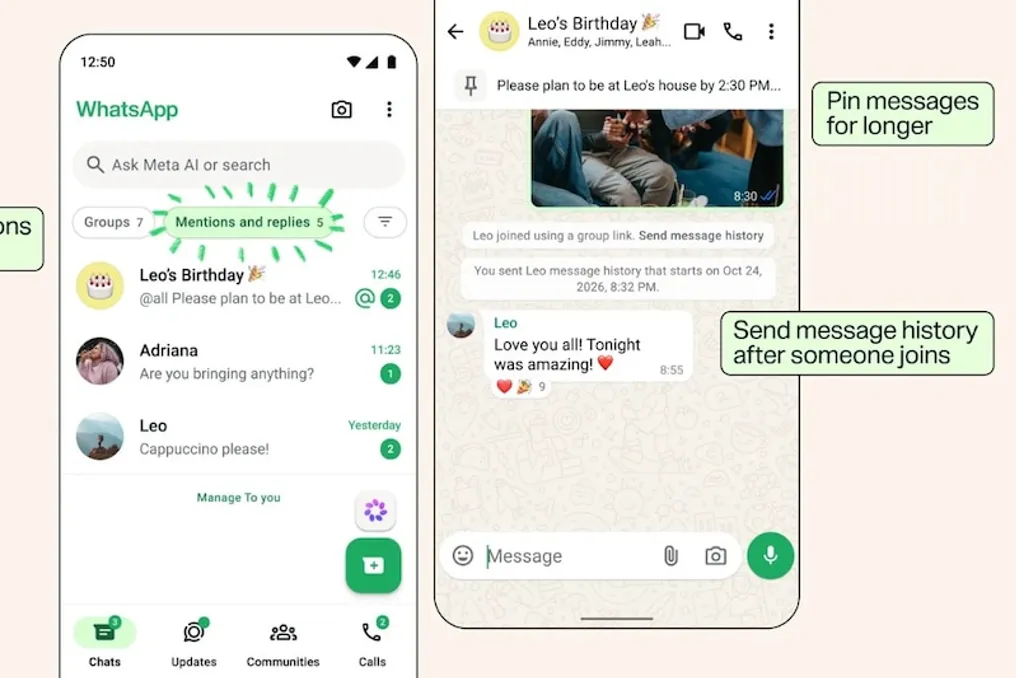
When important information appears in a group chat—such as a wedding address in a family group, a meeting link in an office group, or a travel plan in a friends' group—it is quickly overlooked due to the stream of new messages. To solve this problem, WhatsApp has added a new option for pinning messages. Previously, users had to choose timeframes for pinning (24 hours, 7 days, or 30 days), after which the message required re-pinning.

Now, a pinned message will remain displayed at the top of the group until the user manually deletes it. This eliminates the need for participants to constantly scroll through old parts of the chat to find necessary information.

The second useful feature is designed for those who join a group later. Typically, a new member is unaware of the previous discussion history and must ask other group members for information or request screenshots. WhatsApp has eliminated this difficulty. Now, if a person joins a group, other members can share the history of recent messages with them by tapping on that member's name in the chat.

It is important to note that using this feature no longer requires removing and re-adding the new member to the group, as was previously the case. Previously, the chat history sharing option was only available at the moment of addition.

The third innovation may change how WhatsApp is used. Until now, users could share their status with specific contacts or privacy lists. However, sometimes it is necessary to show a photo or video only to a small circle of people within a specific group, without showing it to family or colleagues. The new Group Status feature simplifies this process.

Users can now publish a status specifically for members of a certain group. All members of that group will see the status, be able to react to it, and also share their own statuses. This group status will function similarly to a regular WhatsApp status and will automatically disappear after 24 hours. The advantage of this feature is that the user does not have to change privacy settings every time for different updates.

The fourth feature is particularly useful for those who actively participate in many groups simultaneously. In the constant stream of messages, it is easy to miss a notification when you are mentioned or when someone replies to your previous message. Later, searching for such messages in the general chat history becomes difficult. WhatsApp solved this problem by introducing a new filter called 'Mentions and Replies'.

Thanks to this filter, users can view individual chats where they have been mentioned or replied to. This filter will also display messages sent via @all. Thus, if someone in the group mentions all participants to convey important information, it becomes easier to find. This is especially beneficial for those who are active in work, family, public, and friends' groups simultaneously, allowing them to focus directly on messages relevant to their interests instead of reading the entire dialogue.

These four new features are available for both Android and iPhone.

Special EPFO Scheme: Potential Incentive of Up to ₹15,000 for New Employees
Read more
www.aajtak.in

Special EPFO Scheme: Potential Incentive of Up to ₹15,000 for New Employees

If you are starting work for the first time and can receive an incentive from the government of up to ₹15,000, this will be a very favorable situation. This bonus may be available to those who begin their career and become members of the Employees' Provident Fund Organisation (EPFO) under the Pradhan Mantri Vishwakarma Rozgar Yojana (PM-VBRY).

However, receiving an incentive of up to ₹15,000 will not happen automatically just by getting employed. A series of conditions must be met, including membership in EPFO, length of service, and compliance with certain requirements. Below is a detailed explanation of who is eligible for this scheme, what the payment amount is, and what steps need to be taken to receive the funds.

According to the PM-VBRY, qualified employees who become EPFO members for the first time may receive an incentive equivalent to one month's EPFO salary. The maximum limit of this incentive is ₹15,000. It is not guaranteed that every employee will receive the full amount of ₹15,000; the actual amount is determined based on the qualified salary and the plan's conditions.

The benefit under the first part of the plan, known as Part A, is intended for qualified workers who become EPFO members for the first time. An important point is whether the employee has a previous record of EPFO membership. To fall under the scope of the plan, the monthly salary must be up to ₹100,000, and other conditions related to employment and EPFO must also be met.

PM-VBRY covers qualified jobs created between August 1, 2025, and July 31, 2027. Nevertheless, simply starting work during this period is not enough. The employee must meet the plan's requirements, and the employer must also complete the necessary EPFO procedures.

To receive the first installment, the employee must work continuously for six months. Furthermore, they must comply with EPFO membership requirements and other eligibility criteria under the plan. Therefore, it is useful to monitor the start date, UAN-related records, and information about contributions made to EPFO.

For the second installment, continuous employment for 12 months is required. In addition, the employee must complete the prescribed financial literacy program. Thus, one year of work is not enough to automatically receive the second installment; one should check the latest information on the program completion process and its confirmation on the official portal.

It is not mandatory. According to the plan's provisions, the second installment funds will be placed in a suitable savings instrument or a fixed deposit for a certain period. Consequently, it cannot be considered immediately available cash. It is crucial to understand the rules regarding the payment and placement of the second installment funds.

The incentive will be transferred to a bank account linked to Aadhaar via the Direct Benefit Transfer (DBT) mechanism for the qualified employee. The Aadhaar bridge payment system will be used for this. Therefore, the employee should ensure that their Aadhaar and bank account details are correct. Errors in bank account and Aadhaar information may affect the payment process.

Yes, qualified employers may also be provided with an incentive under the plan. This amount differs from the benefit received by the employee. According to the plan's terms, the employer can receive up to ₹3,000 per month for each additional qualified employee. For this, the company must meet the eligibility conditions and submit the necessary EPFO records and electronic tax returns.

If you have become an EPFO member for the first time, first check your Universal Account Number (UAN) and EPFO membership record. Then, ensure that the details of your Aadhaar-linked bank account are correct and that the employer is making contributions to EPFO. Monitor the deadlines for completing six and twelve months of work. Also, check the official portal for the financial literacy program procedure for the second installment.

Popular