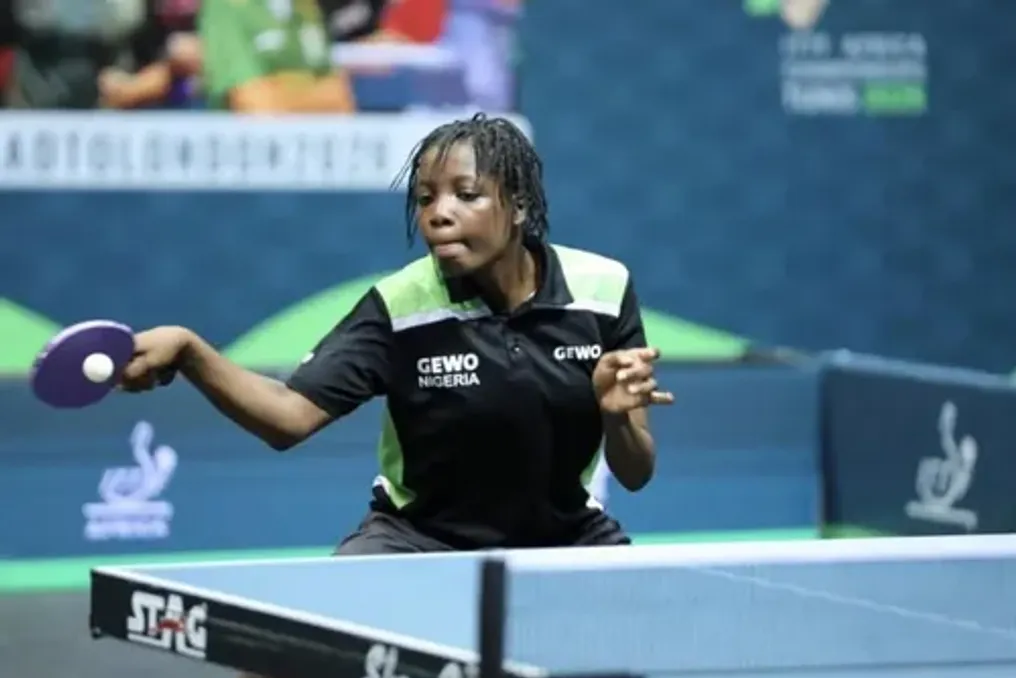
Fawor Ojo began playing table tennis on an improvised wooden board in her family's yard, where she played with boys. One day, she told her mother about her desire to play seriously, and her mother took her straight to the stadium.
This happened in 2021. Five years later, 16-year-old Fawor became Nigeria's sole representative in table tennis at the Youth Olympic Games in Dakar, Senegal—the first Olympic event held on African soil.
Fawor noted the support of her mother and the help of her coach. This coach is Omoniyi Adedotun, who is the head coach for Ondo State table tennis and the national coach for the Nigerian team. He started training her in Akure in 2022.
Adedotun recalled noticing talent, determination, a desire to learn, and competitive spirit in her. He was convinced that with proper guidance, discipline, and constant training, she could compete at the highest level.
His belief proved crucial when hers wavered. Fawor performed well in the first competition but then lost tournament after tournament. Disappointed, she stepped away from the sport. Adedotun kept calling her mother, pleading to bring Fawor back to the game. She returned and soon after won a tournament in Lagos.
"Then I realized that I could do more, that I could be better," she says. Today, every training session starts with running, conditioning exercises, and footwork before she picks up a racket. On days when her motivation drops, Adedotun motivates her to keep going.
"Now I am grateful for everything he has done," she shares.
Fawor progressed rapidly. She won a gold medal with the Nigerian mixed team at the IV African Youth Games in Angola. In October 2025, while still a junior, she participated in the African Women's Senior Team Championship for Nigeria in Tunisia. Nigeria reached the semi-finals in the team standings but lost to Uganda.
"It was a huge achievement for me," she reflects, "to compete in the senior category while still being a junior." This trip also showed her what the sport demands of her. The championship took place during her school exams, and she chose to go.
She admits that her biggest sacrifice so far has been 'giving up exams for sports.' Balancing these two fields remains a difficult task. "Most of the time, if I'm not in school, I'm in competition," she notes. There aren't enough strong players at school for joint training, so during school hours, she works out at the gym, and tennis training is postponed for home time.
Dakar was not in her original plans. She always dreamed of the senior Olympics. Now that the youth tournament is being held on her own continent, she is very happy.
"It means a lot," she says. "I look forward to representing Nigeria." She will be one of 32 girls in the tennis competition, which will take place from October 31 to November 5.
Fawor's ambitions extend beyond Senegal. After finishing school, she hopes to train in France or China with top athletes. "To gain more experience, train with high levels, and improve my game," she states.
Her coach shares this vision for the future. Adedotun asserts: "As a coach, there is no greater satisfaction than discovering young talent, helping to develop that talent, and seeing an athlete successfully represent their country. I believe this is only the beginning."