In her workshop in Bulawayo, Zimbabwe, designer Nkaniethu Malunga creates vibrant fabrics using plants, tree bark, and other natural components gathered from the surrounding environment. The process of color selection or pattern development involves many stages, as each material carries information about how it was collected, prepared, and transformed, which Malunga applies to modern fashion.
Malunga notes that her dyes are mainly extracted from plants such as mnyi and hibiscus. Although she also uses many other plants, including berries suitable for dye extraction, she values hibiscus not only for its petals that yield beautiful shades but also for its tea.
This 37-year-old designer challenges conventional notions of what constitutes a fashion collection and where creative knowledge originates. Through her fashion business GANU, she transforms local materials and skills into clothing and accessories, demonstrating how generational knowledge can contribute to contemporary design, create opportunities for rural women, and preserve cultural practices.
Her approach is based on lessons learned from her late maternal grandmother, Ngatsi Nkata, who lived in Cholotsho, a rural area of Zimbabwe. During school holidays, Malunga and her siblings would travel from Bulawayo to visit their grandmother, observing her turn sisal, reeds, and rushes into sieving baskets.
Malunga recalls: 'When I was a child, I often visited my grandmother in the village with my brothers and sisters. She was very skilled with her hands, and that passion eventually became mutual.'
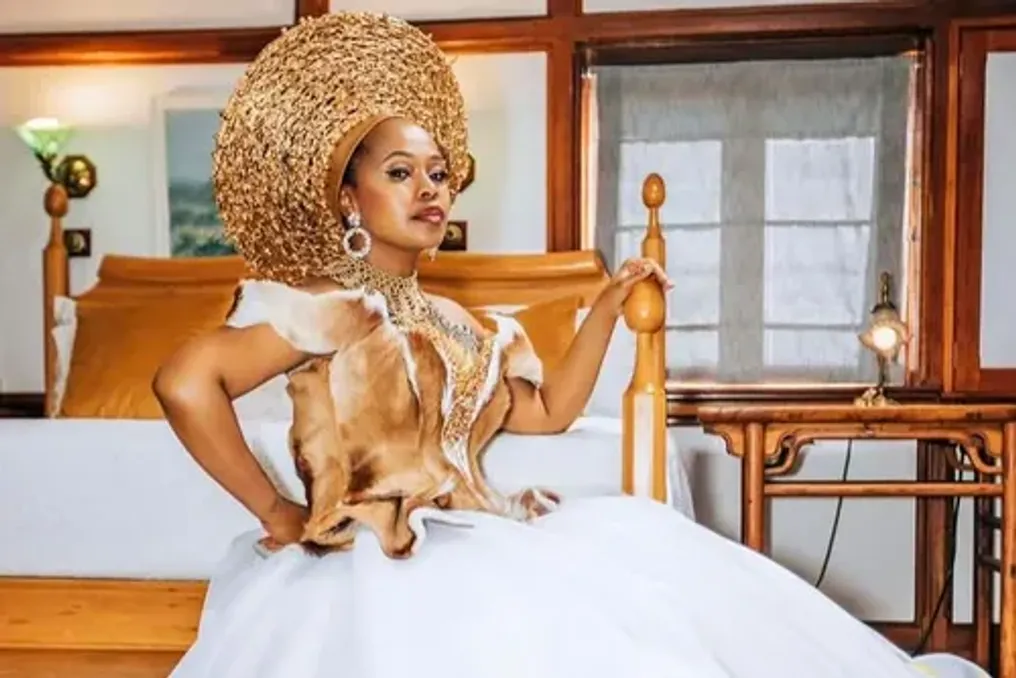
Malunga began experimenting with fashion in her teenage years before launching Ganu in 2013. The name comes from iganu, the Ndabele word for marula fruit, symbolizing her connection to local resources and African identity. Her creations combine basket weaving, crochet, batik, and beadwork with natural dyes, leather, and other local materials.
For Malunga, the importance of these materials goes beyond their appearance. Bamboo, sisal, reeds, and rushes are used in basket weaving, and she raises Angora goats for their wool, which she straightens and dyes to create garments. Cattle hide obtained at local abattoirs is softened at a tannery before being incorporated into leather goods.
She explains: 'I keep Angora goats for the wool needed in garment production. However, raw materials like cattle hide I usually purchase from local abattoirs, and sisal and tree bark I either collect myself or have colleagues based in rural areas extract.'
Desmond Ntini, a cultural entrepreneur from Bulawayo, views Malunga's work as part of a broader shift in the perception and use of African history. He stated that Malunga 'reimagines the fashion industry by blending traditional African influences with modern creativity. Her work explains how our cultural identity can inspire contemporary designs, opening doors for sustainable fashion, business opportunities, and the celebration of African heritage.'
Her projects extend beyond her own brand. In 2024, she founded Matobo Goes Fashion And Beyond, collaborating with Matobo women in partnership with Ekhaya-gaia, My Beautiful Home in Zimbabwe, and Amagugu International Heritage Center. This concept transforms traditional hut paintings into modern clothing.
This initiative aims to address the issue of cultural preservation. Rain can wash away paintings from traditional dwellings, putting communities at risk of losing patterns that are often undocumented. Reproducing these designs on fabric provides another way to document and disseminate them, while also introducing audiences outside the communities where they originated.
Furthermore, this initiative allows women to share their knowledge and participate in interpreting their cultural heritage. Instead of viewing traditional decor as something belonging exclusively to rural dwellings, the concept integrates it into a new context while maintaining a link with the communities that created it.
This approach opens up the possibility of valuing Zimbabwe's resources and capabilities instead of viewing them as separate from the formal fashion sector.
According to a study presented in June 2026, the cultural and creative industries in Zimbabwe contributed approximately $2.7 billion to the country's economy in 2024, equivalent to 5.92% of the gross domestic product. This sector provided around 22,223 jobs.
Dr. Florence Sebele, a senior lecturer and current chair of the Department of Education in Arts, Design, and Technology at the National University of Science and Technology in Bulawayo, studies indigenous knowledge in textile technology. She sees Malunga's method as an opportunity to challenge assumptions about African creativity.
Sebele believes that 'by embracing indigenous knowledge, which has long been underestimated, and transforming it into modern fashion, Malunga speaks to our identity, culture, and heritage as Zimbabweans and as Africans. Her work is a powerful reminder of what we can be proud of, and for the whole world, it challenges the dominant narrative of what fashion is and where innovation comes from, showing that authentic, rooted African knowledge has global significance.'
This dilemma is particularly relevant in an industry where African cultural references may appear on international runways, while the experts and people supporting them receive little recognition. Malunga's work starts with techniques and materials rooted in local culture and is then adapted for contemporary applications.
Sebele posits that this work has applications beyond fashion, such as in cultural tourism, research, and creative entrepreneurship. Its significance lies in making local knowledge visible and demonstrating how it can be used to inform future research and commercial activities.
Malunga's grandmother passed away before she could pass on all her knowledge, leaving Malunga to seek out other custodians of traditional skills.
She added: 'My grandmother died too young, before I could master everything in using local knowledge in creating modern fashion. As a result, I also learned to draw wisdom from various elderly women I met along this journey.'
Her creations have been exhibited in venues outside Zimbabwe, including the Durban Fashion Festival in South Africa in 2016. She was nominated for the Best Fashion Designer award in Bulawayo in 2018 and has worked with markets in Ghana, Europe, and the United States. She exhibited under the ZimTrade pavilion at the Zimbabwe International Trade Fair this April, and the SheExports initiative of that organization helped her explore international markets.
However, the greater significance of Malunga's work lies in what happens before the item reaches the buyer. Plant dyes, basket weaving skills, traditional paintings, and the experience of rural women contribute to a creative process that unites generations and creates new avenues for cultural expression.
Malunga concluded: '...we learn every day, we learn as we go, and we learn from everyone.'
Malunga's mission is to ensure the preservation of this knowledge, recognize the communities that contribute to it, and expand the opportunities it provides beyond the runway.