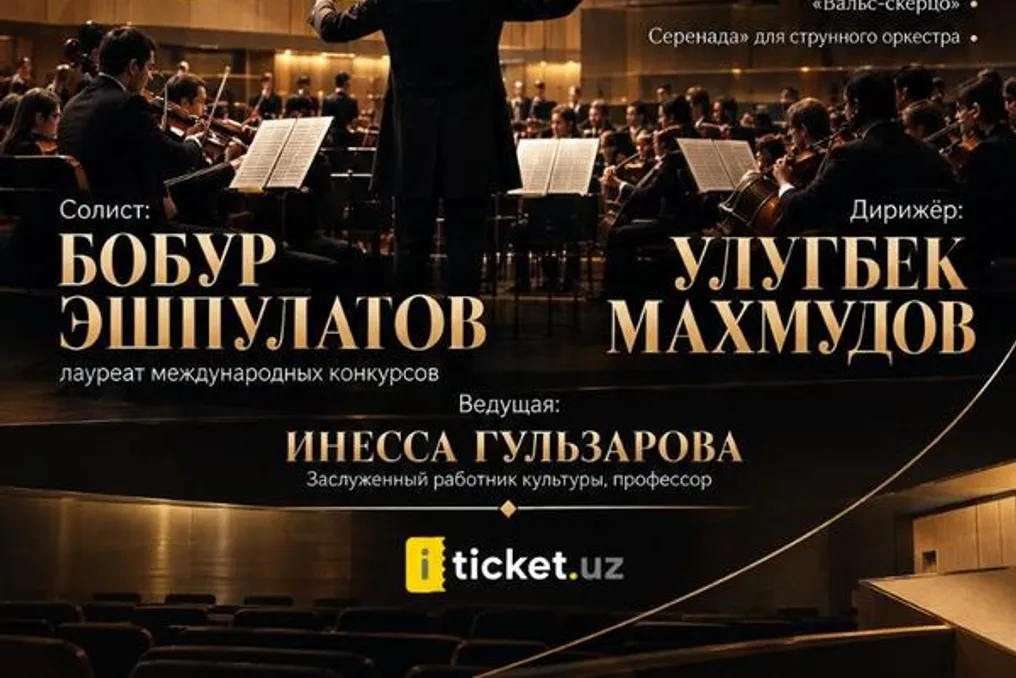
The State Chamber Orchestra 'Soloists of Uzbekistan' held a concert last Thursday at the Organ Hall of the Tashkent Conservatory dedicated to the works of Pyotr Ilyich Tchaikovsky. The evening, titled 'Masterpieces of the Creative Heritage of P.I. Tchaikovsky,' featured compositions by the great Russian composer. The soloist was international competition laureate Bobur Eshpulatov, and the orchestra was conducted by Ulugbek Mahmudov.
This concert was a significant event for admirers of Tchaikovsky's violin art. The Russian composer, known as a romantic, conductor, educator, music critic, and public figure, is among the greatest figures in world music. His vast legacy, comprising over 80 works, has made a huge contribution to world musical culture. The participation of the talented local violinist Bobur Eshpulatov added particular value to the event.
Bobur Eshpulatov studied at the Republican Specialized Music School named after V.A. Uspensky, where he trained under Gulnara Rifatovna Suleymanova, an Honored Worker of Culture of the Republic of Uzbekistan. He then continued his studies at the Singapore Conservatory under the guidance of Professor Chen Zhou. From an early age, Bobur actively participated in various republican and international competitions.
Among his main achievements are: in 2013, he won the 'Grand Prix' of the international 'Blue Bird' competition in Ukraine; in 2019, he was a finalist in the Maria Kantagril Competition in France and a diploma winner of the 'Citizen Bacevich' Competition in Poland; and in 2023, he participated in the E. Izai Competitions in Belgium and the 'Qingdao' Competition in China. After completing his studies at the Singapore Conservatory, Bobur Eshpulatov successfully passed auditions and began his career with the Singapore Symphony Orchestra.
In one interview, the musician mentioned his love for the stage, emphasizing that he always gives his all to the performance, regardless of the number of spectators. For this concert, Bobur Eshpulatov dedicated it to the memory of his first mentor, Gulnara Rifatovna Suleymanova, who played a decisive role in his development. Tchaikovsky was a favorite composer of Gulnara Rifatovna Suleymanova, and the pieces performed that evening were studied with her back in school. He keeps her advice: 'My little Bobur, work, work! You still have things to say, things to show. Don't stop at what you've achieved, keep going. I believe in you!' as a life principle.
The performance of such a high-level soloist invariably transforms the orchestra, creating a special atmosphere in the hall and evoking deep feelings in the listeners. Bobur Eshpulatov guided the entire orchestra with ease and elegance, submitting its vibrant and flexible sound to his musical breath. It seemed as if he was independently shaping the entire orchestral structure according to his vision. His violin told stories filled with longing and joy, alternating with pauses that were not just stops, but periods of intense thought.
The cycle 'Memories of a Dear Place' by Tchaikovsky, written in 1878, occupied a central place in the program. This cycle includes three violin pieces: 'Reflection,' 'Scherzo,' and 'Melody.' They were created at the request of Nadezhda von Meck for private musical enjoyment and were named after the composer's stay at her estate in Brailow. The audience followed the soloist's passionate narrative with great interest. In 'Reflection,' Maria Vakhrusheva's piano playing sounded organically, whose expressive performance created a sense of harmony and unity among all musicians in this bright sonic mystery.
Following the violin cycle, the Serenade for Strings in C major, Op. 48, written by Tchaikovsky in the autumn of 1880 and dedicated to cellist Karl Albrecht, was performed. The premiere of this work took place in St. Petersburg in October 1881 under the direction of Eduard Napravnik. Drawing inspiration from Mozart's music, Tchaikovsky, according to him, approached the genre of the serenade, characteristic of the 18th century. Musicologist Boris Asafyev characterized Pyotr Ilyich's Serenade as a work 'standing halfway between a suite and a symphony.'
The orchestra brilliantly performed the third and fourth movements of the Serenade, which elicited thunderous applause. It was evident that the musicians gifted the audience many moving moments. The completeness and depth of the performing concept were convincing due to the clear logic of form construction, precise articulation, extended melodic lines, organic repetitions, clarity of rhythmic patterns, and masterful build-up of tension before the reprise.
The musical performance proved to be a true discovery. Maestro Mahmudov and the orchestra virtuously revealed the richness of tonal shades, creating a mesmerizing acoustic picture. The hall was filled with both quiet whispers of pianissimo and powerful yet soft fortissimo. The musicians demonstrated impeccable sense of tempo: long, broad phrases, reminiscent of a sigh of the soul, smoothly transitioned into cascades of short motifs, and then, through elegant transitions, immersed the listeners in a new emotional state.
Next, Bobur Eshpulatov returned to the stage to present other beloved works by Tchaikovsky to the public. The 'Sentimental Waltz,' the energetic 'Russian Dance' from 'Swan Lake,' the touching 'Melancholic Serenade,' and the graceful 'Waltz-Scherzo' were performed. The soloist's violin came alive, telling stories. Bobur Eshpulatov demonstrated astonishing subtlety, masterfully conveying the slightest emotional nuances. Phrases, elegantly concluding and reaching their peak in tense moments, lent a special refinement to the sound. The rich spectrum of the violinist's musical ideas resonated in the orchestra, which sounded like a single entity with him. It seemed that the soloist and the orchestra breathed synchronously, forming a single living organism. All rhythmic subtleties, slowing down and speeding up that occurred during the performance under the influence of the soloist, were instantly understood and supported by the orchestra musicians through precise movement and intonation.
The hall erupted in applause, and the audience stood, greeting Bobur Eshpulatov until he played his favorite Bach piece for an encore. The evening at the conservatory's Organ Hall was filled with an atmosphere of creative joy. People of different ages and interests were present—from elderly to youth, from connoisseurs to professional musicians. The concert, which included both popular and time-tested repertoire, achieved outstanding artistic results and was recognized by the Tashkent public, confirming classical music's ability to unite a wide range of listeners.