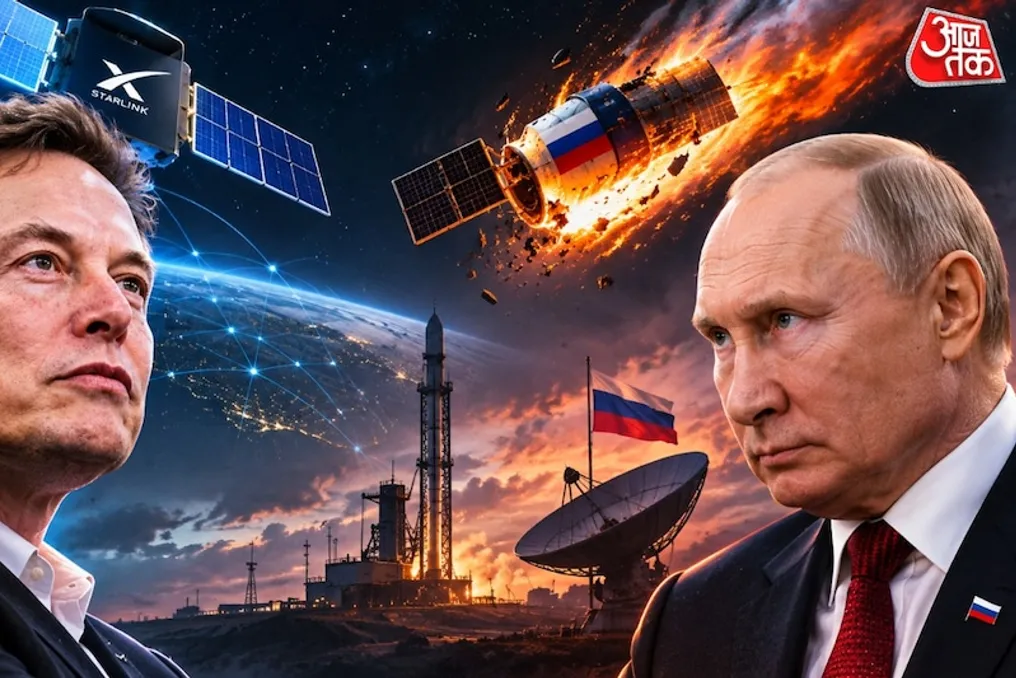
Second Russian internet satellite 'Rassvet-3' burned up in the atmosphere; project difficulties are being discussed
Read more
Aaj Tak
www.aajtak.in

Second Russian internet satellite 'Rassvet-3' burned up in the atmosphere; project difficulties are being discussed

Russia is developing its own satellite internet system called 'Rassvet,' which is intended to function similarly to SpaceX's Starlink. However, the project has encountered difficulties: the 'Rassvet-3' satellite, numbered 17, burned up in the Earth's atmosphere after entering it on October 30. This spacecraft was launched on July 19, and in less than three months, it returned.

A failure also occurred with another satellite in June. Russian President Vladimir Putin insists that the country should not depend on foreign companies, especially in ensuring quality internet access in remote regions. Having its own system is critically important during military operations and under restrictions, which is why Russia is launching many small satellites to create a unified internet network.

Typically, satellites are first placed into a lower altitude and then use their engines to ascend to the required orbit. In the case of this apparatus, it could not rise higher, gradually descending and eventually burning up.

Despite the failure, about 30 satellites are still in orbit, most of which have reached an altitude of about 500 kilometers. Work has not stopped, but problems persist. Achieving and maintaining such a large number of satellites in the correct location is a complex task. SpaceX demonstrated this capability by launching thousands of satellites, whereas Russia still lacks experience.

Furthermore, sanctions may cause difficulties in obtaining some necessary components. The two satellite failures clearly indicate the need for further improvements. Nevertheless, Russia continues to advance this project because a reliable connection for remote areas and the military remains extremely important. Provided errors are corrected, this network potentially could become operational in the future, but the path to success currently looks difficult and requires constant testing and learning.
Similar stories

Russian military satellite Kosmos-2612 approached radar satellite ICEYE-X36, which provides imagery of Ukraine
Read more
www.aajtak.in

Russian military satellite Kosmos-2612 approached radar satellite ICEYE-X36, which provides imagery of Ukraine

The Russian military satellite Kosmos-2612 approached the radar satellite ICEYE-X36, which is registered in the USA and has Finnish-American origins. This incident occurred around October 17 and 18 at an altitude of approximately 547 kilometers above Earth. According to data from LeoLabs, a space satellite tracker, the Russian satellite repeatedly changed its trajectory to get close to ICEYE-X36, with the distance between them reaching about 500 meters, although some sources claim a smaller distance.

This case is significant because the images obtained from the ICEYE radar are used to support the Ukrainian army. These images allow for the detection of objects on the ground even at night or under cloud cover. However, it is unclear whether the images from ICEYE-X36 were transmitted directly to Ukraine. The mere approach of a Russian satellite to another satellite is not a common occurrence.

Russia launched Kosmos-2612 on April 16, 2026. Changes in this satellite's position began to be observed in late September. It changed its trajectory on September 30, October 12, and also on October 15-16, after which it approached ICEYE-X36. Astroanalyst Georgy Trishkin noted that a close zero relative velocity could indicate an attempt to force ICEYE-X36 to perform orbital corrections, which could potentially disrupt its operation and consume fuel. Researcher Michael Bonheart of RAND called this approach a demonstration of force.

Before October 16, the distance between the satellites was several kilometers. After this, the Russian satellite changed its position and remained near ICEYE-X36 for about two days, after which signs of its departure appeared.

Reports emerged that the minimum distance between the satellites was only 26 meters, but this figure has not been definitively confirmed. Experts believe the minimum distance could have been several hundred meters. One satellite tracking website estimated the distance at 578 meters on October 17. It is difficult to accurately determine the location of satellites when they change course, so the 26-meter figure cannot be considered reliable.

During a session of the UN First Committee, it was announced that Russia's military satellite COSMOS 2612 exhibited threatening behavior by intentionally approaching a commercial satellite, which aligns with actions related to space weapons. This violates long-established safety thresholds in low Earth orbit. The United States will continue to ensure and protect its vital national interests in space.

ICEYE, a company founded in Finland, manufactures radar satellites, and ICEYE-X36 is registered in the USA. This company's radar allows for the acquisition of Earth's surface images at any time of day and in the presence of clouds. In January 2026, ICEYE announced an expansion of cooperation with a client of the Ukrainian Ministry of Defense. The satellite images help the Ukrainian armies understand the activity taking place on the ground. Nevertheless, it remains unclear whether the ICEYE-X36 images were specifically used by the Ukrainian army.

Such a close approach requires changes in speed and trajectory, which demands precise information, technology, and fuel. When a satellite remains near another for a long time, experts closely monitor its actions. Such maneuvers may indicate that a country possesses technology to approach another satellite and observe it. However, the approach itself does not prove that Russia engaged in espionage or intended to attack. Currently, there is no confirmation of a collision or damage to ICEYE-X36. This incident shows that space satellite safety has become an important part of growing international tensions.

Popular