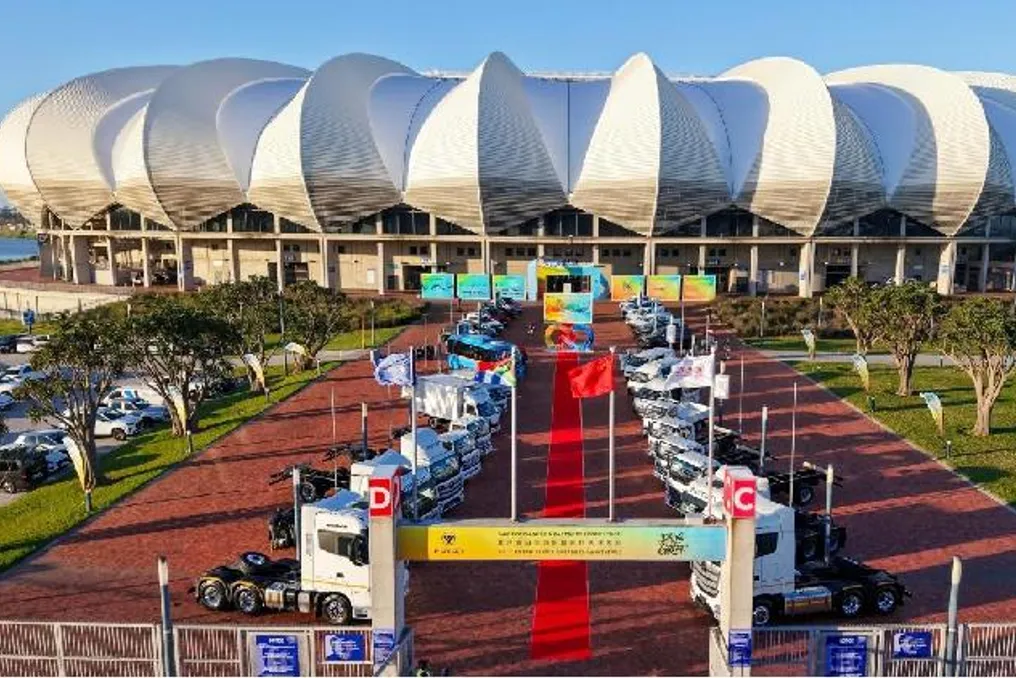
Over 700 delegates from industry, government, and finance sectors representing more than 20 African countries gathered at the Nelson Mandela Stadium in Gqeberha, South Africa. They participated in a major automotive partnership conference to explore joint paths for local production development, transition to green transport, and cross-border connectivity.
The event, held from October 28 to 30 under the slogan 'Drive to Great,' brought together Chinese diplomatic representatives, provincial officials from South Africa, financial institutions, and businessmen to promote industrial cooperation between China and Africa on the continent.
Lulama Sikiti from the South African Industrial Development Corporation noted that Chinese automakers demonstrated outstanding results by presenting powerful and technologically advanced vehicles. She emphasized that advanced technologies are crucial for the African mining industry and long-haul logistics routes, such as from Cape Town to Cairo, given the challenging conditions of the African landscape and roads.
Sikiti added that China has brought immense benefits to the African continent and expressed hope for deepening partnerships, digital upgrades, and technological strengthening across Africa, as improved infrastructure and more modern technologies are necessary for growth.
The conference highlighted the long-term value of automotive cooperation between China and Africa, including adapting vehicles to harsh local climatic conditions and roads, improving after-sales service quality, and reducing operating costs for local businesses and households.
Instead of simply exporting finished cars, Chinese automotive enterprises are employing a localized development strategy focused on the ecosystem for the African market. BAIC FOTON International President Wu Zongtian stated that Africa holds enormous potential for new energy vehicles, as the total cost of ownership of electric vehicles is significantly more favorable than traditional fuel cars, especially against the backdrop of fluctuating global energy prices and rising diesel and gasoline costs.
He specified that the company does not just supply vehicles but collaborates deeply with local partners to create comprehensive ecosystem solutions. These solutions include customized battery configurations, fleet scaling, and appropriate charging and swapping infrastructure to meet local operational scenarios and support Africa's sustainable green transport transformation.
Marius Small, the local General Manager of the automotive division in South Africa, noted that the value proposition of Chinese vehicles is particularly evident in South Africa's current economic climate. These vehicles offer quality comparable to traditional brands while possessing economically efficient performance, which is ideal for local businesses amid high fuel costs and economic pressure.
He also reported that reliable local after-sales service networks have been established across the country, featuring 65 local dealers providing full support throughout the entire lifecycle and reliable service for local users.
Several practical outcomes of cooperation were achieved during the event, covering localization of production lines, automotive financial services, cross-border spare parts supply, and collaboration in new energy vehicle sectors with several African countries, including Mozambique, Ethiopia, Kenya, and Zambia.
Thanks to the landmark joint production project between China and South Africa, located in the Koega Special Economic Zone in Gqeberha, Chinese automakers continue to strengthen localized investments, develop local industrial chains, and create jobs, thereby accelerating the modernization of Africa's automotive industry and contributing to sustainable economic development.