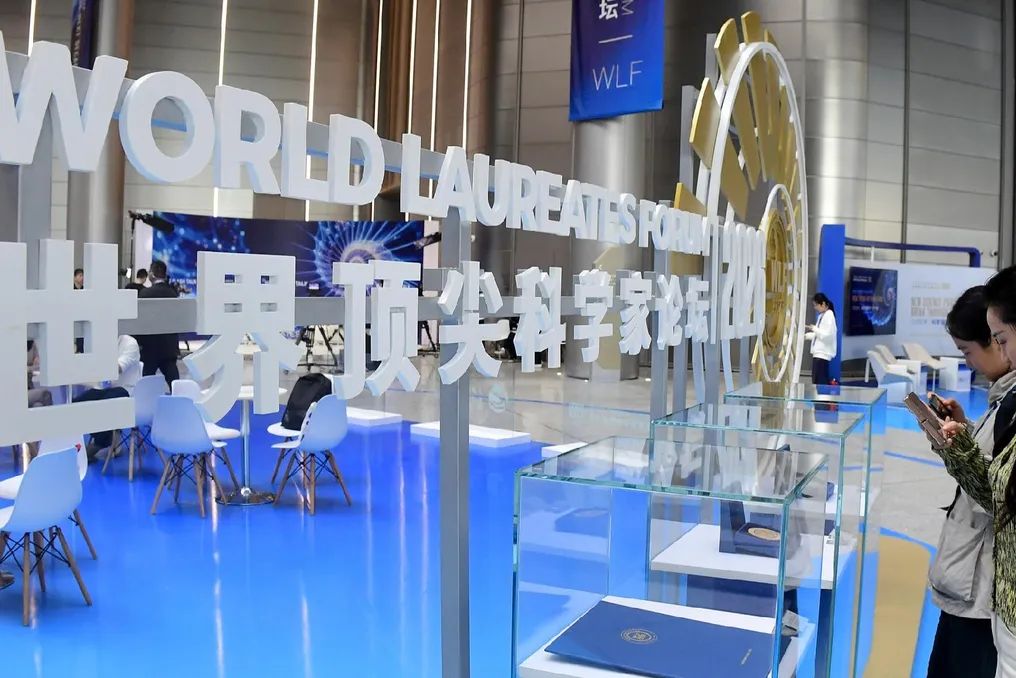
Distinguished scientists and innovators gathered in Shanghai on Saturday for the 2026 Global Laureates Forum. The event provided an opportunity to exchange views on future directions, including semiconductors, biomedicine, aerospace information, artificial intelligence, future energy, and quantum science.
The forum hosted numerous authoritative figures: 32 recipients of international awards such as the Nobel Prize, Turing Award, Wolf Prize, and Fields Medal, as well as 23 members of the Chinese Academy of Sciences and the Chinese Academy of Engineering, 140 senior scientists, and 78 young researchers.
Within the framework of the event, which was themed 'New Scientific Paradigm: Breakthrough for the Next Decade,' the main forum session, six parallel sessions, four events, and a closing ceremony were organized.
At the opening, the 2026 Global Laureates Foundation Award was presented to 11 scientists for their contributions to intellectual science or mathematics, life sciences or medicine, as well as a special award for young scientists.
The Mathematics Prize was awarded to Belgian scientist Ingrid Daubesch. The Prize in Life Sciences or Medicine was conferred upon Yuan Juning, Wang Xiaodong, Shao Feng, and Vishwa Dixit for clarifying the molecular pathways of various forms of programmed cell death. Shao Feng became the first Chinese citizen to receive the Global Laureates Foundation Award.
Yuan expressed hope that the results of her laboratory research would be translated into clinical treatment methods, calling this the most significant reward. She emphasized that practical steps are necessary to realize big ideas. In turn, Wang noted the importance of trust in scientific collaboration, adding that friendly rivalry also has its merits. Dixit added a philosophical aspect, stating that humans exist thanks to the ability of cells to die.
After the awards ceremony, participants were able to ask questions on a special question wall, touching upon topics ranging from the possibility of rotating a perfectly smooth sphere to the readability of consciousness.
The future of artificial intelligence was also a central theme. In his keynote speech, Fields Medalist Loran Lafforg argued that large language models are capable of solving certain problems that human mathematicians have not yet managed, but AI cannot replace the wisdom gained through the effort required for true learning.