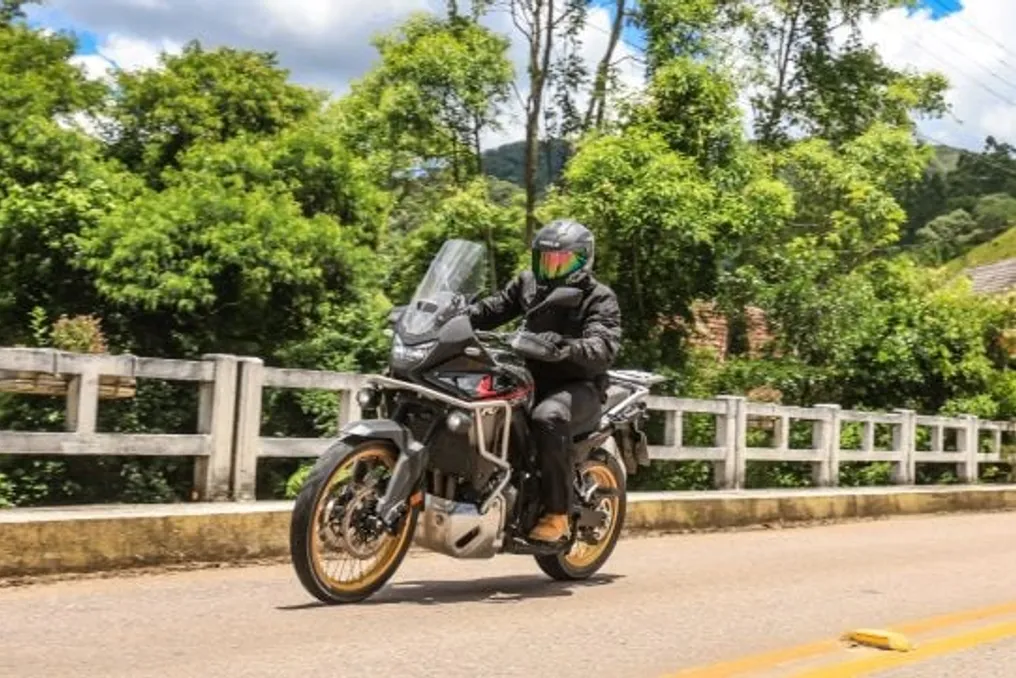
The first contact with the Honda XL750 Transalp occurred while descending the Serra do Rio do Rastro in Santa Catarina, an environment suitable for any mid or large trail motorcycle. After ten days of practical use, which included urban traffic and daily commutes, it became clear that the Transalp occupies a specific niche: highways and touring.
This model returned to the market with a distinct look from its predecessor, the 700, presenting a more imposing appearance and a design that appeals even off-road. Unlike the new CB 750 Hornet, which faced criticism for dropping the four cylinders, the Transalp avoided this scrutiny, as its adventure proposal benefits off-road riders who generally adapt better to less-cylindered engines.
Performance and Handling
Although it shares the same base as the CB 750 Hornet—a 755 cc twin-cylinder engine producing 69.3 hp and 7.04 kgf·m—the Transalp demonstrates different behavior. Its acceleration is smoother at low RPMs, and the engine reaches most of its capacity near 7,000 rpm, providing a noticeable increase in speed and power.
The practical recommendation is to operate the engine at higher RPMs, avoiding a lack of power in lower ranges, especially in higher gears. Even though it is considered 'weaker' in this range, the bike ensures safe riding on any type of road. The setup reveals its maximum potential at higher speeds, during tours and on highways, a moment when its size ceases to be an obstacle and the engine operates within its ideal range.
The ergonomics of the Transalp were pleasing from the first contact, and despite its dimensions being classified as intermediate to large, nothing seems excessive while the bike is moving. Maneuvering it is not difficult, even considering 21-inch front and 18-inch rear wheels, along with 200 mm and 190 mm suspensions, respectively. What truly stands out is the feeling of control in all situations.
Off-Road Capabilities and Equipment
Off the asphalt, the bike performs its role well. Although it is not a CRF nor was it specifically designed for it, it can handle lighter trails without issues. The onboard electronics assist in this regard: among the six available riding modes, the Gravel and customizable User 1 and User 2 modes allow disabling both ABS and traction control (HSTC).
The equipment list is robust, including full LED lighting, the mentioned driving assistance systems, and a 5-inch TFT display. This display is accessed via a joystick located on the left wrist and shows all necessary information to the rider. ABS contributes to greater safety during braking, and HSTC minimizes rear wheel slip; both are disableable in specific modes.
Areas for Improvement and Urban Use
Identified flaws include the lack of smartphone connectivity, a feature already available on the European panel but not yet implemented in South America. Additionally, the USB port is not conveniently positioned near the handlebars, being located under the passenger seat, which requires removing the upholstery to access the phone.
With more time spent with it, overheating became the main negative point. The engine heats the rider's legs, and this discomfort occurs predictably: on trips or cold days, the wind helps cool the unit, eliminating the annoyance. However, at low speed, without airflow and with high temperatures, the heat can rise to the point of bothering the passenger as well. None of these situations prevent the ride, but they serve as an important warning.
There is also a minor annoyance: when stopping and resting the left foot on the ground, the fairing under the seat lifts and touches the rider. During riding, with the foot on the pedal, this is not a problem, but when stopped, it may be necessary to adjust the position slightly further forward on the seat.
In the context of urban traffic, the benefits are limited. The first advantage is the available power when needed, which is useful for overtaking or getting out of difficult situations. The second advantage lies in the handlebar height, which exceeds the rearview mirrors of small cars, facilitating lane splitting. However, against SUVs, whose mirrors are higher, this maneuver is not feasible, although these vehicles still represent a minority.
In summary, the bike is too large and heavy for daily city use; besides the overheating issue, this weakens the justification for the Transalp's proposal in this scenario. Despite being versatile and having more qualities than defects, the final cost is considerable. The suggested retail price is R$ 65,545, potentially reaching R$ 70 thousand at dealerships. For those planning to use it according to its vocation—highway, touring, and leisure rides—the proposal remains valid. For those seeking to face daily urban traffic, the weight, size, and heat make the choice harder to justify at this price.