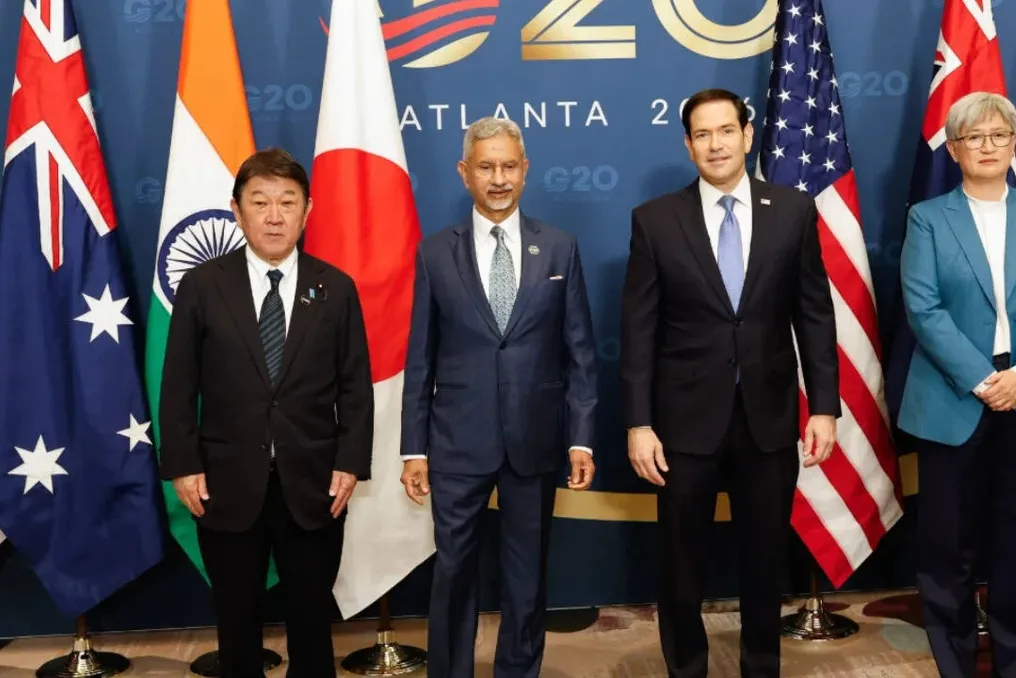
Foreign ministers of the Quad nations expressed serious concern regarding economic coercion, including arbitrary export restrictions and non-market practices that lead to overproduction and disrupt global supply chains in critical sectors. These actions are directed against China's military and economic practices in the Indo-Pacific region.
During the meeting in Atlanta, the Quad countries also announced the provision of over $85 million in technical and financial assistance to expand access to 'Trusted Superintelligence SI' (referring to artificial intelligence) in the Indo-Pacific region. It should be noted that Trump recently signed an executive order changing the name of AI to SI.
The ministers supported continued cooperation in the supply chains of critical minerals and the need to reduce dependence on any single supplier. The Foreign Ministers of Australia, India, Japan, and the US—Penny Wong, S. Jaishankar, Toshimitsu Motegi, and Marco Rubio, respectively—held the fourth Quad foreign ministers' meeting after President Donald Trump's return to the White House last year, on the sidelines of the G20 summit in Atlanta on Saturday.
At this meeting, Motegi voiced strong protest against any unilateral attempts to change the status quo by force or coercion, although the joint Quad statement, unlike the May meeting, refrained from mentioning the South China or East China Sea.
Quad ministers continue to meet despite the leaders' summit remaining frozen, leading to speculation that the Trump administration has effectively downgraded the group's status by not allowing India to participate as planned.
In the joint statement, the ministers reaffirmed their commitment to promoting peace, stability, and prosperity in the Indo-Pacific region, as well as holding the Quad Leaders' Summit. Rubio stated after the meeting that Quad will soon announce a leaders' summit in Manila on the sidelines of ASEAN meetings. President Donald Trump is scheduled to travel to China from Manila to attend the APEC summit.
Leaders also focused on the situation in West Asia, including the Strait of Hormuz. The joint statement emphasized the absolute necessity of protecting and preserving navigation rights and freedoms in the Strait of Hormuz, the Red Sea, and the Bab el-Mandeb Strait in accordance with international law reflected in UNCLOS, recognizing the importance of critical sea routes, uninterrupted trade, energy security, as well as unimpeded passage and safety of maritime crews and vessels without customs duties.
Jaishankar noted that the meeting highlighted the importance of maintaining stability, stimulating prosperity, and ensuring freedom of choice, as well as deepening cooperation to strengthen supply chain resilience and ensure the security of critical minerals and energy technologies. He also mentioned the importance of continuing agreements on counter-terrorism, maritime security, and capacity building to enhance resilience and promote peace and stability.
According to the joint statement, the ministers also announced the first-ever Quad Business Leaders Forum, which will bring together industry leaders, government, and policy experts from Quad countries to strengthen public-private sector ties, including promoting commercial deals in key areas. The statement indicated that the Quad countries reinforced the need to create secure, resilient, and reliable supply chains for advanced semiconductors and SI (AI) equipment.