
Oxford University research reveals that long journeys alter the biological clock of birds, causing an effect similar to human jet lag
Read more
Olhar Digital
olhardigital.com.br

Oxford University research reveals that long journeys alter the biological clock of birds, causing an effect similar to human jet lag

A study conducted by Oxford University, and recently published in the journal Science, demonstrated that birds suffer from a phenomenon analogous to the jet lag experienced by humans.

According to the research, when these birds travel large expanses of the Atlantic Ocean at high speed, their biological clock becomes misaligned with the local solar time. To be able to orient themselves using the sun as a reference, birds require an accurate internal clock, which must be adjusted daily to sunrise to correctly interpret the star's position throughout the day.

When traveling east or west, crossing lines of longitude—which correspond to time zones—the animal's internal time becomes out of sync with the solar time of its arrival point, potentially suffering a delay of up to one hour.

This discovery was made through the analysis of twenty years of GPS tracking data collected from 1,045 individuals of the Little Pied Bat (Puffinus puffinus), a species that nests on islands in the United Kingdom and Ireland. The team of biologists monitored 3,688 foraging journeys, during which the birds frequently travel up to a thousand kilometers west before returning to their nesting sites.

The researchers observed that upon returning eastward, where the sun rises earlier, the birds exhibited a systematic clockwise deviation compared to the predicted route. This dependence on the sun-based navigation system was so prominent that the animals maintained these deviations even when flying parallel to the coastline, where there would be visible geographical landmarks to guide them.

In the examined adults, the practical impact of this deviation was relatively small; an average deviation of seven degrees resulted in an increase of approximately five kilometers over a thousand-kilometer journey. However, scientists warn that this effect can be extremely serious for young birds during their first migration, as uncorrected navigational errors can cause them to deviate from their final destination by hundreds of kilometers.

Patrick Lewin, the study's principal investigator, stated in a release that the findings indicate that the animals experience the same internal clock mismatch that occurs during human jet lag. He added that the next focus of investigation will be to understand how this affects them, questioning whether they exhibit critical behaviors at inappropriate times, if they have physiological side effects similar to humans, and if this misalignment is as detrimental to health as jet lag is for us.

Tim Guilford, co-author of the article, emphasized that the ability to accurately measure the natural movements of animals allows for the revelation of deep cognitive and behavioral mechanisms that were previously considered difficult to study in the natural environment. Scientists believe that understanding how these birds manage long-distance travel may assist medicine in developing treatments to mitigate the negative effects of jet lag on human health.
Similar stories

Experts discuss the prospects of eVTOL flying cars by 2026 and obstacles to their mass adoption
Read more
olhardigital.com.br

Experts discuss the prospects of eVTOL flying cars by 2026 and obstacles to their mass adoption

Despite expectations that flying cars will appear by 2026, the most advanced projects are currently only prototypes undergoing testing. However, the fact that eVTOL (Electric Vertical Take-Off and Landing — electric vertical take-off and landing vehicle) is moving out of the concept stage is not in doubt.

Fernando Martini Catalano, Professor at the Department of Aerospace Engineering and Director of the School of Engineering San Carlos (EESC-USP), confirmed that this will happen. He explained how these aircraft work and what barriers prevent them from beginning full operation.

Fernando Castro Pinto, a lecturer at the Department of Mechanical Engineering of the Polytechnic School UFRJ, also participated in the discussion. Two companies dominate the sector: Joby Aviation from the USA and Eve Air Mobility, a division of the Brazilian company Embraer.

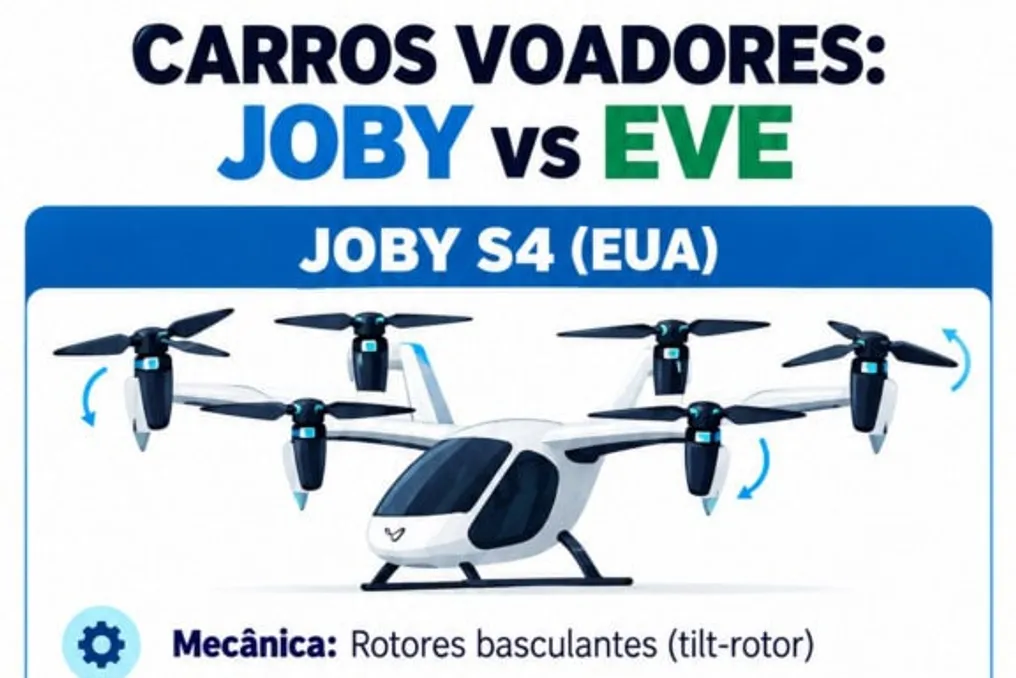
Currently, there is a race between companies to meet the requirements of aviation authorities such as Anac (National Civil Aviation Authority) and the FAA (the equivalent of Anac in the USA). Joby is focusing on conquering the American and Middle Eastern markets using the Joby S4 model, capable of carrying one pilot and four passengers with a tilt-rotor propulsion system. Eve, meanwhile, is betting on the simplicity of its mechanical design and the experience of global certification gained from Embraer.

Joby has partnered with Toyota to ensure large-scale automotive production. Demonstrative and experimental flights of the Joby S4 with passengers are expected to begin in the USA in late 2026 – early 2027. Simultaneously, commercial transport by this American company is expected to start in Dubai, United Arab Emirates.

Eve's eVTOL, codenamed Eve 100, is also designed for one pilot and four passengers. Its technical advantage lies in the 'lift + cruise' design, which uses separate rotors for vertical takeoff and a rear propeller for horizontal flight, providing simpler mechanics and lower maintenance costs compared to the Joby project.

Like Joby, the Eve project is in the testing and certification phase. Although mass production has not yet begun, the factory in Taubaté (São Paulo state), designed by Embraer, is capable of assembling up to 480 aircraft annually. Embraer and Eve management predicts final certification and the start of commercial operation by the end of 2027 or during 2028.

Morgan Stanley estimates the global eVTOL and Urban Air Mobility (UAM) market at $1 trillion (5 trillion Brazilian reais) by 2040, including passenger transport, cargo delivery, and necessary digital and physical infrastructure (vertiports). However, the bank recently lowered its 2030 forecasts by 75%, bringing them down to $12 billion (60 billion reais), because regulatory barriers proved higher than anticipated.

Technical and safety issues are the main obstacle. Fernando Castro Pinto notes that the main technological challenge is similar to the battery problem in electric vehicles: the more energy required, the larger the battery, the heavier the aircraft, and the more energy is needed. Fernando Martini Catalano adds that the weight of batteries remains too high relative to the energy they provide.

Furthermore, Fernando Pinto pointed out other obstacles to implementation in Brazil: the need to obtain a driver's license and comply with traffic rules. He emphasized that an accident at 30 meters altitude would have much more serious consequences than on the ground.

Consolidating eVTOL fleets will require not only a high level of qualification exceeding standard driving licenses but also harmonious coexistence with civil aviation and helicopters, adhering to routes and airport restrictions. The pilot must possess commercial class pilot skills, understanding all limitations related to routes, radio communication, and attentiveness.

When will flying cars become a reality? Catalano believes it will take seven to ten years, noting that the aircraft itself is only part of the problem; the entire ecosystem, including vertiports, charging logistics, noise reduction, and urban legislation, is necessary. Fernando Pinto, on the other hand, predicts decades for mass transport, as infrastructural bottlenecks such as the capacity of the urban power grid, as well as the evolution of battery technologies and the creation of a legal framework, must be resolved.

Catalano suggests considering medical emergency transport, organ transport, and cargo transport as the initial entry of eVTOL into cities, as these can become faster and more accessible solutions compared to helicopters, especially since not all hospitals are equipped with helipads, and a vertiport can be a cheaper and more urgent alternative.

The main challenge, according to experts, is to make the use of flying cars relatively inexpensive so that they do not remain a luxury item but serve a real benefit to the population.

Explanation of the choice of the cuckoo as the traditional bird of clocks
Read more
super.abril.com.br

Explanation of the choice of the cuckoo as the traditional bird of clocks

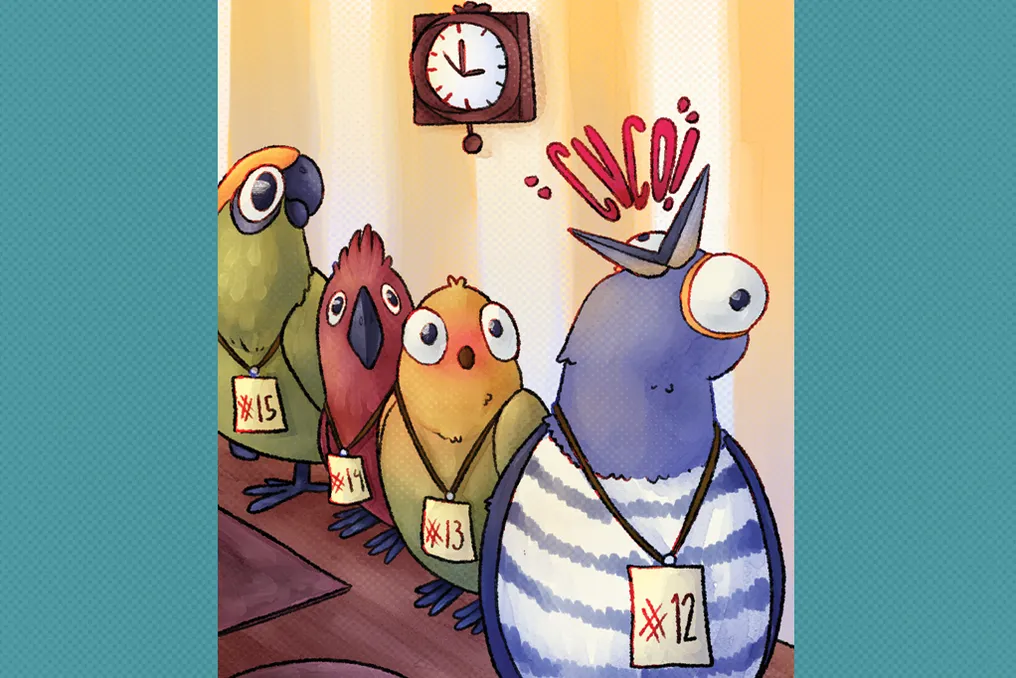
The selection of the cuckoo as the representative bird for clocks has several reasons. An important factor is the presence of this species in the area where clocks originated. The term 'cuckoo' generally refers to birds of the Cuculidae family, which includes over 140 different types. Among them, the common cuckoo (Cuculus canorus) stands out, known for emitting the characteristic 'cuckoo' sound and inspiring cuckoo clocks.

The common cuckoo is a migratory bird that can be found in Europe, Asia, and parts of Africa. It is particularly frequent in the Black Forest, a region of Germany where cuckoo clocks were developed. This bird migrates away during the German winter and returns in the warmer months, establishing a link between its song and the arrival of spring.

Another relevant aspect is the simple nature of the cuckoo's song. Its sound consists of only two notes: a higher one followed by a lower one. This simplicity facilitates the mechanical replication of this sound, as occurs in clocks. Traditional models use a bellows mechanism that directs air through wooden whistles, generating these two distinctive notes.

Although the precise origin of cuckoo clocks remains uncertain, it is known that their production and commercialization became popular in the mid-18th century, serving as an additional source of income for artisan peasants in the Black Forest. Clockmaker Franz Anton Ketterer is cited as one of the possible inventors of the cuckoo clock, although this hypothesis has not been confirmed.

In summary, the song of the cuckoo bird combines desirable elements in a sound that marks time: it is easy to mechanically replicate, is linked to the passage of time, and has a short and simple duration, avoiding auditory boredom.

Popular