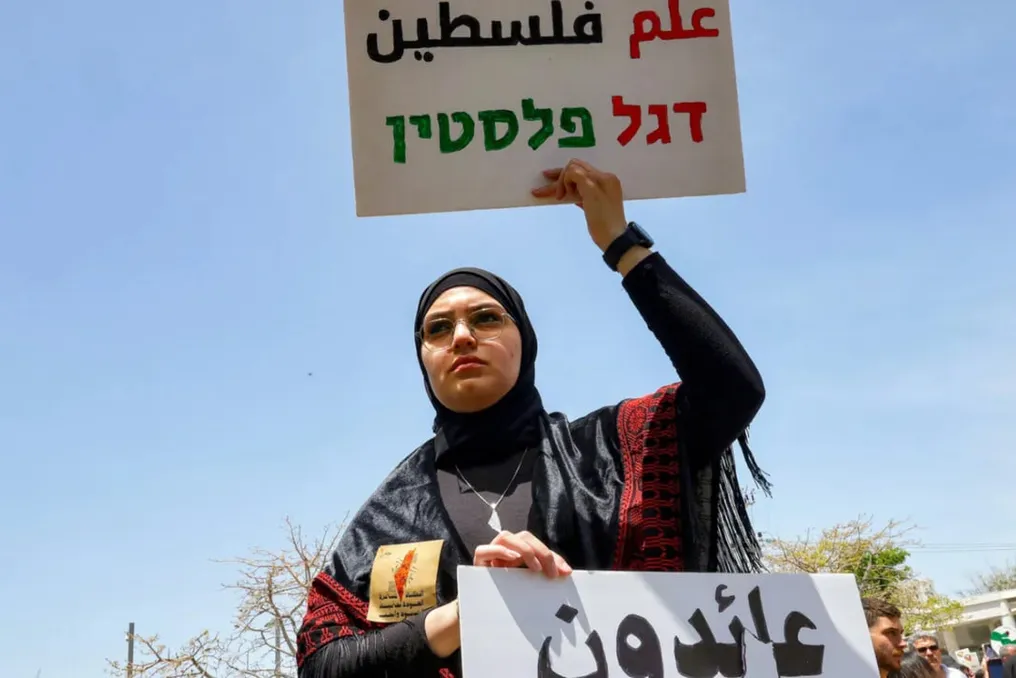
Palestinian citizens of Israel, also referred to as 'Palestinians of 1948' or 'Palestinians within Israel,' are subjected to discrimination and violence by successive Israeli governments.
These citizens constitute about one-fifth of Israel's population, and their votes in the October 27 Knesset elections could play a decisive role in forming the next government. Israeli Prime Minister Netanyahu, his Likud party, and extremist allies expressed dissatisfaction with having won 19 seats in the 120-seat Knesset and launched a campaign against them, mistakenly linking high voter turnout to Qatar, Turkey, and other countries.
These indigenous residents of Palestine have faced marginalization, discrimination, and violence for decades. They are descendants of Palestinians who experienced the Nakba and remained within the actual borders of Israel after its establishment in 1948. Today, their population is around two million, which accounts for approximately one-fifth of Israel's population.
Despite holding Israeli citizenship, they continue to experience state oppression and discrimination. Deeply rooted inequality persists in areas such as housing, land rights, education, and public services, while they struggle with high levels of violent crime and insufficient police protection. Furthermore, they have been victims of lethal police violence and arrests during protests in support of Palestinians in the occupied West Bank and Gaza Strip.
Minority in Their Homeland
Arab Palestinians constituted the majority of the population of historical Palestine before 1947. The territory today includes Israel, the occupied West Bank, and the Gaza Strip. Between 1947 and 1948, Zionist militias, and later Israeli forces, carried out ethnic cleansing of Palestinians to make way for the establishment of Israel. Palestinians call this the Nakba, or catastrophe.
As part of a deliberate military campaign, Zionist forces killed thousands of Palestinians, destroyed hundreds of villages, and forcibly expelled 80 percent of the Palestinian population from their homes. The violence officially ceased in 1949 when Israel signed peace agreements with neighboring Arab states whose troops entered the war to stop the capture of Palestine. Israel captured 78 percent of historical Palestine. About 150,000 Palestinians remained in the territory that became Israel.
Some survived because Israeli forces had not yet reached their areas, and others resisted attempts to displace them. Nearly a quarter of those remaining were internally displaced persons. They were forbidden from returning to their homes, many of which were in destroyed villages. Overnight, the Palestinians remaining in the territory became a minority on their own land.
Today, they account for about 20 percent of Israel's population, estimated at around 10 million people. They live mainly in cities and settlements with a Palestinian majority in Galilee in the north, the Triangle region in central Israel, and the Negev desert in the south. Approximately 80 percent are Muslim, 10 percent are Christian, and 10 percent are Druze. Israel and much of its society often refer to them as 'Israeli Arabs' or 'Arab citizens of Israel.' However, many identify themselves as 'Palestinian citizens of Israel,' 'Palestinians of 1948,' or 'Palestinians within Israel,' using these terms to affirm their Palestinian identity alongside their status as Israeli citizens.
Military Rule and Resistance
Although Palestinians were granted Israeli citizenship after 1948, early Israeli governments treated them with suspicion and subjected them to state violence. From 1948 to 1966, they lived under a military regime established exclusively for them, while Jewish citizens were governed by civil law.
During this period, they faced movement restrictions, curfews, state repression, and limitations on political activity. One of the darkest episodes was the mass killing in Kafr Qasim. On October 29, 1956, Israeli forces suddenly imposed a curfew in the Palestinian village of Kafr Qasim. Hundreds of residents working outside the village were unaware of the change. Soldiers were ordered to shoot curfew violators. As workers returned home, troops stopped them at the village entrance and shot them at close range. Over several hours, 49 Palestinian citizens, including women and children, died.
Military rule finally ended in 1966. In the following years, Palestinians increasingly connected with the broader Palestinian population, especially after Israel's occupation of the West Bank and Gaza Strip in 1967. One of the most significant protests occurred on March 30, 1976, in response to Israeli plans to confiscate Palestinian lands in Galilee. Israeli police brutally suppressed the demonstrations, killing six Palestinian citizens and injuring hundreds. These events became known as Land Day and are commemorated annually on March 30 as a symbol of the struggle for Palestinian land and rights.
During the Second Palestinian Intifada, which began in 2000, Palestinian citizens of Israel held mass protests against the Israeli occupation and in solidarity with Palestinians in the occupied territories. The police responded with lethal force, killing 13 Palestinian demonstrators and arresting hundreds of others.
Discrimination and Crime
In addition to state violence, Palestinians have faced discriminatory laws and policies enacted by successive Israeli governments for decades. According to Adalah, a legal center in Haifa defending Palestinian rights, over 65 Israeli laws passed since 1948 directly or indirectly discriminate against Palestinians in Israel and the occupied territories. These laws cover areas such as land ownership, housing, state funding, and family reunification.
One of the earliest examples was the Absentee Property Law, adopted in 1950. It classified Palestinians who left, fled, or were expelled from their homes during the 1948 Nakba as 'absentees.' Their land, homes, and other property were transferred to state control, including assets of some Palestinians who later became Israeli citizens.
In 2003, Israel passed a law restricting family reunification between Israeli citizens and spouses from the occupied West Bank and Gaza Strip. The 2011 law empowered adoption committees in certain agricultural and communal towns to assess applicants wishing to live there. Critics argue that this law allows discrimination against Palestinian citizens by permitting committees to reject candidates deemed incompatible with the community's 'Zionist-Jewish character.'
One of the most controversial measures was the Knesset's adoption of the Basic Law: Israel as the Nation-State of the Jewish People in 2018. This law reserves the right to national self-determination in Israel exclusively for the Jewish people. It also demotes the Arabic language from official to a language with 'special status' and declares Jewish settlement a national value that the state should promote.
Alongside legal discrimination, Palestinian communities face a deepening crisis of organized crime and violent killings. The Israeli civil society organization Abraham Initiatives linked this crisis to what it describes as 'insufficient patrolling and strained relations with the Israeli police.' In 2023, the NGO stated that 50 percent of all violent crime in the country affects Palestinians, even though they constitute only 20 percent of Israel's population. Representatives of the Palestinian community accuse the Israeli police of ignoring illegal arms trafficking and, in some cases, indirectly facilitating it. Israel denies responsibility for the crime crisis.
The number of Palestinian victims has sharply increased in recent years. In 2022, 116 people were killed, and in 2023, 244. Most victims were not involved in criminal activities. In 2025, the death toll reached 252, marking the deadliest year in history. The Abraham Initiatives 2024 report also highlighted a sharp disparity in murder investigations. The Israeli police solved less than 15 percent of murders in Palestinian communities compared to a clearance rate of about 65 percent for cases where the victims were Jewish.
Political Parties
To counter discrimination, state violence, and the Israeli occupation of Palestinian territories, Palestinian citizens of Israel have long utilized political organization. Political activity began in the 1950s, but military rule and state suppression severely limited their ability to organize and participate in public life.
By the 1970s, Palestinians were forming stronger parliamentary and grassroots movements. In 1977, Hadash—Democratic Front for Peace and Equality—was founded. It remains one of the most prominent political forces among Palestinian citizens. In subsequent decades, other influential parties emerged, including Balad, National Democratic Assembly; Ta'al, Arab Renewal Movement; and Reem, United Arab List.
In 1982, the High Committee for the Observation of Arab Citizens of Israel was formed. It became the key umbrella body representing Palestinian citizens across all political parties and local authorities. The committee acts as the leading voice of the Palestinian minority outside parliament, linking local municipalities with national political movements.
Palestinian parties have participated in Knesset elections since their inception but have mostly remained outside ruling coalitions. In 2015, Hadash, Balad, Ta'al, and Reem united to form the United List. This alliance followed the 2014 decision to raise the electoral threshold from 2 percent to 3.25 percent, which raised concerns that smaller parties would struggle to enter parliament independently.
The United List won 15 seats in the March 2020 elections, becoming the third-largest parliamentary bloc in the Knesset. Internal disagreements later led to the alliance's split, weakening its collective influence. For decades, cooperation with Palestinian parties was considered a political taboo. Many Jewish voters in Israel opposed such partnerships, while Palestinian citizens themselves remained divided on whether joining a government could bring about significant changes.
This barrier was overcome in 2021 when Reem joined the governing coalition led by Naftali Bennett and Yair Lapid. Its four seats helped secure a narrow parliamentary majority, ending Benjamin Netanyahu's 12-year tenure as prime minister. Ahead of the 2026 elections, Hadash, Balad, and Ta'al reunited under the banner of the United List, while Reem remained a separate party. Together, these two electoral alliances are projected to gain 19 seats, potentially giving Palestinian parties new influence in coalition negotiations and the formation of the next Israeli government. Their influence may prove decisive in determining who governs and whether Palestinian citizens can translate parliamentary representation into meaningful political change.